
A Christopher Wren church gutted in the London Blitz was taken down and shipped, about 800 tons of stone, to a small college town in Missouri in 1966. It was rebuilt there because Winston Churchill gave his famous Iron Curtain speech on that campus in 1946
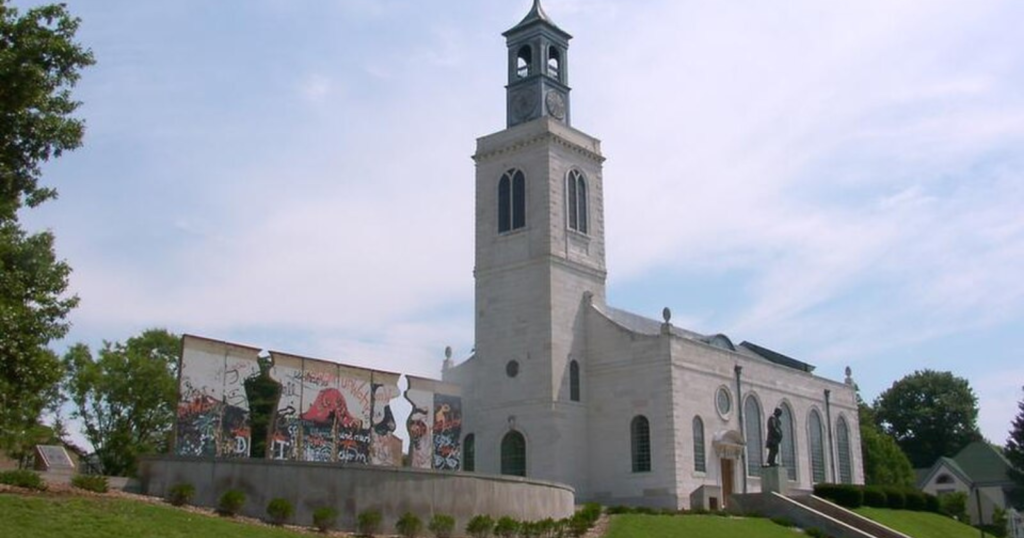
On the campus of a small college in Fulton, Missouri, stands a white stone church that looks as if it belongs on a narrow street in the City of London. It has tall arched windows, a classic English tower and the elegant proportions of a 17th-century design.
That’s because it was built in London. More than 300 years after it was first completed, it was taken apart stone by stone and carried across the Atlantic to the American Midwest.
A church with a long history
The Church of St Mary the Virgin, Aldermanbury, stood near the Guildhall in the City of London. A church had been on the site since at least the 12th century.
In 1666, the Great Fire of London destroyed it, along with most of the medieval city. The architect Sir Christopher Wren, who rebuilt St Paul’s Cathedral, also designed new churches across the City. St Mary Aldermanbury was rebuilt to his design in Portland stone and completed in the 1670s.
For nearly three centuries, it served its local parish. Then came the Second World War.
Destroyed again in the Blitz
On the night of December 29, 1940, German bombers launched a massive raid on the City of London. It started so many fires that it became known as the Second Great Fire of London.
St Mary Aldermanbury was gutted. The roof and interior were destroyed, leaving only the outer walls and tower standing. After the war, with fewer people living in the City and many bombed churches to deal with, it was not rebuilt. By the early 1960s, the ruins were expected to be cleared.
Why a Missouri college wanted it
The connection to Missouri began in 1946. That March, Winston Churchill, no longer prime minister, travelled to Westminster College in Fulton to give a lecture. President Harry Truman, a Missouri native, introduced him.
In that speech, officially titled “The Sinews of Peace,” Churchill warned that an “iron curtain” had descended across Europe, dividing the free West from the Soviet-controlled East. The phrase became one of the defining images of the Cold War, and it made the small town of Fulton famous.
In the early 1960s, the college wanted a lasting memorial to Churchill and the speech. Its leaders learned about the bombed Wren churches in London and came up with a bold idea: bring one to Missouri.
The world’s biggest jigsaw puzzle
St Mary Aldermanbury was chosen partly because of its manageable size and its long history. In 1965, workers in London began dismantling what was left of the church.
Each of its roughly 7,000 stones was labeled to record its position. More than 700 tons of stone were shipped to Fulton by boat and rail. According to several accounts, the stones crossed the Atlantic free of charge, because they were carried as ship’s ballast.
The plan hit a snag along the way. The stones arrived out of order, making the rebuild far more complicated. The London Times reportedly called it perhaps the biggest jigsaw puzzle in the history of architecture.
Rebuilt in Missouri
The foundation stone was laid in Fulton in October 1966, 300 years after the Great Fire had destroyed the earlier church. Builders followed Wren’s original design closely, using his surviving plans and photographs of the church. New woodwork and fittings were made to replace what had been lost in the Blitz.
On May 7, 1969, the church was rededicated in a ceremony attended by thousands of people, with a speech from Lord Mountbatten. Beneath it, the college opened a museum about Churchill. Today, the site is known as America’s National Churchill Museum.
Nearby stands Breakthrough, a sculpture by Churchill’s granddaughter Edwina Sandys. It’s made from sections of the Berlin Wall, which fell decades after Churchill first described the iron curtain.
What’s left in London
In London, the original site of St Mary Aldermanbury is now a small public garden near the Guildhall. The outline of the church’s foundations can still be seen, and a plaque explains that the church now stands in Missouri.
The church in Fulton was restored again in the 2020s. It’s still used for services, concerts and weddings.
A building that tells several stories
Few buildings carry as much history as St Mary Aldermanbury. It survived the medieval city, burned in the Great Fire, was rebuilt by one of Britain’s greatest architects, and was destroyed again in the Blitz.
Its move to Missouri gave it a third life and tied it to one of the most important speeches of the 20th century. It’s a reminder that historic buildings don’t always stay in one place, and sometimes the best way to save one is to give it a new home.