
In 1970, a French engineer living in London paid £100 for a wooden chest and used it as a TV stand; it had been missing since 1941, the V&A had spent decades trying to trace it, and in 2013 it sold for €7.3 million
A Japanese lacquer chest, the companion of the V&A's Mazarin Chest, was bought for £100 in London in 1970, used as a TV stand, and sold for €7.3 million in 2013.
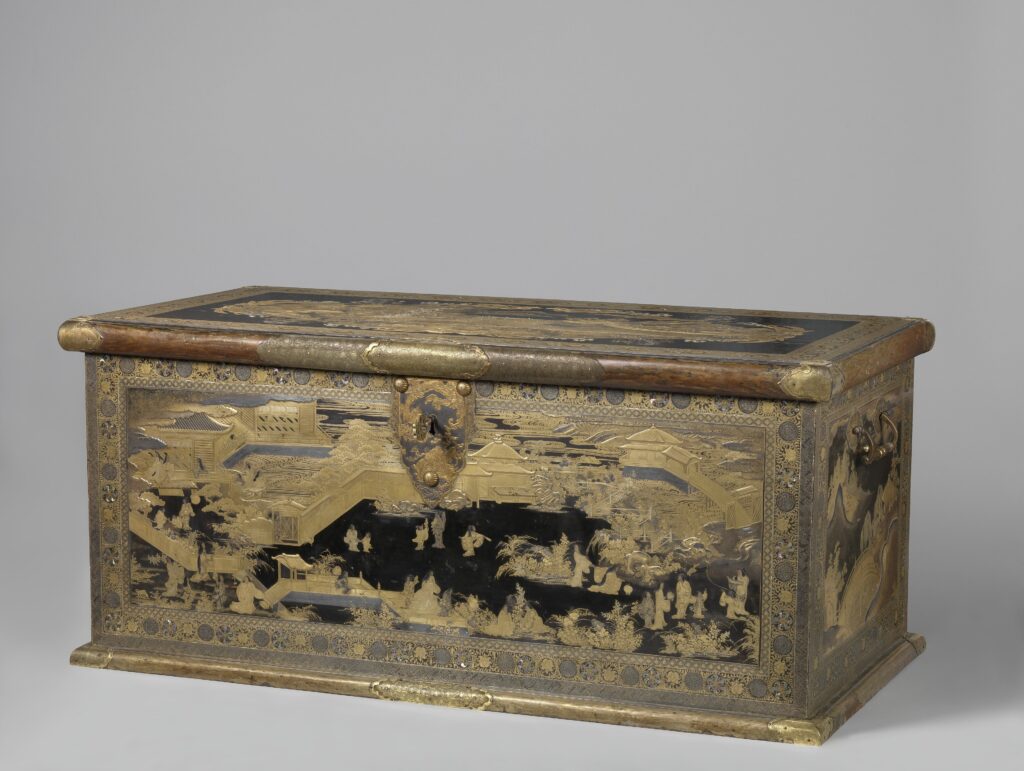
In 1970, a French engineer working for Shell in London paid £100 for a large wooden chest and stood his television on it. It was a Japanese lacquer chest made around 1640, the larger companion of the V&A’s Mazarin Chest, and its whereabouts had been unknown since 1941. On 9 June 2013 it sold at auction in France for €7.3 million.
The engineer was not named in reports of the sale. The £100 price was reported by the Daily Mail, in an article reproduced by the Rouillac auction house, which says he bought the chest from a London-based Polish doctor named Zaniewski. The History Blog describes the engineer as the doctor’s tenant, while Antiques Trade Gazette calls him a friend and gives no price.
Three minutes from the museum
The Victoria and Albert Museum has owned the chest’s smaller companion since 1882. Its catalogue record for the Mazarin Chest, on display in the museum’s Japan gallery in South Kensington, says the larger one was bought at the same Hamilton Palace sale by the collector Sir Trevor Lawrence. It later belonged to the Welsh colliery owner Sir Clifford Cory, and was last recorded in 1941 in the sale of the contents of Llantarnam Abbey in Wales.
How it slipped away is explained by the History Blog: the 1941 catalogue listed it only as a large Chinese chest, with no mention of Mazarin or Japan. The same account records V&A appeals for it in Country Life in the 1980s and on the museum’s website in the 2000s. The Mail says the museum also approached likely collectors and sent a description to auction houses. Its headline has the V&A searching since 1941, and its text says for more than half a century.
All that time the chest was close by. By the Mail’s account it spent 16 years under a television in a South Kensington home about three minutes’ walk from the museum. The same report’s headline says three miles, which its own text contradicts.
From Kyoto to a Loire Valley drinks cabinet
The Rijksmuseum dates the chest to between about 1635 and 1645 and attributes it to the Koami workshop in Kyoto. It is 144.5cm wide, against 100.3cm for the V&A’s. It is decorated inside and out in gold on black lacquer, with scenes that include episodes from The Tale of Genji, and Antiques Trade Gazette counts it among about ten surviving export pieces ordered by François Caron, head of the Dutch East India Company’s office in Japan.
The auctioneers traced it to Cardinal Mazarin, chief minister of France, who acquired it in 1658 according to an AFP report of the sale. The V&A is more careful about its own chest: its record says nothing is known of the early history, and that the earliest evidence of ownership is a Mazarin family coat of arms on the key. The writer and collector William Beckford bought both chests at the start of the 19th century, and they passed through his daughter to the Dukes of Hamilton, whose palace contents were sold in 1882.
In 1986 the engineer retired to the Loire Valley and took the chest with him. There it became a drinks cabinet. After his death his family called in the auctioneer Philippe Rouillac, who recognised what was holding the bottles. His brother Aymeric traced its history.
Bidding opened at €200,000
The sale was held at the Château de Cheverny. Bidding opened at €200,000, and the Rijksmuseum in Amsterdam won at €7.31 million with the buyer’s premium, Antiques Trade Gazette reported, with an American museum as underbidder. The trade paper thought it the second-highest auction price for a Japanese work of art. The Mail put the figure at £6.3 million, for a chest that had cost £100 some 43 years earlier.
The V&A was not among the bidders. Its curator Julia Hutt told the Mail the museum would have liked to bid but did not have the money, and that she was glad the chest had gone to the Rijksmuseum. The V&A’s catalogue now calls it the Rijksmuseum Chest.
It is one of several bargain buys that turned out to be museum pieces. An Edinburgh dealer paid £5 for a Lewis chessman in 1964, and a woman in west London wore a £10 car boot ring for 30 years before learning what it was.