
Richard Hammond paid a reported £2 million for Bollitree Castle, a fake castle in Herefordshire said to have been built for a Spanish bride. In 2023 the council refused his plans to alter it
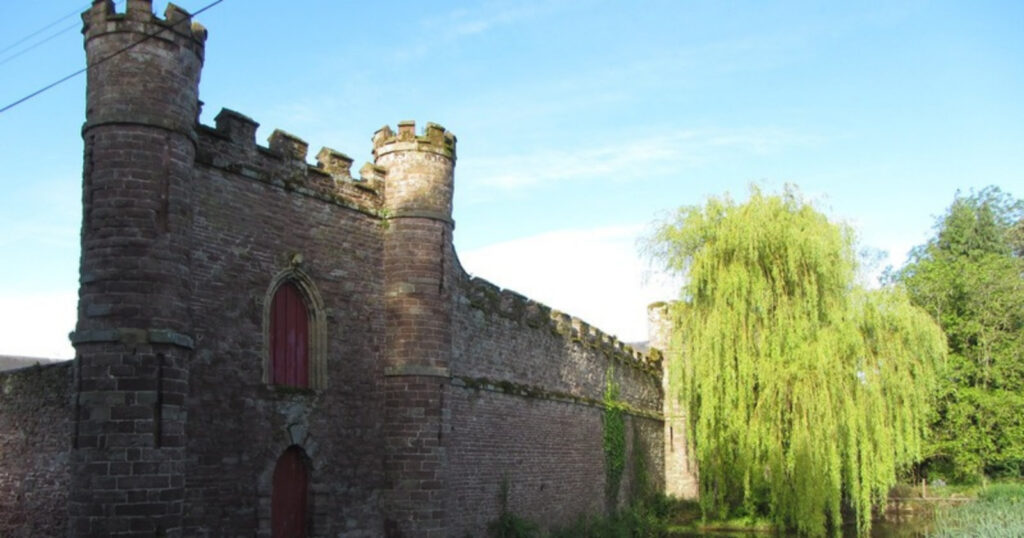
Nobody has ever besieged Bollitree Castle, and nobody ever could have. The towers are decorative, the moat is more of a garden pond, and the “curtain wall” mostly holds up a barn. It is a castle in the way a stage set is a street: very convincing from the front.
That has not stopped it becoming a heavily listed group of buildings, the subject of a legend about a rejected suitor, and, in 2023, the setting for a planning saga starring a former Top Gear presenter and his kitchen.
A castle with no enemies
Bollitree stands near Weston under Penyard, a few miles from Ross-on-Wye. The part that does the castle impression is the farmyard, and Historic England’s list entry says so bluntly: a barn and yard walls “forming sham castle”, built in the mid-18th century in the Gothick style, with round corner turrets, battlements, pointed windows and some reused medieval fragments. The barn’s west wall, facing the house, is symmetrical, as a good fake should be.
Behind it sits a perfectly sensible farmhouse of about 1700, five bays wide, with sash windows and a respectable doorway. Only the back of the house joined the joke, with battlements and octagonal turrets with arrow slits. Imagine a bank manager who wears a suit to work and a full suit of armour at home.
Both are listed: the barn and walls at Grade I, the house at Grade II*. Historic England’s educational note on the site puts it simply: “It is not a real castle.” It adds that some of the stone is thought to have come from the ruins of nearby Penyard Castle, so the fake was at least built from the remains of a real one.
The lady who wanted a castle
Every folly needs a reason, and Bollitree’s is a good one. According to Herefordshire Past, which collects local history, the estate passed in 1776 to Thomas Hopkins Merrick. He fell in love with a Spanish lady who declared she could not possibly live in England unless it was in a castle. Thomas dutifully gave his house a castle front. She was unimpressed, he was left out of pocket and without a bride, and by 1789 he was dead and his farm equipment was being sold at auction.
It is a lovely story. Here is the caveat. That account comes from local tradition, and I could not find a letter, a marriage record or even the lady’s name to back it up. The dates also sit awkwardly: Historic England dates the castle-style building to the mid-18th century, and Merrick did not inherit until 1776. Either the work was done earlier by someone else, or the legend latched on to the wrong owner.
Either way, “said to have been built for a Spanish bride” is the safe phrasing. A bride is exactly what she never became.
Enter the Hamster
Richard Hammond, the Top Gear and Grand Tour presenter, is reported by The Times to have paid £2 million for the castle in 2008, with his wife Mindy. It came with a 31-acre estate, which is enough room to lose a few of his cars. The price has always been a reported one, not a published record.
Herefordshire is already home to a surprising number of famous restorers and ruin-lovers, including Monty Don and his roofless house. Hammond’s challenge was the opposite one: how do you update a listed house without upsetting the people who protect it?
Why would anyone object to a kitchen?
The 2019 plans for works at the castle won permission and listed building consent. The Times says Historic England called them “elegant”. Then in March 2021 Hammond put in a revised scheme: glazed kitchen and boot-room extensions, some internal alterations, and the existing conservatory demolished to make way for a new sunroom.
The objections, reported by the Hereford Times, were sharp. The council’s buildings conservation officer said the new application had simply reused the old heritage statement, and that the “pavilion-like” kitchen would bring in a use the building never intended. The Georgian Group called it “a lumpen alien feature” against a “delicate largely eighteenth-century gothick façade”. Historic England objected to its “visually and architecturally intrusive form and inappropriate function”.
The sting in that last phrase is about status. As quoted in the national press, Historic England’s objection turned on the idea that a kitchen was traditionally a low-status room, tucked away discreetly, and that putting one on the garden front goes against how the house was meant to read. You can have a fake castle, it seems, but not a fake-looking kitchen on it.
Refused, or just disposed of?
The title’s claim needs a footnote. In May 2023 Herefordshire Council’s development manager, Simon Rowles, wrote to Hammond to say that, given how long had passed since consultation on the scheme ended, the application was now “disposed of”. According to the same Hereford Times report, he added that a number of attempts to address the heritage concerns had failed because it had not been possible to arrange a meeting, and the additional information the council wanted had not been provided.
That is not quite a refusal. It is the council closing a file that had stalled, and some outlets nonetheless reported it as one. I found no sign of an appeal. Hammond was asked for comment, and the reports carry no reply.
Seeing it for yourself
Bollitree Castle is a private family home, so there is no ticket office and no gift shop. The battlemented farmyard wall, though, runs beside a lane near Weston under Penyard, and the turrets and willow-fringed pond can be glimpsed from the road. Look, admire, and do not go knocking to ask about the kitchen.