
Forget Bath’s Roman Baths: Chester has the most complete Roman and medieval town walls in Britain, and you can walk an almost 2-mile loop along the top
When people go looking for Roman Britain, many head for Bath, where the Roman Baths draw huge crowds every year. To the north, near the Welsh border, Chester offers something different: a complete ring of stone walls you can walk all the way around.
Visit Chester, the city’s tourism site, calls them “the longest and most complete city walls in Britain.” Cheshire West and Chester Council puts it more simply: many towns once had walls, but “today only Chester has a complete circuit around the city.”
A Roman fortress on the Dee
The story starts with the Roman army. Chester had a natural advantage: what the Victoria County History calls “a fine harbour at the highest navigable point on the Dee.”
In or shortly after AD 74, the Second Legion was moved there to build a new legionary base. “The river in time gave its name to the site in a Latinized form,” the history notes: “Deva, ‘the holy one’.”
The first defenses were simple. According to the history’s chapter on the city walls, “when first built in the 70s and 80s, the legionary fortress was defended by an earth rampart topped by a wooden palisade.” Stone came later. “The advent of the Twentieth Legion at the end of the 1st century saw the beginnings of a general reconstruction in stone,” but “the rebuilding was abandoned, incomplete, in the early 2nd century and eventually finished over a hundred years later.”
Visit Chester notes that “much of the northern and eastern circuit of the walls still follows the line of the Roman fortress wall.” The county history goes a step further, though cautiously: it thinks it more likely that the walls under construction around AD 100 were “those which survived, albeit with later additions, on the north and east sides into modern times.” Walking those two sides, you are following the edge of a legionary fortress laid out nearly 2,000 years ago.
Saxons, Normans and a complete loop
Roman rule did not last forever. According to the Victoria County History’s chapter on the city walls, maintenance of the fortress defenses “continued to the end of the 4th century,” and its history of early medieval Chester notes that “some form of occupation may have continued after the Roman army left.”
The walls came back into service in the 10th century. In 907, Chester was refortified by “the ruler of Mercia, King Alfred’s daughter Æthelflæd.” The county history calls this the real starting point: “The history of medieval Chester can be said to begin only in 907 with the refortification of the site.” The town had reason to be on guard. “In 893 Vikings raided Chester,” the history records.
How much of the Roman circuit she reused “remains uncertain.” The history’s suggestion is that “she adopted the north and east walls,” extending them to the river and “creating thereby an L-shaped landward defence.”
The full loop came later. According to Cheshire West and Chester Council, “during the 12th century, the Normans rebuilt and extended the Walls,” creating a complete circuit for the first time since the Romans.
Walking the circuit
The full loop is almost two miles long. Visit Chester describes it as “a pleasant two-mile (3km) walk”.
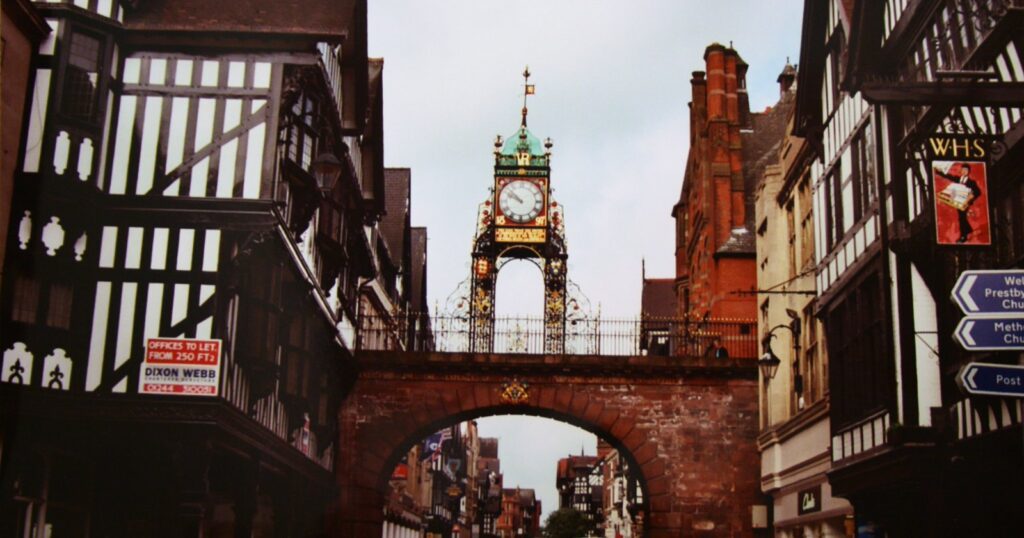
Along the way are several landmarks, among them the Eastgate Clock. The Eastgate itself is not medieval: its Grade I listing describes an “archway in place of former gatehouse,” built in 1768–69. On top sits an “ornate wrought-iron pavilion” holding a “four-dial clock by JB Joyce of Whitchurch.”
Bath has its baths. Chester has a Roman fortress wall that never quite stopped being used.