
Britain’s mince pies were once made with real meat, including tongue, beef, mutton and even tripe, and the Puritans attacked them as too indulgent and too Catholic
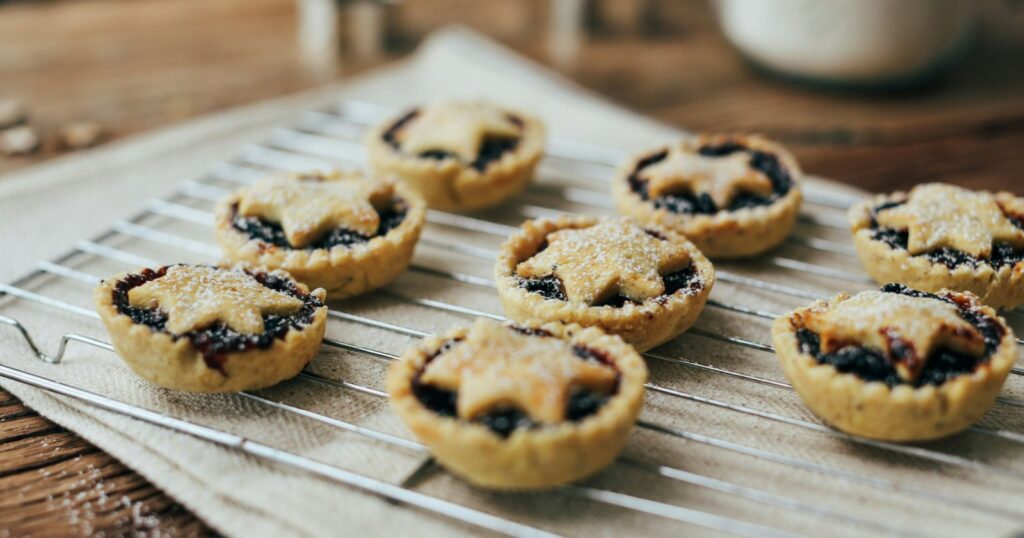
Every December, British supermarkets stack up boxes of mince pies, small round tarts of buttery pastry filled with dried fruit, sugar and spice. The name seems a little odd today, since there is no mince in them. For most of their history, though, there was. The early mince pie was a meat pie, and it was rich enough to get caught up in the religious battles of the 17th century.
From mutton to tongue to tripe
Spiced meat pies go back to the Middle Ages. English Heritage points to a “Tart of Flesh” in The Forme of Cury, a 14th-century cookbook made with minced pork, figs, raisins, wine, pine kernels, cheese, honey and spices.
By the Tudor period, the recipe had settled into something more recognizable. A 1591 recipe printed in A Book of Cookrye calls for “lean mutton or beef,” mixed with suet, spices and dried fruit.
The choice of meat varied. In a history of the dish for Country Life, Martin Fone notes that mutton was the usual choice early on. Gervase Markham’s 1615 The English Huswife used a whole leg of mutton and three pounds of suet. Samuel Pepys records dining on “some good ribs of beef roasted and mince pies” in 1666. Some cooks went further, adding deer innards, lamb’s stones or udder.
By the 18th century, Fone writes, “cheaper cuts of meat such as tongue and tripe” were replacing the mutton, pork and beef.. Hannah Glasse, the best-selling cookery writer of the 1740s, told readers that “if you chuse meat in your pies parboil a neat’s tongue,” neat being an old word for cattle.
A pie shaped like a manger
Mince pies were Christmas food from early on, and they carried religious meaning. According to English Heritage, they were often baked in a rectangular shape, which people came to associate with the manger, and sometimes topped with a pastry figure of the baby Jesus. Country Life adds that the spices were linked to the gifts of the Magi.
They were also expensive. English Heritage notes that heavily spiced pies “were not every day fare,” and were saved for feast days such as Christmas and Easter.
Too rich, too Catholic
That combination, luxury plus religious symbolism, made the mince pie a target when Puritans gained power in the 1640s. Many Puritans regarded the traditional church calendar as a leftover of Catholicism. As historian Rachel Foxley of the University of Reading puts it, to them the old feasts “were idolatrous and popish – and all too popular.” Puritans preferred fasting to feasting.
Writing in History Today, the social historian J.A.R. Pimlott described Sir Thomas Overbury’s early-17th-century caricature of a Puritan who would condemn “those who ate mince pies as Papists and idolaters.” In 1632, the pamphleteer William Prynne worried about what outsiders would think of a Saviour honored with such feasting, asking whether they would take him for “a glutton, an epicure, a wine-bibber.”
A history of Christmas food in Countryfile magazine sums it up: the Puritans “identified these indulgent pies as Catholic and tried to stop them from being made at Christmastime.”
The bigger blow fell on Christmas itself. In 1647, Parliament banned Christmas, Easter and the other holy days. A legend later grew that Oliver Cromwell personally outlawed mince pies. English Heritage calls that “a myth.”The pies were caught up in a wider ban on the festival, not singled out by law.
How the meat disappeared
Over the following century, the recipe slowly drifted from savory to sweet. English Heritage says that by the end of the 17th century, mince pies were being made round.
The meat hung on for a long time. Eliza Acton’s 1845 mincemeat recipe still “includes ox tongue.” Mrs. Beeton’s Book of Household Management, first published in 1861, gave two recipes, one with meat and one without.
By the 20th century, according to English Heritage, “the only trace of meat in the eponymous mince pie was the suet.” That is still true of many traditional recipes today. The beef fat in the filling is the last link to a pie that once held mutton, tongue and tripe.