
In September 1922, the same week Clementine gave birth to their daughter Mary, Winston Churchill bought Chartwell for £5,000 without telling her. He built most of its kitchen garden wall with his own hands, and after the war friends bought it for the National Trust so the couple could stay on at £350 a year
Churchill made his first offer for Chartwell on the day his daughter Mary was born, without telling Clementine. He later built most of its garden wall himself and rented it back for £350 a year.
On 14 September 1922, a letter from the estate agents Knight, Frank and Rutley reached Winston Churchill in London. Chartwell, a run-down manor near Westerham in Kent, was his if he wanted it, at £5,500, and he had ten days to decide. His wife Clementine was about to give birth to their fifth child.
Mary Churchill was born the next day, 15 September. That same day, as the historian David Lough sets out in his account of the purchase, Churchill decided not to disturb his wife and made an offer of £4,800, arguing that the house would have to be “very largely rebuilt”. The haggling was done from his government offices in London, and a price of £5,000 was agreed on 20 September. Martin Gilbert’s official biography dates the seller’s acceptance to 24 September, after which Churchill sent a £500 cheque to secure it. The sale was formally completed that November.
Clementine was not told. Neither were the older children, who, according to America’s National Churchill Museum, begged their father to buy the place after a visit, only to learn later that he already had.
A house she had turned against
Clementine had not always been opposed. Churchill first saw Chartwell in July 1921, and when she went to see it that month she wrote to him: “My darling, I can think of nothing but that heavenly tree-crowned Hill.” The property went to auction a week later, failed to reach its reserve and was withdrawn. Five weeks after that, the Churchills’ two-year-old daughter Marigold died, and the house slipped from their minds.
By the time it came back on the market in 1922, Clementine, pregnant again, had changed her mind. The house was too close to the road, she felt, and faced the wrong way. She suggested buying on the Essex coast at Frinton instead.
She had a point about the work involved. The young architect Philip Tilden’s first forecast for the rebuilding was £8,000, and Lough records that the job ended up costing about three times that. By 1924 client and architect were barely speaking, and the family did not move in until April of that year.
Clementine worried about the cost for years. On 2 September 1923, Churchill wrote to her: “My beloved I do beg you not to worry about money, or to feel insecure… Chartwell is to be our home.” She made it one, but Mary later wrote that the purchase was the only matter “over which Clementine felt Winston had acted with less than candour towards her”. The Churchill Archives Centre notes that the resentment surfaced from time to time throughout their marriage.
The timing matters more than it first appears
It is easy to read the story as a husband making a reckless purchase behind his wife’s back, and that is part of it. But the Churchills had buried Marigold barely a year earlier. Mary’s arrival after Marigold’s death was, in the words of her obituary in The New Republic, “a joyful consolation”.
Churchill had been searching for a country home for two years. Writing to the seller, Captain Archibald Campbell Colquhoun, an old Harrow contemporary, he called the site “the most beautiful and charming I have ever seen”. Years later he put it more simply: “I bought Chartwell for that view.” Whatever his reasons for not telling Clementine, the house he bargained for in the days after Mary’s birth became the backdrop to almost her entire childhood. Her older siblings had moved between rented houses and governesses. As her biographer David Reynolds wrote, Mary’s formative years were spent entirely at Chartwell.
The wall he built himself
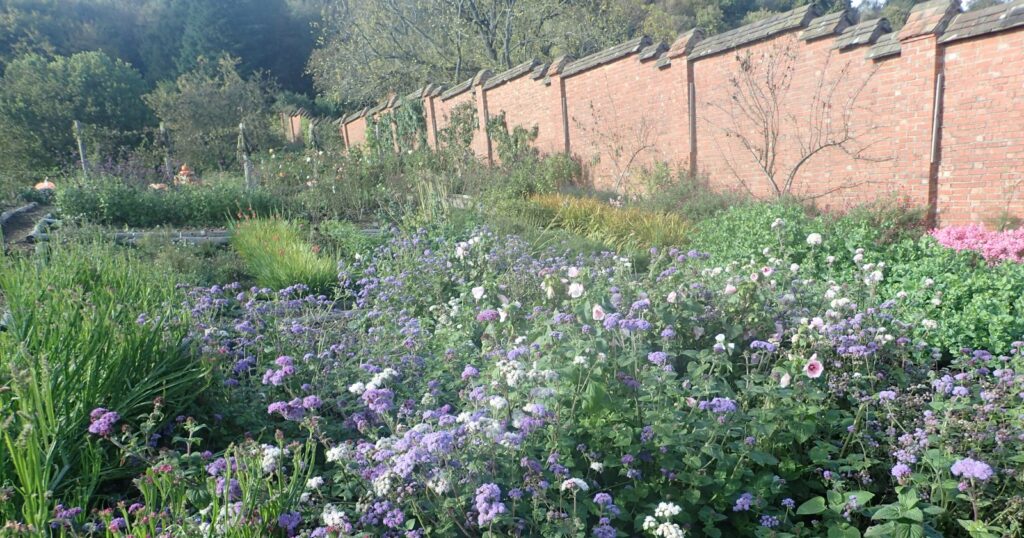
Churchill took up bricklaying at Chartwell and pursued it with the same intensity he brought to everything else. Between 1925 and 1932 he built the greater part of the high brick wall enclosing the kitchen garden, an area of roughly 90 by 55 metres. A plaque on the wall today reads: “The greater part of this wall was built between the years 1925 & 1932 by Sir Winston Churchill with his own hands.”
He took it seriously enough to join the Amalgamated Union of Building Trade Workers in 1928, which caused a row at the time. He was, after all, Chancellor of the Exchequer.
Tucked into the south-east corner of that same walled garden is the Marycot, a little brick summerhouse he built for Mary. The daughter born on the day he made his first offer got a building of her own inside the wall he spent seven years laying.
He was still at it after the Second World War, by then with a couple of professional bricklayers to help. His grandson, also named Winston, later recalled spending school holidays at Chartwell as a boy of five or six, passing him bricks while the former Prime Minister mixed what he called “pug”, his word for the sand and cement mortar.
How friends saved it
Chartwell was always expensive. Churchill nearly sold it in 1938, when heavy losses on Wall Street hit his share portfolio, and the question came up again after he lost the 1945 general election. He had written little for six years and his income had fallen sharply.
A group of friends and admirers led by the newspaper proprietor Lord Camrose stepped in. They bought Chartwell and immediately gave it to the National Trust, on the condition that Winston and Clementine could go on living there for as long as they wished. The sale was completed in November 1946. The terms were generous: the Churchills paid a rent of £350 a year, plus rates. The exact sums involved were never made public and accounts differ, but the arrangement itself was clear. The house would pass to the nation, and the couple would never have to leave it.
Churchill wrote to Camrose that his thanks felt inadequate for a friend who had “never wavered” through “all these long and tumultuous years”.
What the walled garden holds now
Mary came back to Chartwell after the war. Her husband Christopher Soames ran the farms Churchill bought around the estate, and the couple lived in the farmhouse down the hill.
In 1958, for her parents’ golden wedding anniversary, Mary and the garden designer Lanning Roper laid out the Golden Rose Walk, an avenue of yellow and gold roses running straight down the middle of the old kitchen garden. It sits inside the wall her father built by hand, a few paces from the summerhouse he made for her.
Churchill died in January 1965. Clementine gave up her rights to the house, and the National Trust opened it to the public in 1966. The house Clementine had turned against, bought behind her back in the week her daughter was born, is now among the Trust’s most popular properties, and the wall is still standing.