
In 1891, William Waldorf Astor, one of the richest men in America, left New York saying America was “no longer a fit place for a gentleman to live”; in 1903 he bought Anne Boleyn’s childhood home, Hever Castle, and spent five years restoring it and digging a lake
When his father died in early 1890, William Waldorf Astor inherited a fortune that, according to Hever Castle’s own history of its owners, made him the richest man in America. He did not stay to enjoy it there. He had grown disenchanted with his country, announcing that it was “no longer a fit place for a gentleman to live,” and in 1891 he moved to England with a reputed $100 million.
Dates for the move differ slightly depending on where you look. The Encyclopaedia Britannica puts his permanent move in 1890, after a stint in the New York state legislature and three years as US minister to Italy. Either way, by the early 1890s one of the great American fortunes had relocated to England, and it stayed there. Astor became a British subject in 1899.
A castle that was “little more than a farmstead”
More than a decade after arriving, Astor bought the place that would absorb much of his money and attention. On 27 July 1903, the sale of Hever Castle in Kent was completed. Astor recorded it in his personal ledger, a line Hever quotes in a 2019 post marking the anniversary: “The sale of the freehold of the Castle and 630 acres was completed by Edmund Meade Waldo. Esq.”
The appeal was not the building’s condition. Hever’s history is long. The castle dates to the 14th century, and it was the childhood home of Anne Boleyn, the second wife of Henry VIII. But by 1903 it had seen better days. Charles Frederick Huebner, son of the castle’s first curator, described Hever at the time of the purchase as “little more than a farmstead.” Astor saw something he could build on.
Five years, hundreds of craftsmen
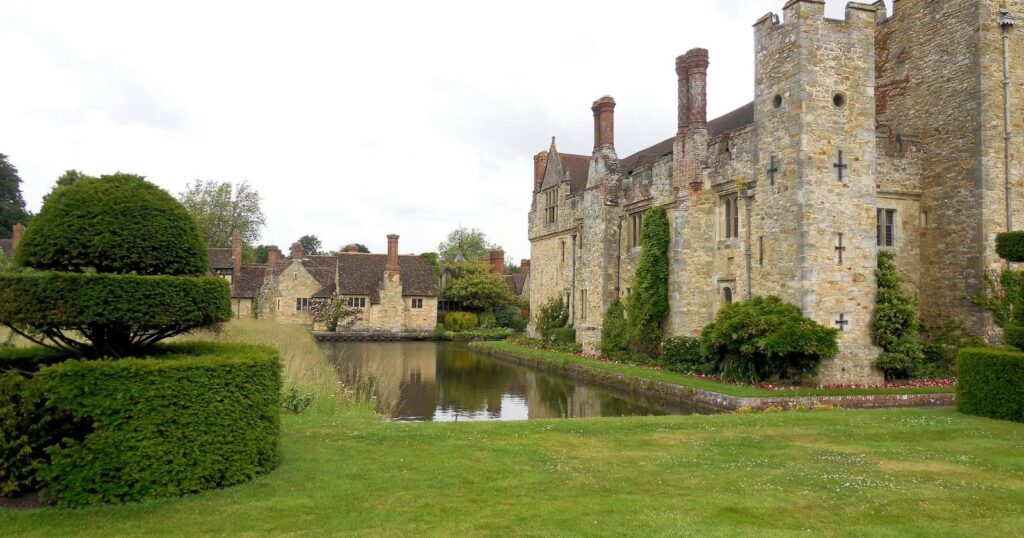
Between 1903 and 1908, Astor restored the castle, added a new wing to house family and guests, and created the lake and gardens. The new wing, now called the Astor Wing, is often described as a “Tudor village.”
The labor force was enormous. Hever says the project employed 748 craftsmen, including some of the most skilled plasterers, carpenters, stonemasons and metal workers of their generation. Astor also toured Tudor and Elizabethan buildings for ideas. The cost, by the castle’s own account, reputedly reached £10 million at the time, which Hever estimates at more than £1 billion in today’s money. Nearly £1 million of that went on the gardens and lake.
The gardens had a purpose beyond looking pleasant. Astor had a large collection of Italian sculpture, built up during his years in Italy, and the Italian Garden at Hever was laid out to display it.
Digging the lake
The lake is the part of the project that best shows the scale of what Astor was willing to do. At the far end of the gardens he decided to turn 38 acres of low meadow into open water.
According to Hever’s guide to its lake walk, 800 men were contracted in December 1904 to carry on the work “regularly and continuously by day and night (except on Sundays) when so ordered.” Kent County Council’s historic environment record notes the lake was finished in about 19 months from the signing of the contract, using six steam diggers and seven miles of internal railway linked to the main line. The surrounding land had to be drained and the River Eden diverted. The lake bed was dug to a depth of 3 to 10 feet and reinforced with concrete where needed.
The record also describes more than 1,000 men working on the gardens between 1904 and 1908. In that time, Hever says, 125 acres of gardens and landscape were made out of what had been marshland and rough meadow.
What came after
Astor kept moving up in his adopted country. He became Baron Astor and then, in 1917, Viscount Astor of Hever Castle, according to the Kent record. When he died in 1919, Hever passed to his son John Jacob Astor. The family opened the castle and gardens to the public for the first time in 1963, and sold the castle along with some 3,000 acres in 1983.
The man who decided America was not good enough for a gentleman spent five years and a fortune rebuilding a corner of Tudor England. Visitors today walk around a lake that, a little over a century ago, was a meadow and a river.