
In 1845, Queen Victoria and Prince Albert paid £28,000 for Osborne, a Georgian house on the Isle of Wight, then pulled it down and built an Italianate palace; after she died there in 1901, Edward VII gave it to the nation
English Heritage records that Victoria and Albert paid £28,000 for Osborne in May 1845, demolished the old house in 1848 and built an Italianate palace.
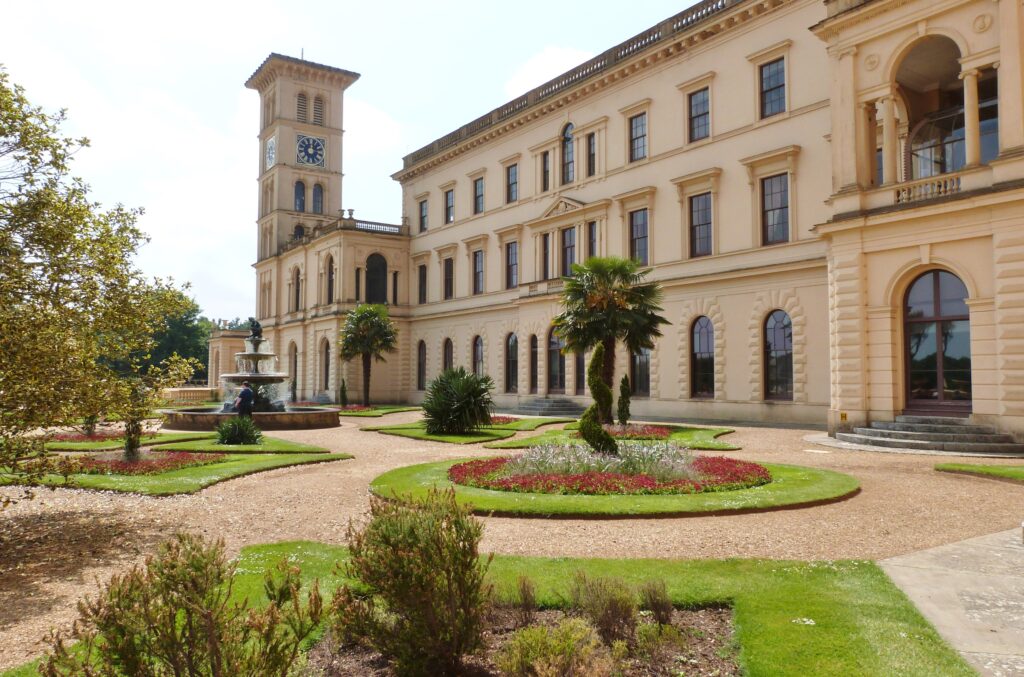
Queen Victoria and Prince Albert bought the Osborne estate on the Isle of Wight in May 1845 for £28,000, having first taken it on a lease. Within three years the house that came with the land had been pulled down, and in its place rose the Italian-styled residence that still looks out over the Solent.
The couple wanted a private retreat away from London and Windsor. The estate, then owned by Lady Isabella Blachford, was recommended to them by the Prime Minister, Sir Robert Peel. English Heritage, which has managed the site since 1986, gives the purchase price as £28,000 in May 1845; some older accounts put the figure at £26,000.
What the royal couple acquired was not the house visitors see today. The estate had come into the hands of the Blachford family in 1705, and between 1774 and 1781 Robert Pope Blachford extended and adapted an existing building into a three-storey residence, with a walled kitchen garden and a brick stable block. The substantial stone foundations of the stable block may relate to an earlier building on the site.
The house that was too small
That late 18th-century house, Georgian by date if not by English Heritage’s own label, was too small for a monarch, a consort and a growing family, and an extension was required almost at once. Rather than hand the job to the Department of Woods and Forests, which was then in charge of all government building, Prince Albert bypassed the department’s architects so that the work would not be restricted by it.
He turned instead to Thomas Cubitt (1788-1855), the master builder who had developed much of the Duke of Westminster’s Belgravia estate in London. Cubitt advised that rather than alter the old house it would be best to build a new one, and went on to design it in collaboration with Albert. The prince’s involvement was not nominal. The planting in the grounds follows his designs, and English Heritage describes the Italianate house as his inspiration.
Building came in phases. The first was completed in 1846 with the Pavilion, housing the private rooms of Queen Victoria and Prince Albert and the royal nurseries. The household wing, containing accommodation for the members of the royal household who accompanied the Queen to Osborne, was completed in 1848.
Demolition in 1848 and an Italian palazzo
Only then did the old house go. It was demolished in 1848, and the main wing, completed in 1851, was built on its site and linked by a long corridor to the household wing. The main wing was used initially by the royal children. The terraces on the north-east side of the Pavilion and main wing were designed to complement the house and are filled with the signature features of classical Italian gardens.
The result, in English Heritage’s words, was built in a “quintessential Italian ‘palazzo’ style”, with a picturesque silhouette, a pair of towers, and terraces connected by flights of steps. It was meant to suit its setting. The island’s temperate climate and the panoramic views over the Solent reminded Albert of the Bay of Naples, which he had visited in 1839, and there were several English precedents for such an approach.
Osborne’s influence travelled. English Heritage traces how the house’s Italianate design came to be imitated in public buildings throughout the British Empire, from Naples to Melbourne, a borrowing that acquired its own name as the “Osborne Style”. More on the house and the Queen’s years there can be found in British Heritage’s guide to Victoria’s Osborne House.
A death in 1901 and a gift to the nation
Queen Victoria died at Osborne in 1901, and her funeral procession left the house on 1 February that year. Her death left a vacuum arguably much more dramatic in its consequences for the estate than that of its creator, Prince Albert, who had died in 1861.
Osborne was the private property of the royal family, and Victoria’s successor, Edward VII (1841-1910), did not need it. No other member of the royal family wanted to take on the upkeep, and on Coronation Day 1902 the king gave the estate to the nation. The transfer was given statutory form by the Osborne Estate Act 1902.
Public access came slowly. Part of the ground floor of the house was opened to the public in 1904, and most of the other parts were converted into a convalescent home for officers. A naval college also took in part of the estate, and cadets were photographed there practising their knots in about 1905. For decades, in other words, most of Osborne was a working institution rather than a museum, with the royal rooms shown only in part.
Visitor numbers rose sharply in 1977, and many rooms were redecorated at that time. English Heritage assumed the management of Osborne in 1986 and has since carried out much external repair and a programme of internal redecoration and re-presentation, including the recreation of the royal nursery suite on the second floor of the Pavilion. The rooms remain filled with original furniture and works of art. Fuller accounts of the building sequence and of the house’s Italian sources are published by English Heritage in its history of Osborne and its page on the Osborne Style.