
A diamond ring Lady Duff Gordon was wearing when the Titanic sank, which escaped in a lifeboat built for 40 that held 12, sold for £150,000 in Devizes on Saturday; a pass letting an 18-year-old victim’s mother watch it leave Southampton made £40,000
The solitaire diamond ring Lucy, Lady Duff Gordon wore as the Titanic sank made £150,000 at Henry Aldridge and Son in Devizes on Saturday 21 November.
A diamond ring that Lucy, Lady Duff Gordon was wearing as the Titanic went down has sold for £150,000 at auction in Wiltshire.
The solitaire ring went under the hammer at Henry Aldridge & Son in Devizes on Saturday 21 November, sold via a direct descendant. It had been expected to make up to £80,000.
Lady Duff Gordon was wearing it when the liner sank on 15 April 1912 on its maiden voyage, with the loss of about 1,500 lives. It was the only piece of jewellery of significance she owned that did not go down with the ship. The family knew it as The Titanic Ring, and it was believed to have been her engagement ring.
“It’s exceptionally rare for jewellery related to a Titanic survivor to come to market but almost unprecedented for such a personal item from such a high-profile passenger to be sold at auction via direct descent,” Andrew Aldridge, of Henry Aldridge & Son, said.
The ring had been given to Lady Duff Gordon’s grandson John, the 3rd Earl of Halsbury, a British crossbench peer and scientist. After his death it stayed within the family.
Two prices for one ring
The £150,000 figure includes the buyer’s premium. The Independent, which gave that price, said: “The sale totals include buyer’s premium.”
The BBC said the ring “was bought for £140,000”. That is the hammer price, the sum reached in the room before the premium is added.
The ring was not the biggest seller of the day. A pocket watch that belonged to Mary Mangan, a third-class passenger, fetched £250,000 and was the top lot. The golden watch was found on the body of the 32-year-old Irish passenger and was returned to her family alongside her other possessions. Mangan had moved to the United States and had returned to Ireland in early 1912 to visit family. The watch recently spent several weeks on exhibition with the rest of the Mangan Collection at Titanic Belfast.
Twelve aboard a boat built for 40
Lady Duff Gordon travelled to the United States in 1912 as a first-class passenger with her husband, Sir Cosmo. The couple and their secretary, Laura Mabel Francatelli, escaped in Lifeboat No 1.
The Independent said the boat was “designed to hold 40 people, but it was lowered with only 12 aboard, seven of them crew”.
On board RMS Carpathia, the Cunard liner that rescued Titanic survivors, Sir Cosmo gave each of the men from Lifeboat No 1 a cheque for £5. The money was to help them after the White Star Line stopped their wages when the Titanic sank.
It “led to gossip” that the Duff Gordons had bribed their lifeboat’s crew not to return to save swimmers, out of fear the vessel would be swamped. The accounts of the sale carry that as gossip and nothing more.
British Heritage has previously published first-hand accounts from survivors of the Titanic.
The ticket Eliza Dibden carried
Elsewhere in the sale, a day ticket to view the Titanic on the day of its departure from Southampton sold for £40,000.
The card bears the White Star burgee and is addressed to the officer in charge. It states: “Please allow Mr Talbot and 2 friends to view the S.S. Titanic.” It is stamped “second-class” and dated 10 April 1912. A handwritten note on the reverse says: “Mrs Dibden plus two sisters.”
Eliza Dibden, the mother of 18-year-old William Dibden, from the New Forest in Hampshire, carried the ticket on to the Titanic. The pass allowed her to watch the liner’s departure. Her son died in the disaster. His first communion certificate, dated Easter 1908, was sold with the ticket.
A postcard written by Jack Phillips, the Titanic’s senior wireless operator, while the liner was docked at Southampton sold for £32,000. Phillips, 25, wrote the card, which features a photograph of the Titanic on the front, to his sister Elsie Phillips, of Godalming, on 6 April 1912. He remained at his post as the ship went down, sending wireless messages that enlisted other ships to help rescue passengers and crew. Aldridge called him “one of the true heroes of the disaster”.
A water-stained letter recovered from the body of Ramon Artagaveytia Gomez, a first-class passenger, was auctioned for £80,000. Written in Spanish on official Titanic letter-headed paper, it describes the ship in detail, from paint colours to temperature and the number of diners. British Heritage has also covered the last letter written on board the Titanic.
More than 100 items linked to the liner were sold, among them an insurance document at £27,000 and a rare ticket at £45,500. Aldridge said the “epic sale” was evidence of the lasting global interest in the story.
British Heritage has set out the losses in the RMS Titanic by numbers. The liner left Southampton on 10 April 1912 and struck an iceberg in the North Atlantic on the evening of 14 April, sinking in the early hours of the following morning.
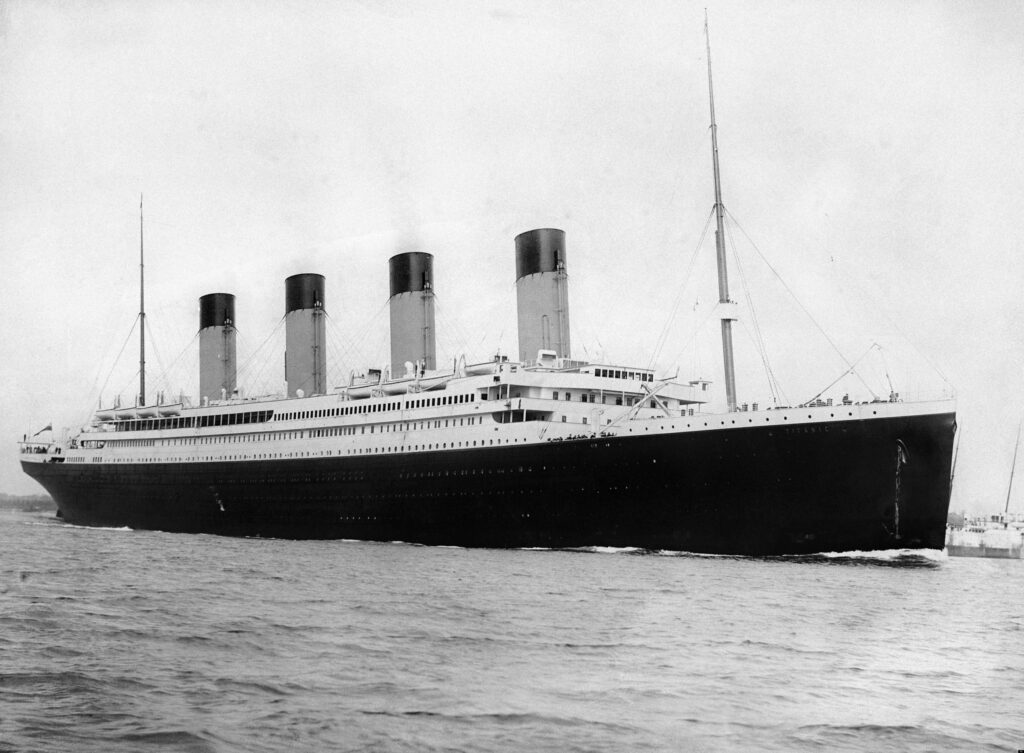
Featured image: RMS Titanic departing Southampton on 10 April 1912, photographed by F. G. O. Stuart (Public domain, Wikimedia Commons). This is not a photograph of the ring or the auction.
