
Victoria and Albert were engraved around a candlelit tree on 23 December 1848, and in December 1850 a Philadelphia monthly reprinted the picture with Albert’s moustache and royal star removed
Williams's 1848 engraving of Victoria and Albert at a candlelit tree was reprinted by Godey's Lady's Book in 1850 without Albert's moustache, sash or star.
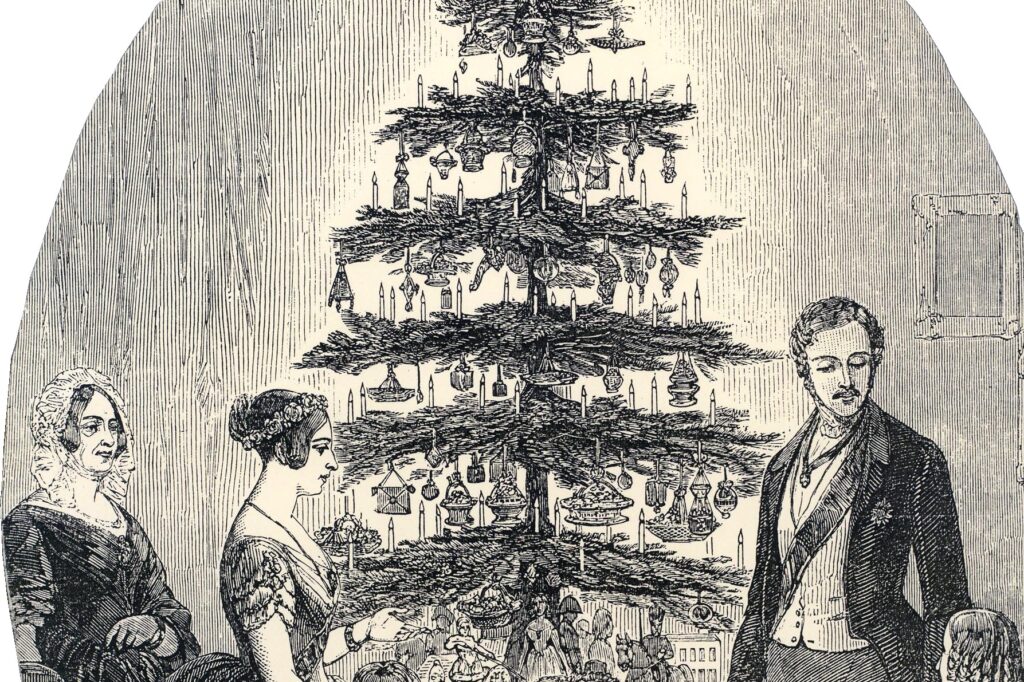
The picture behind the story is an oval wood engraving titled “Christmas Tree at Windsor Castle”, drawn by J. L. Williams and printed in the Illustrated London News Christmas supplement of 23 December 1848, and catalogued by the Library of Congress from page 409 of that number. It shows Queen Victoria, Prince Albert and their children gathered around a candlelit tree standing on a table.
Two years later, in December 1850, the Philadelphia women’s monthly Godey’s Lady’s Book ran the same scene under the plain caption “The Christmas Tree”. The grouping was the same and the tree was the same, but the royal couple were no longer obviously royal.
The Windsor Castle engraving of 1848
Joseph Lionel Williams, who died in 1877, was the draughtsman, and his plate for the Christmas number is a domestic interior rather than a state occasion. The tree is small enough to stand on a table, its branches hung with decorations and carrying lit candles, and the family is arranged around it inside an oval frame that closes off everything beyond the room.

Victoria stands in profile to the left of the tree, with a floral wreath in her hair. She wears no crown, neither in this print nor in the American one that followed. Albert stands opposite her, on the right, with a moustache, a sash running across his chest and a star on his coat. The children are grouped between and below the two of them, and the table with its candles is the brightest thing on the page.
The setting is the one the engraving itself names. “Christmas Tree at Windsor Castle” is the title carried by the Illustrated London News and repeated in the Library of Congress record of the plate, and it is the first thing the American reprint set aside.
What readers of the Christmas supplement saw, then, was a sovereign and her consort doing something a prosperous household could recognise and want: standing with their children beside a lit tree in a room of their own. The moustache, the sash and the star were the plainest marks of rank on the page.
What Godey’s edited out in Philadelphia
Godey’s Lady’s Book took the engraving and altered it. In the December 1850 version the arrangement of the figures is unchanged, the tree is unchanged and the candles are unchanged. Albert’s moustache is gone. The sash across his chest is gone. The star on his coat is gone.

Victoria keeps the floral wreath she wore in 1848. There is no crown in either print, and none was removed. The changes made to Albert were the ones that counted, because the moustache, the sash and the star were what marked the man beside the tree as a prince consort rather than a householder.
The framing changed too. The oval of 1848 has become a rectangular interior, with a curtain gathered at the left and a picture frame on the wall behind the family, and the caption beneath reads simply “THE CHRISTMAS TREE”. Nothing in the American version tells a reader whose parlour this is, or which country it stands in. The effect of the edits together is that the royal couple look like an ordinary American family gathered around a decorated tree.
The New England Historical Society, in its account of how the Christmas tree reached American homes, describes Sarah Josepha Hale, the editor of Godey’s Lady’s Book and of what it calls a popular women’s magazine published in Philadelphia, running the woodcut two years after its London appearance, having edited it so that it was supposed to depict the modern American family. How the plate was recut or redrawn for the Philadelphia printing is not recorded in these accounts. What can be checked is the result, which is visible in the print itself.
An early American picture of the decorated tree
The Godey’s reprint was one of the first widely circulated pictures of a decorated Christmas tree in America. That is a narrower claim than the one sometimes made for it, and worth keeping narrow. The magazine did not invent the custom, and it did not make the Christmas tree American on its own.
What the December 1850 plate did was put the thing on the page, in a form readers could see and copy, in a magazine they already consulted on how a home should look. A written description of a candlelit tree asks a reader to imagine it. A picture of one shows the size of the tree, its place on the table, the way the candles sit among the branches, and the way a family is meant to stand around it while they are lit.
The two prints survive in the public domain and can be set beside one another: the 1848 Illustrated London News engraving and the 1850 Godey’s version. The differences need no specialist knowledge to see. One is a royal family at Windsor Castle. The other is the same scene with the rank taken off it.

What survived the crossing was the part that could be copied: the small tree on its table, the candles among the branches, the children around it. The rest was fitted to a new page. The oval opened out into a room with a curtain and a framed picture on the wall, the Windsor title gave way to a caption that names nothing, and the man on the right of the tree lost the moustache, the sash and the star, which was enough to make him anybody’s father.