
In 1885, a young servant in a burning London house dropped her three small nieces from a window onto a feather bed, then was fatally hurt jumping after them
Alice Ayres threw the bed out first, then the children, one at a time. The newspapers that praised her could not agree on how she fell, and the memorial tablet that honours her says she saved all three.
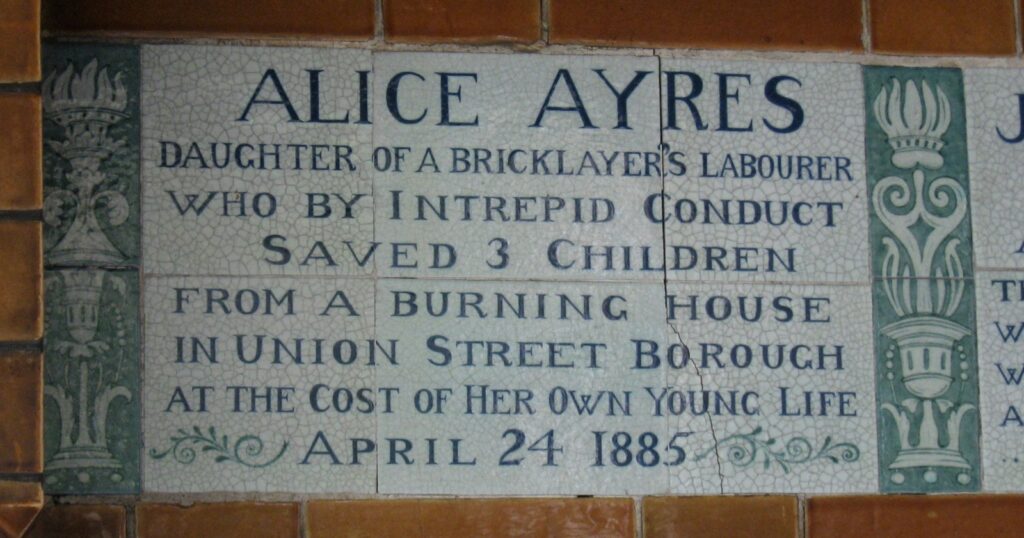
Alice Ayres threw a feather bed out of a second-floor window above a burning shop at 194 Union Street, then dropped three small girls after it, one at a time. Two of them survived. She did not. Ayres died in hospital on Sunday 26 April 1885, two days after the fire.
She was living with her sister’s family above the Chandlers’ oil and colour shop on the corner of Gravel Lane, in the Borough, south of the Thames. The Illustrated London News of 9 May 1885 named the three girls who shared her room as Edith, aged five, Ellen, four, and Elizabeth, three. Their parents, Henry and Mary Ann Chandler, and their six-year-old brother, Harry, died in the fire. The Daily Telegraph reported that the father was found on the stairs with his cash box beside him.
The feather bed
The fire took hold in the shop below, which the Telegraph said was stocked with oils, varnishes and “other inflammable matter”. By the paper’s account, a passer-by saw flames coming through the shop shutters around two in the morning and raised the cry.
Ayres woke to the noise and went to the front window to scream for help. The street filled quickly. The day after the fire, The Times described what happened next, and Australian papers reprinted the passage that June. People below shouted at her to jump and stretched out clothing to break her fall. The Telegraph adds that women took off their shawls and men their coats and tied them together.
She did not jump. The Illustrated London News reported that her first thought was to tie the girls to sheets knotted together and lower them, “but this would not do”. What she did instead is the part every account of the rescue agrees on. In the words of The Times, “She first dragged a feather-bed to the window and threw it out.” The crowd caught it and spread it beneath the window.
Then she brought the children, one at a time. The Telegraph has her calling down “to know if all was right” before she let go of the first child, and going back into the smoke between each one.
Where she landed
What happened when she came to the window for the last time depends on which paper you read.
The Times said that “in her nervous and exhausted state she missed her mark, jumped short of the bed, and fell heavily on to the pavement.” The Illustrated London News said much the same. Its report of 2 May said she “fell upon the ground”, and a week later it described her “striking in her fall against something which turned her aside from the mattress beneath.”
The Telegraph told it differently. In its report of 6 May, which a Tasmanian paper reprinted that July, she struck the upper part of the shop front and fell “head foremost upon the bed, breaking her spine”. The Graphic had her landing head first on the bed too, after hitting one of the large dummy jars over the shop.
Of those four, two put her on the ground and two put her on the bed. All four agree that she went out of the window after the children, that something went wrong and that she was terribly injured.
Guy’s or St Thomas’s
The papers did not agree on the hospital either. The Graphic sent her to St Thomas’s, while the Telegraph and the Illustrated London News both name Guy’s. The Telegraph wrote that she never regained consciousness, yet The Graphic reported that a hospital physician told her how the public and the press were praising her, and that the news seemed to give her pleasure.
Early reports were hopeful about the children. The Times thought one girl unhurt and the other two only slightly hurt. By 2 May, though, the Illustrated London News and The Graphic were both reporting that one of the girls had died. The Graphic said it was the youngest, whom the Illustrated London News later named as Elizabeth.
Even the family tie was reported two ways. The Times wrote of “her master’s children”, and to most of the press Ayres was a servant girl. The Graphic and the Illustrated London News called her Mrs Chandler’s sister and the girls her nieces. Both descriptions can fit a sister who lived with the family and looked after its children.
One of the early versions is now fixed in tile in Postman’s Park. The ceramic tablet there, put up in 1902, says she “saved 3 children from a burning house”. A Postman’s Park website that promotes books about the memorial notes that the tablets were often worded from the earliest newspaper reports, which tended to carry details that were later corrected.
Sixteen firemen and a workhouse
Ayres was buried at Isleworth Cemetery, west of London, near her parents’ home. According to the St James’s Gazette and the Telegraph, sixteen firemen carried the coffin from the house to the grave in relays of four. Twenty girls in white from the village school she had attended came with flowers. The coffin bore the inscription “aged twenty-six”.
The praise did little for her mother. In a piece reprinted in March 1894, the journalist George R. Sims, writing as “Dagonet” in The Referee, reported that she was now 72 and a pauper in Brentford Workhouse, having lost her daughter’s support. He appealed for enough money to give her an income, so that she would not end her days in the workhouse. Whether the appeal succeeded is not recorded in the report that carried it.
Room for 120
The painter George Frederic Watts had been fascinated since the 1860s by the heroism of ordinary people, and for years he compiled lists from the newspapers of those who died saving others. On 5 September 1887 he proposed, in a letter to The Times, a national monument to these “likely to be forgotten heroes” as a way to mark Queen Victoria’s Golden Jubilee. The plan went nowhere that year. In 1898 the vicar of St Botolph’s Aldersgate offered him part of a planned extension to the churchyard garden north of St Paul’s Cathedral.
The memorial opened on 30 July 1900 with four tablets. Alice Ayres’s was among nine more added in 1902, all chosen by Watts himself. He died in 1904. The wall was built to hold 120 tablets, and today it carries 53 historical ones plus a single tablet added in 2009.
The historian John Price has spent years researching the people on the memorial. In a paper published in 2025 in the journal Heroism Science, he reports that a handwritten list of Watts’s, “Index of London Records”, documents 120 incidents that Watts appears to have marked for the wall. Seventy-two tablets, covering 84 people, are missing, while six of the tablets now on the wall were not on Watts’s list. He cites a current estimate of around £500,000 to fill the gaps, and suggests that completing the wall as Watts intended could be argued to make a more historically accurate monument than the one that stands.
The question has come up before. In 2010, according to the same Postman’s Park website, a meeting of the groups with an interest in the memorial concluded it was no longer appropriate to add tablets. Among its reasons were that the memorial was Watts’s personal project and that the modern honours system can now recognise bravery after death. Price’s paper allows that some will want the wall left as it is, and that new wording would be needed for cases where Watts left no narrative.
Meanwhile the wall has a problem of its own. The church of St Sepulchre-without-Newgate, whose rector is responsible for the site, says the memorial has a history of movement and is to be monitored, likely for twelve months from November 2026, to decide whether repairs are needed. Whatever comes of that, 84 people Watts chose are still missing from the wall, their cases listed among his papers in the Watts Gallery archive at Compton.