
On Christmas morning 1950, four students stole Scotland’s coronation stone from Westminster Abbey, broke it in two and were never charged
Police identified four suspects, and three admitted their part. The Attorney General still declined to prosecute, saying he would not hand them the chance to be seen by their followers as martyrs or heroes.
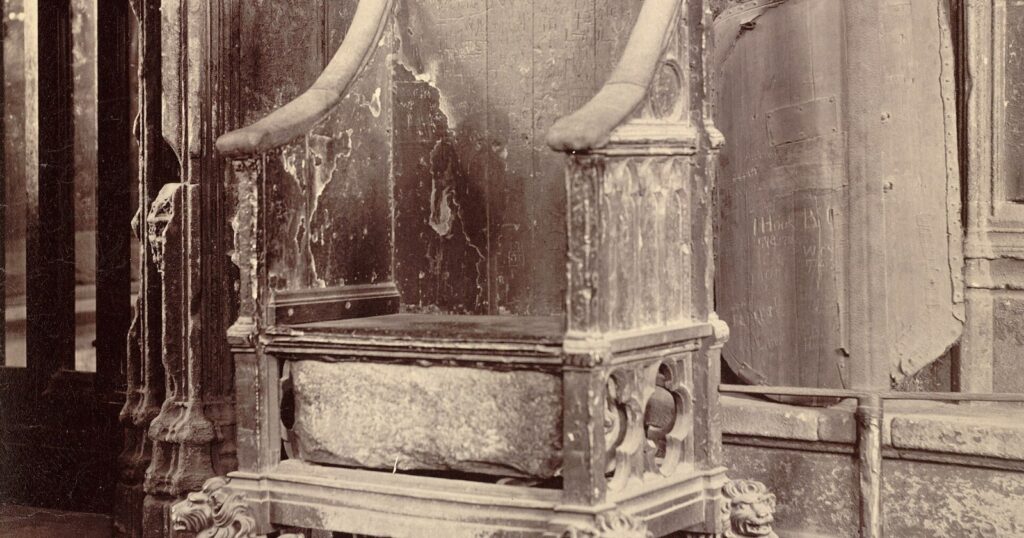
It was still dark on Christmas morning 1950 when three young Scots inside Westminster Abbey began working the Stone of Scone free from beneath the Coronation Chair. Edward I had brought the red sandstone block south from Scotland in 1296, and the chair was built to hold it a few years later. Ian Hamilton took hold of one of its iron rings and pulled, and a section came away from the main block. “We’ve broken Scotland’s luck,” Alan Stuart whispered, as Hamilton remembered it in No Stone Unturned, his 1952 book about the raid.
They took it anyway. The four students, Hamilton, Stuart, Gavin Vernon and Kay Matheson, got both pieces out of London, and by April 1951 the mended stone had been left at Arbroath Abbey by fellow nationalists. Police identified four suspects, and three of them gave statements admitting their own part. On 19 April 1951 the Attorney General told the House of Commons that he would not bring criminal proceedings. None of them was ever charged.
A courting couple in the dark
The four had driven down from Glasgow during the university Christmas holidays in two elderly Ford cars. Matheson stayed at the wheel of one, ready to drive off, while the three men went in.
The stone weighs about 152 kilograms (336lb) in all. Hamilton carried the smaller section, roughly 40 kilograms, out to Matheson’s car and draped a spare coat over it on the back seat. Then a police constable walked over. The pair passed themselves off as a courting couple looking for somewhere to stay, and he sent them on their way.
Vernon and Stuart, thinking they had been left behind, had already fled without the larger piece. That left Hamilton to go back and heave it into the boot of the car on his own, as BBC Scotland’s account of the night, republished by the University of Glasgow, tells it. The big piece was buried in open country near Rochester, in Kent. The small one ended up in a garage in Birmingham. At Hogmanay (New Year’s Eve), Hamilton, Stuart and two others drove back to Kent to dig the larger piece up.
A message left at Arbroath
Back in Scotland, the stone was handed over to other members of the Scottish Covenant Association. It was rejoined with metal fixings under the supervision of the stonemason and nationalist politician Bertie Gray.
Then, in April 1951, it turned up at the ruins of Arbroath Abbey. The choice was pointed. It was from Arbroath that Scotland’s barons sent their 1320 letter to the Pope, demanding freedom for their nation.
On 12 April the Home Secretary, Chuter Ede, told MPs that the stone “was deposited at Arbroath Abbey yesterday” and was now with the Glasgow police. The Clerk of the Works at Westminster Abbey, a man familiar with the stone, had examined it and confirmed it was the one taken from the chair. It went back to London, where, according to Westminster Abbey, it was kept in a vault and not returned to the chair until February 1952.
Why the four never stood trial
The Attorney General, Sir Hartley Shawcross, did not go easy on them in words. He called the stone’s removal and “the manifest disregard for the sanctity of the Abbey” “vulgar acts of vandalism which have caused great distress and offence both in England and Scotland”.
Then he declined to act. “I do not think, however, that the public interest requires that I should direct criminal proceedings to be taken.”
The Labour MP Emrys Hughes pushed him on it. Many Scots, Hughes said, saw the raid as an attempt to recover stolen property, and the four would have been well defended in court. “I confess that these considerations were not absent from my mind,” Shawcross replied. A jury’s verdict was impossible to forecast, he went on, “in cases where no actual dishonesty in the ordinary sense is involved”. And he had “no desire to provide these individuals with the opportunity either of being regarded by their followers as martyrs if convicted, or as heroes if they are not convicted.”
What the legend leaves out
Told as a caper, the story is tidy: four students, a broken stone, no charges. Each part needs a qualifier.
The stone did come apart in their hands, but probably not only because of them. When Hamilton shone his torch on the break, most of it was much darker than a thin rim along the top edge. “The Stone had been cracked for years, and they had not told us,” he wrote. Historic Environment Scotland’s 2018 imaging review records a vertical crack across the stone’s back face, with the stone worked differently on either side of it. The review gives no date for the crack, but it raises the possibility that it was found long before the raid: an attempt, at some unknown date, to cut a recess into the top of the stone “may have been abandoned following discovery of the crack”. Either way, the raid most likely split the stone along a weakness that was already there.
The students need a footnote too. Hamilton, Vernon and Stuart were at the University of Glasgow. Matheson was a student as well, though not at the university: she studied domestic science teaching at the “Dough School”, as her college was nicknamed.
As for the charges, not bringing any was a choice rather than a failure of detection. Police had statements from three of the four. The reasons Shawcross gave the Commons, an unpredictable jury and no wish to make martyrs or heroes, amounted, in effect, to a political judgement.
Was the stone that came back the one that left? Westminster’s own Clerk of the Works said so in 1951. The repair did leave loose ends of its own, though. Professor Sally Foster of the University of Stirling is tracing the stone’s fragments. She believes the work produced as many as 34 numbered pieces, most of whose whereabouts are unknown, STV News reported in January 2025.
Where to see it now
The stone stayed at Westminster until 1996, when the government agreed to send it back to Scotland. It left the Coronation Chair that November and went on display at Edinburgh Castle, apart from a brief trip south for the coronation of Charles III in 2023. Since 2024 it has been the centrepiece of the new Perth Museum on St John’s Place, which opened that March.
Entry to the museum’s permanent galleries and to its Stone of Destiny Experience is free. The stone is shown in timed sessions, which must be booked at the front desk, and visitors to the Experience have their bags checked. Anyone hoping to mark the anniversary in person should note that the museum is closed on 25 and 26 December 2026, and again from 1 to 12 January 2027.
In London, the Coronation Chair now stands in its own enclosure in St George’s Chapel, at the west end of the abbey’s nave. Its back is scratched with names carved by schoolboys and visitors in the 18th and 19th centuries, and, in the abbey’s own words, it “now stands empty after 700 years”. At Arbroath, the abbey ruins are looked after by Historic Environment Scotland, whose visitor centre tells the story of the Declaration of Arbroath in films and displays. The abbey closes from 25 to 28 December.
The stone still carried that Christmas night when Historic Environment Scotland imaged it. On its back face, the review found, the left-hand half sat 2 to 3 millimetres lower than the right, which it put down to “the very poor repair” of 1951. More than six decades after the repair, the two halves still did not quite line up.