
Drones flying over Witley Court in this summer’s heatwave picked out the outlines of lost Victorian flowerbeds around its Perseus and Andromeda fountain, and English Heritage is now recreating them at the mansion gutted by fire in 1937
Drone images taken over Witley Court in the summer heatwave revealed some of the outlines of lost Victorian flowerbeds, with planting due to start next year.
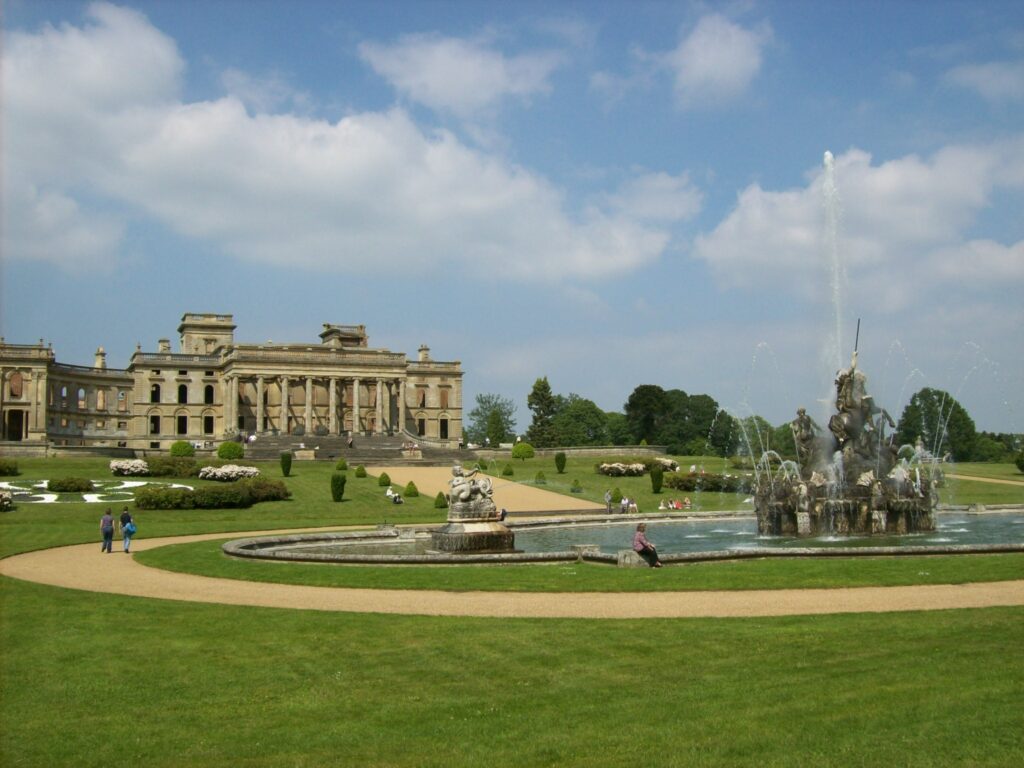
Drone images taken over Witley Court during this summer’s heatwave have picked out some of the outlines of the mansion’s lost Victorian flowerbeds, and English Heritage intends to start planting in their place next year.
The charity said it hoped to reinstate the embroidery-like flowerbeds around the site’s Perseus and Andromeda fountain at the ruined house at Great Witley, in Worcestershire. Aerial images taken by drones during the summer heatwave revealed some of their outlines and will be used alongside historical plans and sketches, BBC News reported on 16 November.
Parch marks from a July flight
The drone footage was taken in July and showed outlines, or parch marks, of the original flowerbeds. Hot, dry weather regularly exposes buried archaeology in Britain, because grass growing over stone, gravel or old cut beds browns at a different rate from the turf around it. The pale shapes are often clear from the air and almost invisible from the ground.
A one-week dig is exploring traces of William Andrews Nesfield’s design of 1850 to 1870, using a geophysical survey and the aerial photographs. The surveys revealed outlines of lost flowerbeds, including one measuring 6m (20ft) wide and 18m (59ft) long, a single bed roughly the footprint of a small house.
Archaeologists have uncovered buried bases for lost tazzas, the large ornamental urns that once stood among the beds, and a piece of patterned Bath stone. Researchers hope the stone will reveal the exact size of the urns, which would settle one of the details that plans and sketches do not record.
English Heritage said the work had brought together archaeologists, gardeners and volunteers on the same site, with the excavation evidence feeding directly into the planting design rather than into a report alone.
A garden built for show
Witley Court was once the home of the 1st Earl of Dudley and, according to English Heritage, was known for hosting glittering balls. Its gardens were created to impress by Nesfield, one of Victorian Britain’s foremost landscape designers, who was known for his complex patterns.
Those patterns were parterres of the French type, in which clipped edging and coloured gravels trace scrollwork that only reads properly from a terrace or an upper window. English Heritage said: “The parterres were designed to be viewed from above, providing an easy place to socialise with guests while admiring the beauty of the flowers.”
Mark Pardey, Witley Court’s head gardener, said: “This was very high Italian, ornate, high French – think Versailles. [It was] a show of exuberance, of wealth, decadence, [it said], ‘look at how fantastic this is, come and look at my gardens’.”
He said people would have been “desperate for invites” to see the spectacular garden. “At the time it was really avant-garde,” he said. “They would have been using plants that probably wouldn’t have been seen anywhere else or were so rare in the country that this was a real treat to come and see [them].”
That ambition ended with the house. The mansion was consumed by fire in 1937 and later saved by English Heritage, which keeps the shell and its gardens open to visitors. The ornamental planting went first, leaving the terraces, the stonework and the fountains as the main evidence of what Nesfield had laid out.
Planting due to start next year
Planting in Nesfield’s colourful style is due to start next year. Nothing has been put back into the beds yet. The current stage is survey, excavation and design: fixing where each bed sat, how big it was and what shape its edges took, using the drone images against the historic plans and sketches.
Pardey said elaborate Victorian planting was becoming a lost art, but the site’s gardeners and volunteers had the skills and enthusiasm to help revive it. Bedding on this scale is labour-intensive work, laid out and replaced by hand through the season, which is one reason few estates still attempt it.
English Heritage has carried out restoration work at Great Witley before, including about 20 years ago when it restored parts of the parterres and the fountain. Other historic gardens have been brought back from neglect as well, including Sissinghurst in Kent. The Perseus and Andromeda fountain, which sits at the centre of the beds now being traced, is the feature most visitors come to see, and the lost planting would have been arranged to frame it.
The new flowerbeds will be read against the surviving stonework rather than guessed at, which is why the tazza bases and the fragment of patterned Bath stone matter to the design team. The urns gave the parterre its vertical accents, and their size and spacing shape how the planting between them is set out.
Pardey said: “Gradually, we hope to restore more of Nesfield’s extraordinary landscape here at Witley Court for everyone to enjoy.”