
Carrots won’t help you see in the dark; Britain spread that idea during World War II to explain how RAF night fighter John “Cat’s Eyes” Cunningham kept finding German bombers, when his real secret was a new airborne radar
On the night of 19 November 1940, a twin-engined RAF Beaufighter climbed into the blacked-out skies over southern England. Somewhere ahead, a German bomber was heading inland. The pilot, 23-year-old John Cunningham, couldn’t see it. But the man sitting behind him, staring at a small glowing screen, could.
That night, Cunningham became one of the first RAF pilots to shoot down an enemy aircraft with the help of airborne radar. The public would soon hear a very different explanation for his success.
The Blitz by night
By the autumn of 1940, the Luftwaffe had switched much of its bombing campaign to the hours of darkness. Night raids were harder to stop. Fighters could patrol for hours without spotting a bomber, even when ground controllers knew roughly where it was.
Britain’s chain of ground radar stations along the coast could detect incoming raids, but it couldn’t guide a fighter close enough for the pilot to see his target in the dark. The answer was to put radar inside the aircraft itself.
A secret in the cockpit
The new equipment was called Airborne Interception radar, or AI. It let a crew member track an enemy aircraft on a small screen and direct the pilot towards it, until the pilot was close enough to see the bomber’s dark shape against the sky.
Cunningham flew with No. 604 Squadron, and for much of the war his radar operator was Jimmy Rawnsley. Together they became one of the RAF’s most successful night fighter teams. Cunningham finished the war with 20 victories, 19 of them at night.
The carrot story
The press nicknamed Cunningham “Cat’s Eyes,” suggesting he had remarkable night vision. The story that followed has become one of the best-known tales of the war: British officials told newspapers that pilots like him owed their success to eating plenty of carrots.
Carrots contain beta carotene, which the body turns into vitamin A, and a severe lack of vitamin A can cause night blindness. So the claim sounded believable. The idea, as the story goes, was to explain the RAF’s sudden success while keeping the radar secret.
Did it really fool the Germans?
Historians are doubtful. Germany had its own radar, knew Britain had ground stations, and was unlikely to be surprised that radar could be fitted to aircraft. Bryan Legate, an assistant curator at the RAF Museum, has said German intelligence wouldn’t have been surprised by airborne radar at all.
There are apocryphal stories of Germans feeding their own pilots extra carrots, but little evidence that the trick changed anything. Even John Stolarczyk of the World Carrot Museum, who has researched the story, has said he isn’t certain exactly where it started.
The campaign at home
Where the carrot message really took hold was in Britain itself. With food imports cut and rationing in place, the Ministry of Food wanted people to grow and eat more vegetables. Carrots were plentiful and could be grown at home, so they became a star of the Dig for Victory campaign.
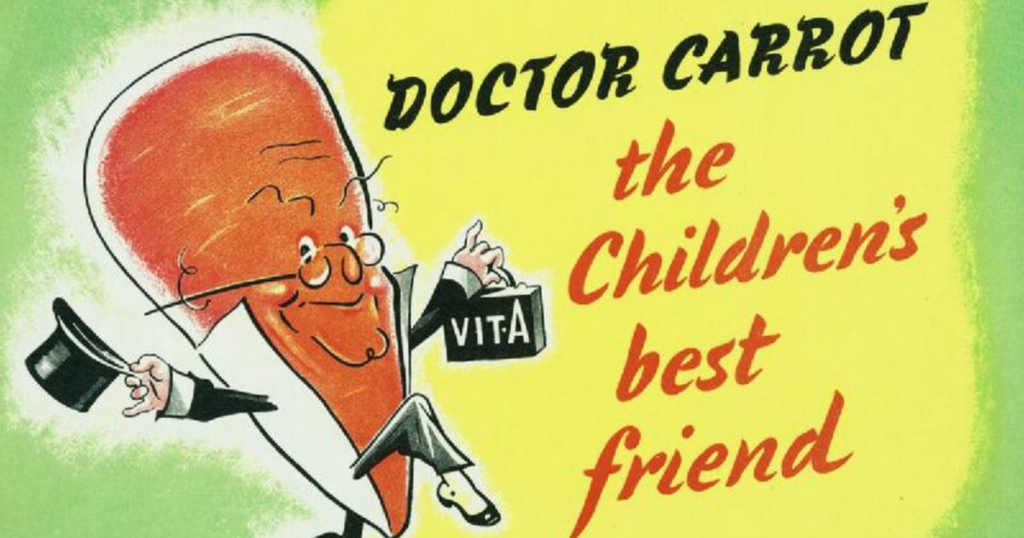
Posters claimed that carrots kept people healthy and helped them see in the blackout. The ministry introduced a cartoon mascot called Doctor Carrot and published recipes for carrot cake, carrot jam and even carrot fudge. The campaign worked so well that by 1942 Britain had a surplus of around 100,000 tons of carrots.
What carrots really do
Carrots are good for you, and vitamin A is important for healthy eyes. But for people who already get enough vitamin A, which most people in Britain today do, eating more carrots won’t improve night vision. Your eyes will adapt to darkness at the same pace whether you eat one carrot or ten.
Cunningham went on to a remarkable career after the war. As chief test pilot at de Havilland, he flew the world’s first jet airliner, the Comet, on its maiden flight in 1949. He died in 2002, still remembered as “Cat’s Eyes,” a nickname built partly on a vegetable myth that has outlived nearly everyone who flew in those night skies.