
In 1968, Jimi Hendrix moved into a Mayfair flat at 23 Brook Street, next door to the house where Handel wrote Messiah in 1741; today the two homes are one museum
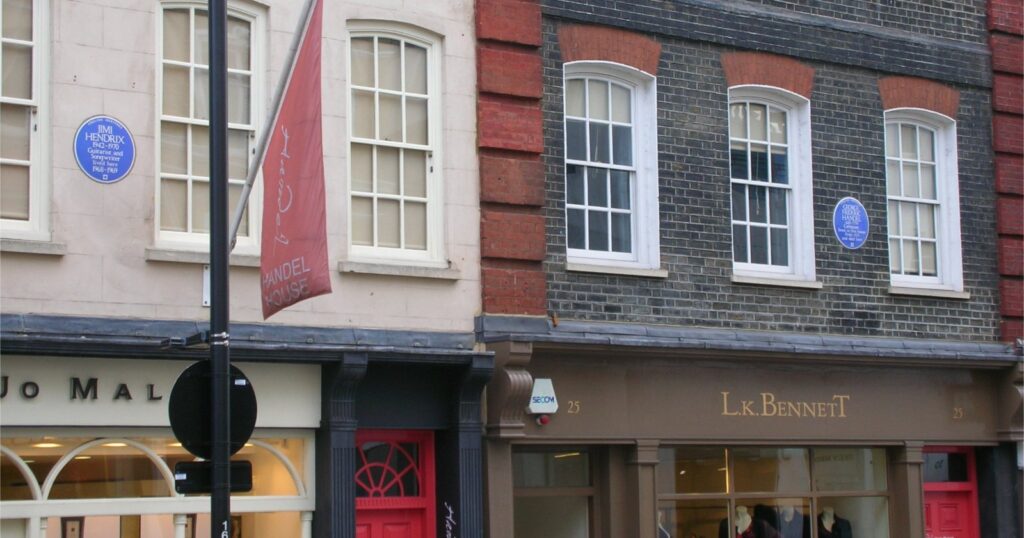
Brook Street in Mayfair is mostly smart shopfronts and offices now, a few minutes’ walk from Bond Street station. Two front doors on it, numbers 23 and 25, carry blue plaques side by side. One is for a German-born composer who died in 1759. The other is for an American guitarist who died in 1970. They never met, and their years on Brook Street were more than two centuries apart, but they lived on opposite sides of the same wall.
Handel’s house
George Frideric Handel moved into 25 Brook Street in July 1723 and stayed there until his death 36 years later, according to English Heritage. It was a working home. English Heritage says the house was where “he composed his best-known work, the oratorio Messiah (1741).”
Handel went on living and composing at Brook Street for almost two more decades after Messiah. He died in the house in 1759, at 74.
Hendrix next door
More than 200 years later, the upper-floor flat at number 23 became Jimi Hendrix’s home. He had arrived in London in September 1966, brought over by his manager, Chas Chandler. Historic England says he lived at 23 Brook Street “briefly from July 1968 to March 1969.”
Getting the flat was not easy. His girlfriend at the time, Kathy Etchingham, lived there with him and later recalled how estate agents reacted when they learned who the tenant would be. “As soon as they heard it was for Jimi Hendrix, it was a NO,” she told Channel 4 in 2016, in remarks quoted in a 2020 report. “They didn’t want somebody like him in their blocks of flats.” Etchingham furnished the place herself, partly with things bought at John Lewis on Oxford Street.
Hendrix took to it. Christian Lloyd, a historian, said Hendrix considered it his first “real home.”
He did not spend much of that year in London, but for a stretch the flat was the center of his life. According to the museum, for about three months he used it as his base, “giving interviews there, writing new songs, and preparing for his February concerts at the Royal Albert Hall.” The clubs where he liked to sit in, among them the Marquee and the Speakeasy, were a short walk away.
A ghost in the mirror
Hendrix knew who his old neighbor was. When he found out that Handel had lived next door, the museum says, he went with Etchingham to the One Stop Record Shop on South Molton Street “and bought some classical albums,” including recordings of Messiah and the Water Music.
There was some confusion about exactly where Handel had lived. According to AFP, a plaque for the composer was at the time fixed between the two buildings, so Hendrix believed they had lived in the same house. Lloyd has noted that Hendrix once thought he saw Handel’s ghost in a mirror.
Two plaques, one museum
Hendrix left Brook Street in 1969. His time at number 23 was recognized in 1997, when English Heritage put up a blue plaque beside Handel’s. A museum devoted to Handel opened across numbers 23 and 25 in 2001.
The Hendrix flat opened permanently to the public in February 2016, according to the museum.
The museum closed for a full restoration in 2021 and reopened in May 2023 as Handel Hendrix House. Gramophone reported that the project cost £3 million. Handel’s rooms were restored down to the curtain colors and ironmongery, and the kitchen’s pots and pewter plates were remade using 18th-century techniques. Hendrix’s flat, recreated for its 2016 opening, is based on photographs from 1969.
The two homes now make up a single museum. Visitors can stand in the rooms where Messiah was written, then walk next door into the flat of the man who bought a copy of it from a record shop around the corner.