
The owner of a Cotswold estate fled to France in 1812 to escape his creditors, and the economist who bought it two years later with a stock exchange fortune enlarged the house Princess Anne lives in today
David Ricardo made his money on the Stock Exchange and in 1814 bought a Gloucestershire estate whose owner had fled his creditors. The legend says Waterloo paid for it. The dates say otherwise, and the house he enlarged is now the Princess Royal's home.
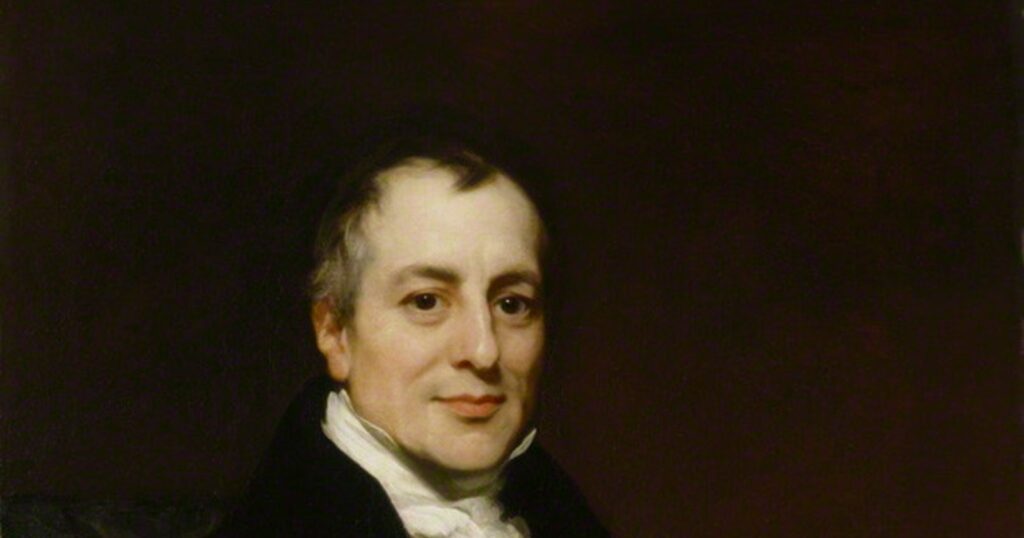
“I believe that in this sweet place I shall not sigh after the Stock Exchge. and its enjoyments.”
David Ricardo added that postscript to a letter he sent the economist Thomas Malthus on 25 July 1814, the day after he arrived at Gatcomb Park, near Minchinhampton in Gloucestershire. He had made his fortune as a Stock Exchange jobber and government loan contractor, and he was making his name as an economist. Now he had a country estate.
Its previous owner, Philip Sheppard, had fled to France in 1812 to get away from his creditors. Ricardo had the house enlarged around 1820, and Gatcombe, as it is spelled today, is Princess Anne’s home.
Summer 1814
Ricardo arrived on the afternoon of 24 July with his second daughter, Priscilla, “Sylla” in his letter. The rest of the family stayed in London. He was “as happy as I can be separated from the whole family”, he told Malthus, though he was “surrounded by upholsterers, carpenters, &a.” His wife was “unwilling to bring the children here till the whole house is perfectly arranged.”
Ricardo kept a foot in the City. “I have not quite given up the Stock Exchange,” he wrote to John Sinclair that October, “but for a few months in the year, I mean to enjoy the calm repose of a country life.” He had a few acres in hand, he added, but was “not yet become a farmer.”
James Mill, the philosopher, had not yet seen the place when he wrote in November. A Mr Hume had come to the gate meaning to visit, Mill reported, but turned back at the lodge on hearing the Ricardos had left for London that morning. Hume described “a large, elegant, modern built house, standing in a hollow”, and understood the estate to be “a very good purchase”. Mill added a warning of his own: if Ricardo farmed it himself, he would “but lose money by that.” In December the French economist Jean-Baptiste Say came to stay.
Waterloo and the money
A popular account of Ricardo’s life says he paid for Gatcombe by speculating on Waterloo. The often-quoted form of the claim comes from an obituary in the Sunday Times in September 1823, which suggested he had “netted upwards of a million sterling”. The story appears in books as recent as 2016, according to Wilfried Parys, an economist at the University of Antwerp who has gone through Ricardo’s finances in the archives, the Bank of England’s stock ledgers among them.
Waterloo was fought on 18 June 1815, nearly a year after Ricardo moved in, and the purchase had been agreed earlier still. In a 2020 working paper, Parys quotes a deed of covenant drawn up in June 1814, citing David Weatherall’s 1976 biography of Ricardo. It begins: “Whereas sometime in the year 1813 the said Philip Sheppard agreed with the said David Ricardo”. Ricardo’s plan for a country life, Parys concludes, was in place by 1813, the year of two very profitable government loans.
That working paper is our source for the deed, the obituary’s wording and the stock ledgers. The peer-reviewed version, published in the Cambridge Journal of Economics in 2024, is paywalled, and we read only its abstract. That abstract says the 1815 loan brought Ricardo “exceptional profits”, but not the million sterling of the legend.
Ricardo described his Waterloo summer himself. Writing to Malthus on 27 June 1815, he called himself “a considerable gainer by the loan”. He had bought back stock he sold before the contract, and made “a moderate gain” on his extra share, which he sold “at a premium of from 3 to 5 pct.” Those sales, Parys points out, came before the official news of Waterloo reached London, too early for the best profits.
The sources also differ on the year of the purchase. The 1896 Dictionary of National Biography has Ricardo buying Gatcombe “about the end of 1813”, while Historic England and the Victoria County History give 1814. On the deed’s evidence, the agreement came in 1813 and the deed followed in June 1814.
Philip Sheppard’s debts
The Sheppards had held the manor of Minchinhampton since 1656. Edward Sheppard, a clothier, began the house at Gatcombe in 1771, and Historic England’s register entry says he built it “to reflect the family’s new-found wealth”.
His son Philip inherited it in 1803 and lived beyond his means. The Victoria County History of Gloucestershire says his “extravagance led to the piecemeal selling” of parts of the estate. In 1812 he fled to France, and in 1814 he sold the manor to “David Ricardo, the political economist”.
Around 1820 the architect George Basevi added bow-fronted wings for Ricardo, and in the same period a curved iron conservatory and stables round an oval yard were built. Historic England says the house has changed little since the 1820s.
Ricardo served as sheriff in 1818. Early in 1819 he became MP for Portarlington, an Irish borough of about twelve constituents. He had never been to Ireland, and the Dictionary of National Biography says he “probably bought the borough”. The novelist Maria Edgeworth stayed at Gatcombe in 1821, and the same entry, drawing on her letters, says she found a “delightfully pleasant house” and a host who joined in the charades.
What he left behind
Ricardo was at Gatcombe in September 1823, working on a plan for a national bank, when an old ear complaint turned serious. He died on 11 September, aged 51. His second son, David, inherited the estate, and by 1839 most of the land Philip Sheppard had sold off had been bought back. The Ricardos held Gatcombe until the late 1930s. It then passed from Samuel Courtauld to his son-in-law, Rab Butler, who sold it to the Queen in 1976 for Anne and Captain Mark Phillips.
Ricardo’s own account of those first years at Gatcombe is free to read. Piero Sraffa’s edition of his correspondence is online at the Online Library of Liberty. In volume six, start with letter 53, his 25 July 1814 letter to Malthus, then read James Mill’s letter of 24 November.