
A 20-foot statue of Freddie Mercury stood over London’s Dominion Theatre for 11 years; when We Will Rock You closed in 2014, Queen drummer Roger Taylor had it trucked to the garden of his Surrey home
The gold statue of Freddie Mercury went up on the Dominion Theatre in June 2003, came down in 2014 and ended up in Roger Taylor's Surrey garden.
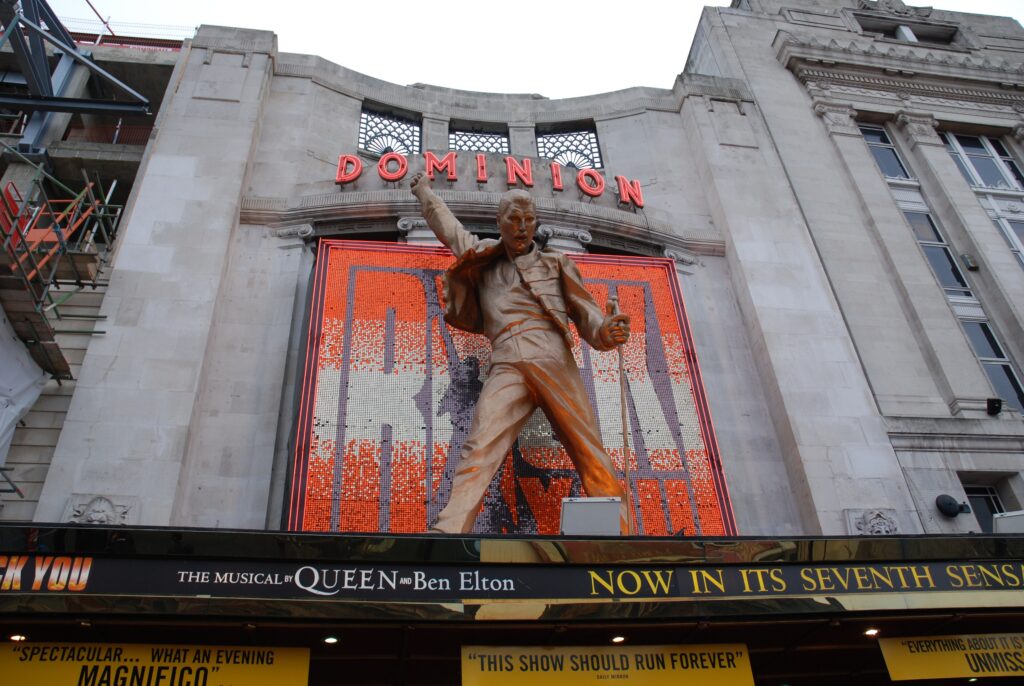
A gold statue of Freddie Mercury, usually described as 20 feet tall, stood on the canopy of the Dominion Theatre in London from June 2003 until the Queen musical We Will Rock You closed there on 31 May 2014. Within months it was in the Surrey garden of Queen’s drummer, Roger Taylor, who says he had it put on a lorry and brought to his house.
Most accounts say the statue stood for 12 years. The show did; the statue did not. A report dated 10 June 2003 describes it being lifted into place on a Saturday morning, an operation that took two hours and closed part of Tottenham Court Road, with the unveiling set for 18 June to mark the show’s first year. Agency photographs of the installation are dated 15 June, a few days later than that report, but both place it in June 2003. Opening night had been 14 May 2002.
The height is not settled either. The 2003 report, citing the website Brianmaynews.com, gave eight metres, or about 27 feet. The Independent, writing in the show’s final week, called it a 20ft-tall gold statue, and that is the figure most reports have used since.
Modelled on Montreux
The figure is based on Irena Sedlecká’s bronze of Mercury in Montreux, Switzerland, which is about 10 feet tall. The Daily Telegraph’s obituary of the sculptor says her statue served as the model for the large illuminated figure outside the Dominion. Later reports disagree about what the London version is made of: some call it bronze, others fibreglass.
The theatre had a link to Mercury before the musical. Londonist notes that he made his final public appearance at the Dominion, at the 1990 Brit Awards, the year before he died.
We Will Rock You, written by Ben Elton with May and Taylor, played 4,600 performances at the Dominion to 6.6 million people, by the Independent’s count. As the run ended, a planning statement lodged with Camden Council on the theatre’s behalf, dated 30 April 2014, asked to replace the statue and the show’s signage with an LED screen on the canopy.
A lorry to Surrey
In November 2014 Elton told Radio Times where the statue had gone. It was in Taylor’s garden, he said, and May was not happy about it. “So, Roger stole Freddie from Brian,” he added, in remarks reported by WhatsOnStage.
Taylor’s own version is less dramatic. He told Classic Rock in 2021 that he had asked the show’s producer, Phil McIntyre, where the statue was, learned it was in a warehouse and costing money to store, and suggested they “put it on a lorry” and bring it to his garden. He said May was annoyed not to have thought of it first, and that Mercury would have found the whole thing funny.
The planners take an interest
A 20-foot gold figure in the grounds of an 18th-century house did not go unnoticed. Londonist reported that Guildford Borough Council’s planners took issue with its size, and NME said in 2021 that Taylor had faced a dispute with planners after first putting it in his rockery. By then he was reported to be seeking permission for a wider redesign of the garden, with the statue as its centrepiece.
The Dominion reopened in September 2014 after a refurbishment. The theatre’s own history still credits the statue with making the building famous. When We Will Rock You returned to London in 2023, at the Coliseum, a new statue was built for it.
Other pieces of Mercury’s life have moved on too. The Yamaha baby grand he wrote Bohemian Rhapsody on was sold at Sotheby’s, and the Kensington mansion he bought in 1980 passed to his friend Mary Austin.