
John Lennon had his black Rolls-Royce painted in psychedelic flowers in 1967, gave it to a museum a decade later to cover a $250,000 tax bill, and in 1985 a Canadian billionaire paid $2.29 million for it, then a record for a car at auction
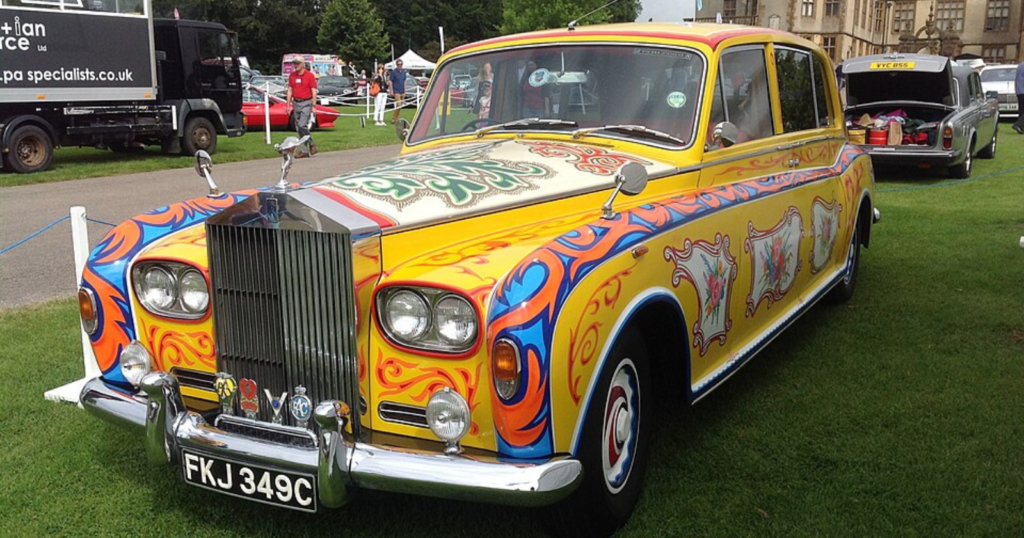
In the spring of 1967, a coachbuilding firm in Chertsey, Surrey, took delivery of a gleaming black Rolls-Royce limousine. Its owner, John Lennon, had a plan for it that would horrify traditional Rolls-Royce fans.
A few weeks later, the stately car rolled out painted bright yellow and covered in swirling red, orange, green and blue scrolls, flowers and a zodiac sign on the roof. It became one of the most famous cars of the 1960s.
A Beatle’s limousine
Lennon ordered the Rolls-Royce Phantom V in December 1964 and took delivery in June 1965. At the time, he didn’t even have a driving licence, and he hired a chauffeur to drive him around.
The Phantom V was one of the grandest cars of its era, used by royalty and heads of state. Only a few hundred were built. Lennon’s had a black finish, a television, a telephone, a fridge and a record player. In October 1965, the Beatles rode in it to Buckingham Palace to receive their MBEs from the Queen.
From black to bright yellow
By 1967, the Beatles were moving into their most colourful period, and the sober black paint no longer suited Lennon’s taste. He took the car to J.P. Fallon Ltd in Chertsey, near his home at Kenwood in Weybridge, Surrey.
The car was sprayed bright yellow, and local artist Steve Weaver painted ornate decorations over it. The design was inspired by traditional Romany caravans, though it’s usually described as psychedelic. Lennon received the car in late May 1967, around the time the Beatles released Sgt. Pepper’s Lonely Hearts Club Band.
Shocking the establishment
The car caused a sensation. Many saw it as an insult to one of Britain’s most respected brands. According to one well-known story, an older woman was so outraged when she saw it in London that she hit it with her umbrella.
For fans, it summed up the spirit of 1967, the Summer of Love, when the Beatles were reshaping pop music and fashion. The Rolls was lent to other musicians, including the Rolling Stones and Bob Dylan, and became a symbol of the era.
A tax bill and a museum
Lennon moved to New York in 1971, and the car was shipped to the United States. By then, he used it rarely, and it spent long periods in storage.
In 1977, Lennon and Yoko Ono had problems with the US tax authorities. They donated the car to the Cooper-Hewitt Museum, the Smithsonian Institution’s design museum in New York, in exchange for a tax credit of about $250,000. The museum displayed it for a time before it went back into storage.
A record-breaking sale
In June 1985, the Cooper-Hewitt Museum put the car up for auction at Sotheby’s in New York. The auction house expected it to sell for around $200,000 to $300,000.
Instead, bidding soared. The winner was Jim Pattison, a Vancouver businessman who owned the Ripley’s Believe It or Not museums, and he paid $2,299,000. At the time, it was the highest price ever paid for a car at auction. Pattison displayed it in a Ripley’s museum and later at Expo 86 in Vancouver.
The car today
In 1993, the car was donated to the Province of British Columbia, and it has since been looked after by the Royal BC Museum in Victoria. It has been shown in exhibitions around the world, including a return to Britain for displays.
Nearly 60 years after it left a Surrey workshop, the yellow Rolls-Royce is still one of the best-known cars in music history. It’s a reminder of a time when a Beatle could turn a symbol of British tradition into a piece of pop art, and change how people saw both.