
In 1965, Ringo Starr paid £37,000 for a mock-Tudor house in Surrey less than a mile from John Lennon’s and built a bar in it called the Flying Cow, because he had always wanted a pub
Ringo Starr's first house had its own pub, the Flying Cow, with a till, a little sink and a plaque of a cow with wings. "I've always wanted a pub, from movies I think," he said.
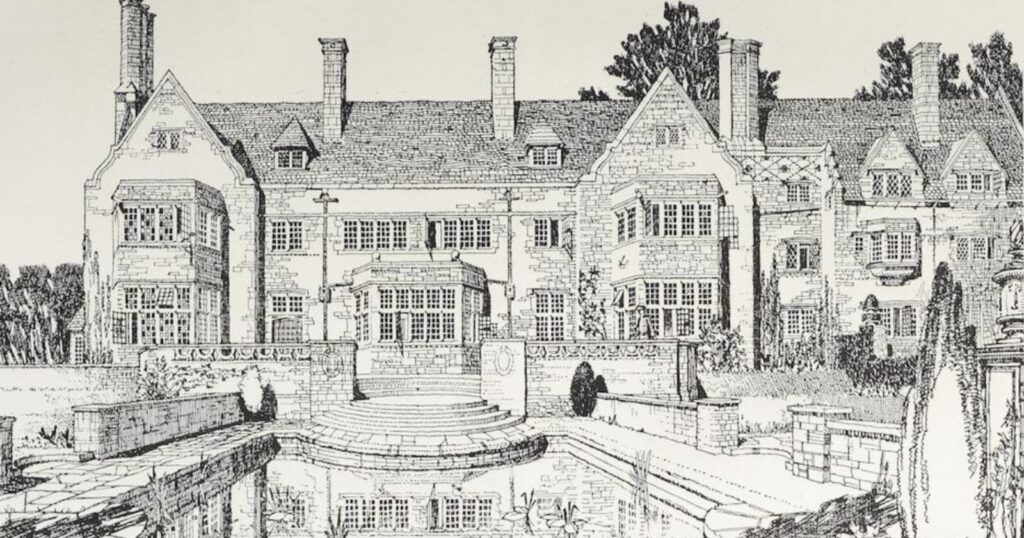
Ringo Starr’s first house had a pub in it. It was called the Flying Cow, and it had its own till. What Starr liked doing best, a visiting reporter wrote in 1966, was sitting in it on a high stool.
The place was Sunny Heights, a mock-Tudor house on St George’s Hill, a private estate in Weybridge, Surrey. Starr and his wife, Maureen, bought it in July 1965. It cost £37,000, according to Hunter Davies, the Beatles’ authorised biographer, who was writing in 1968 while the couple still lived there. John Lennon’s house, Kenwood, was on the same estate, less than a kilometre away by Davies’s later reckoning.
Lennon had moved to St George’s Hill the year before, and George Harrison lived nearby at Kinfauns, in Esher. Paul McCartney was the one Beatle who stayed in London.
Behind the bar
The journalist Maureen Cleave visited Weybridge for a profile in the Evening Standard‘s series How a Beatle Lives, published in March 1966. She found Starr at the bottom of the hill that Lennon lived on top of, in a home that was “large and Tudor-ish”. The garden had a goldfish pond, a tree house and an old air-raid shelter. Starr liked to call all this “the grounds”, and he showed her round with a silver-topped walking stick in one hand, pushing his baby son, Zak, in his pram with the other. The roof was stuck all over with television aerials so that he could get four channels. “I get all my knowledge from TV,” he said.
The bar, she wrote, was “an admirable place called the Flying Cow”. A plaque of a specially designed cow with wings hung on some antlers inside the door. There was a till, a little sink, cigarettes in packets and whisky bottles upside down on the walls. “I’ve always wanted a pub, from movies I think,” Starr said. What he would like was for about 15 friends “to pop in here without being asked, without me being here even”. He still wished it were a real pub. “My mother was a barmaid once,” he said.
The pub even had its own telephone. While Cleave was there, George Harrison’s wife, Pattie, came through on it, and Lennon arrived with his son, Julian. Dinner was cooked by one of the workmen who were finishing off the house.
Cynthia Lennon remembered the room in her memoir, John: a replica pub in the front room, with a counter and till, tankards, mirrored walls and a pool table. “He’d nip behind the bar to serve us all drinks,” she wrote.
Writing in 1968, Davies described a place with more area than Lennon’s, “with lots of trees, shrubs and expensive landscaping”. It was not cheap, either. Rebuilding one semicircular wall had brought in a bill for £10,000, “to Ringo’s amazement”, and Starr shuddered to think what he had paid for a deep brown carpet made in one piece to cover the whole drawing room. In the bar was a cowboy holster that Elvis Presley had given him.
It was a family house, too. Zak had been born in September 1965, and Jason followed in August 1967. Pop records and television were on all the time, and there were six TV sets. In 1967 the grounds also became one of the locations for Magical Mystery Tour.
Having a bar of his own did not cure Starr of real pubs. Davies told of a night when Starr and Lennon were driving back from London in Lennon’s Rolls-Royce and passed a pub “all lit up”. When they got home, they changed and went out for a drink. “We had a bottle of brown [ale] each,” Starr said. “We had to sign a few autographs, but it wasn’t too bad.”
Three figures for the building work
The £37,000 is the steadiest number in the story. Davies gave it in 1968, and later books repeat it. What Starr spent on the house afterwards depends on whom you read. Davies put the work at “another £40,000”. Craig Brown, in his 2020 book One Two Three Four, has a further £53,000, and a sale four years later for £47,000. Michael Seth Starr’s 2015 biography says the renovations “ended up costing Ringo £90,000”. None of the passages we could read cites a deed, a bill or a sale record, so there is no way here to say which figure is right.
Even the date has a wrinkle. Later references, including Davies’s own The Beatles Book and the Beatles Bible, give 24 July 1965, which was a Saturday. “I bought this house on a Monday,” Cleave reported him saying, though she added that he was less prepared to tell you the week, month or year. Neither Starr nor Cleave says which stage of the sale he meant.
Leaving the hill
In November 1968, according to Davies’s later The Beatles Book, Starr and Maureen bought Brookfield, Peter Sellers’ country house in Elstead, and left the hill. Brookfield has its own story, including the account that Sellers turned down a bigger offer from Lennon; that article also notes that accounts of when Starr bought it differ. Lennon and Yoko Ono stayed at Sunny Heights for a short time after Lennon left Kenwood, and Sunny Heights was sold in May 1969.
The house was later renamed Summer Haze. In 2015 the Daily Mail reported that its owner, Vladimir Scherbakov, a former deputy prime minister of the Soviet Union who had bought it in 2013, had permission from Elmbridge Borough Council to knock it down and build a new one.
The bulldozers had still not come when Spear’s reported from St George’s Hill in May 2025. By then Scherbakov had died, in 2017, and his estate had been fought over in the High Court. The gates were chained shut and covered in creepers, and the place appeared to have stood empty for years. The magazine reported no plans for it. Behind those gates, when Spear’s looked, stood the house where a Beatle once kept a pub of his own. What becomes of it is up to whoever opens them next.