
In 1906, George Bernard Shaw rented a Hertfordshire rectory the Church of England thought too big for its parish. He bought it in 1920 for £6,220 and wrote many of his major plays in a 64-square-foot hut at the bottom of the garden that turned to follow the sun
On March 20, 1913, the Inland Revenue’s Valuation Office surveyed a house in the Hertfordshire village of Ayot St Lawrence. It was recorded as “Rectory House,” and the surveyor’s field book noted that the land was “let by the Rector to Bernard Shaw.” Shaw, by then one of the best-known playwrights in Britain, was renting the parish’s rectory.
A rectory the parish didn’t need
The house was new. According to the National Trust, which now owns it, the Church of England built it in 1902 as the New Rectory for Ayot St Lawrence, in the Arts and Crafts style, with stained-glass windows and hearts cut into the banisters.
It did not serve as a rectory for long. Within a few years it was “considered too large for the size of the parish,” according to TheGenealogist, which has examined the 1913 survey records. In 1906 the Church offered it for rent, fully furnished.
The timing suited the Shaws. Bernard Shaw and his wife, Charlotte Payne-Townshend, had just left a house in nearby Welwyn and were, as he put it in a letter to H.G. Wells, in “the agonies of house hunting.” They took the rectory that year.
The 1913 survey gives a sense of what they were renting: three reception rooms, three bedrooms on the first floor, maid’s accommodation on the second, a kitchen, scullery and coal cellar, and a “motor garage in the garden.” The plot came to just over two and a half acres.
From tenant to owner
The village took a while to warm to them. The National Trust says villagers “had reservations about their famous neighbour” until 1915, when Shaw helped clear the roads after a bad storm. Locals had started calling the place Shaw’s Corner soon after the couple arrived.
In 1920 the Shaws bought the house outright, and the nickname became its official name. The price is usually given as £6,220, the figure TheGenealogist cites for the house and its land. The National Trust’s own timeline puts it slightly higher, at £6,332.
In 1923 the garden grew, with an extra strip of land to the west and south. TheGenealogist notes that Shaw bought land from his neighbor Apsley Cherry-Garrard, a member of Captain Scott’s Terra Nova expedition to Antarctica. Shaw had encouraged him to write his account of it, The Worst Journey in the World, published in 1922.
The hut that turned
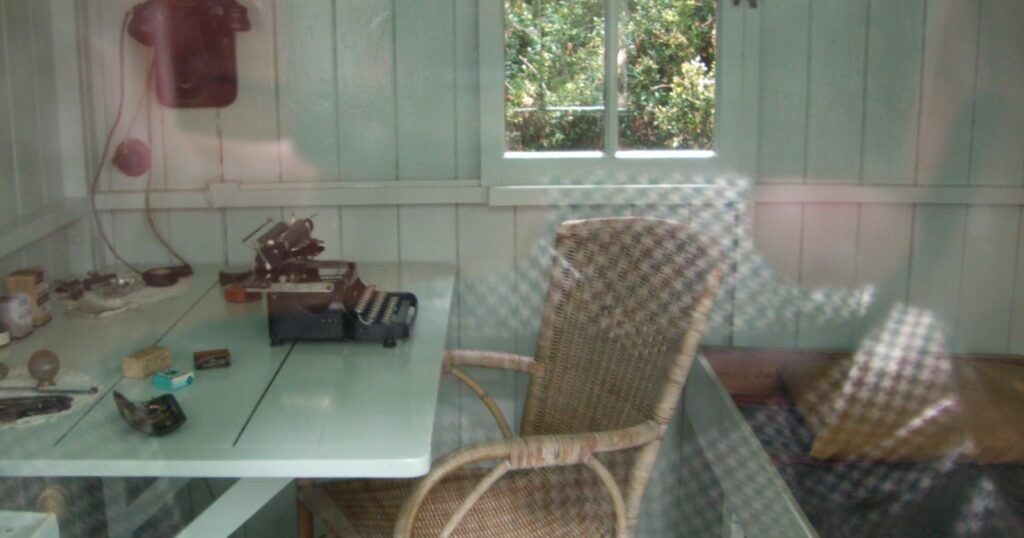
Much of Shaw’s writing at Ayot St Lawrence didn’t happen in the house at all. It happened in a shed at the bottom of the garden.
The National Trust’s garden guide says the hut “was mounted on a revolving mechanism so that as he worked, Shaw could follow the sun throughout the day,” and that “he wrote many of his plays” there.
It also had a name. Shaw called the hut “London,” Open Culture reports, so that anyone who turned up at the house looking for him could be told, truthfully, that he was in London.
Quoting Alex Johnson of The Idler, the site describes it as “a six-square-meter wooden summerhouse,” about 64 square feet.
44 years in Ayot St Lawrence
After Charlotte’s death, Shaw left the property to the National Trust in 1944. He died in the house’s dining room on November 2, 1950, and on March 17, 1951, the house opened to the public. He had lived there for 44 years, the first 14 of them as a tenant.
The hut is still at the bottom of the garden.