
When London Zoo sold Jumbo the elephant to P.T. Barnum for £2,000, the Daily Telegraph cabled him that Britain’s children were distressed and asked his price to give him back, and Barnum said £100,000 would not do it
British children did write to save Jumbo in 1882. Their letters went to Barnum and the zoo, and the Daily Telegraph's cable in their name drew the showman's answer.
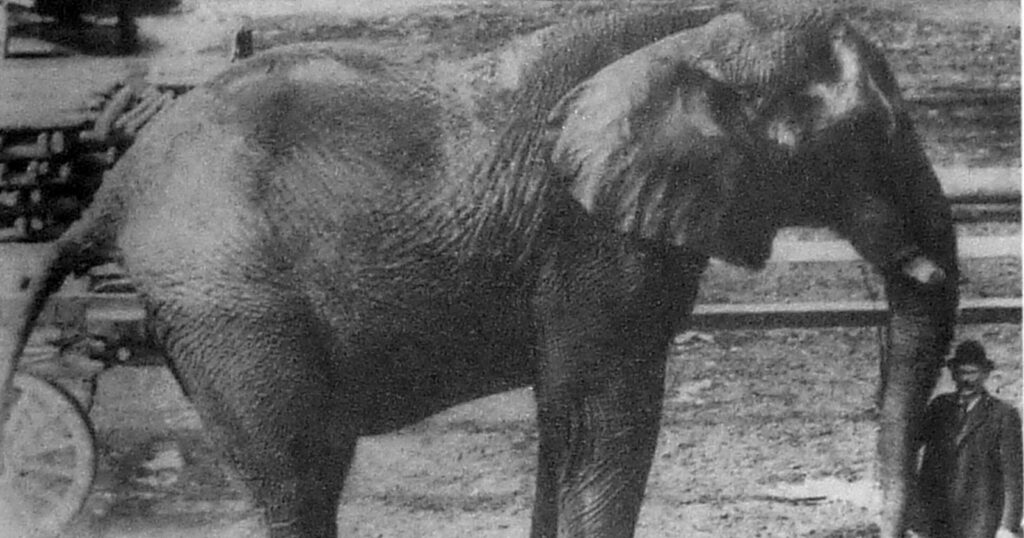
“All British children distressed at elephant’s departure.”
That was the Daily Telegraph’s message to P.T. Barnum, cabled to New York in late February 1882. The elephant was Jumbo, London Zoo’s biggest star, and the zoo had just sold him to the American showman for £2,000. The cable went on: “Hundreds of correspondents beg us to inquire on what terms you will kindly return Jumbo. Answer prepaid, unlimited.”
Barnum answered at length and later printed the exchange in his memoir. Among the compliments and the advertising for his circus sat one plain line: “Hundred thousand pounds would be no inducement to cancel purchase.”
Why the zoo sold him
Jumbo arrived at the Zoological Society of London’s gardens in Regent’s Park on 26 June 1865. He was a sickly young African elephant, sent from the Jardin des Plantes in Paris. According to ZSL’s own account, his keeper, Matthew Scott, nursed him back to health. He grew into the largest elephant many visitors had ever seen, and gave children rides around the gardens on his back.
His nights were another matter. As he matured he turned aggressive after dark, which the zoo put down at the time to musth, the hormonal surge adult bulls go through. ZSL now notes that later research points to painful, misshapen teeth.
That made the superintendent, Abraham Bartlett, receptive when one of Barnum’s agents asked if Jumbo was for sale. The accounts disagree on how quickly he said yes. Barnum wrote that Bartlett first turned the agent down and came round when pressed. In John Sutherland’s biography of Jumbo, published in 2014, Bartlett “leapt at it” and telegraphed “Will sell him for £2,000”. Barnum’s agent carried a bank draft for that sum to London, and the sale was public by late January 1882.
The elephant who would not leave
Getting Jumbo out of Regent’s Park proved harder than selling him. An iron-bound crate was built and set on wheels, and in February he was led up to it. He refused. The next day he refused again.
Next they tried walking him out through the gates towards the ship. The Telegraph’s report of that attempt, reprinted in 1886 by the American naturalist Charles Frederick Holder in The Ivory King, described the elephant moaning, wrapping his trunk around Scott and “actually kneeling before him.” He was taken back to his house. Holder himself thought the press was giving his movements “a significance which in all probability they did not have.”
Public anger, Holder wrote, broke out “with renewed fury.” Crowds came to the zoo to see Jumbo before he went, and Barnum later estimated the zoo’s extra takings at thousands of pounds. It was in this mood that the Telegraph sent its cable to New York. When Barnum’s reply came, the paper printed it, and a day later conceded in a leader: “Jumbo’s fate is sealed.”
Letters to a showman
Children did write. Holder printed several letters sent to Barnum by “the young folks”, as he called them, selected “from the hundreds of such.”
Gertrude Cox wrote from Liverpool on 7 March. “There are plenty of other elephants,” she pointed out, and asked whether he might take one “that does not mind going.” Another correspondent, who signed herself “A young English girl”, assured him that the parents of her city would help pay back his money, with something extra for his expenses.
Ninety pupils at a school on the Edgware Road petitioned the zoo instead. The zoo’s secretary, Philip Sclater, wrote back on 2 March to “Miss E. V. Nichols and her companions”. The superintendent, he said, knew best which elephants were suitable, and “There are still three elephants left in the gardens, upon which we hope you will have many rides in future.”
Adults weighed in too. John Ruskin, a life fellow of the society, used a letter to the Morning Post, published on 25 February, to disown the council’s decision as “disgraceful to the city of London and dishonourable to common humanity.” His letter also had a suggestion for the children: “pay their pence, and make Jumbo their own for ever.”
Some fellows went to court to stop Barnum removing him. As the Spectator reported, the application failed because the council had always bought and sold animals and had ratified this sale. On 10 March the MP Henry Labouchere raised the matter in the House of Commons, asking about “the uncertain temper of the elephant” and about shipping him on a line of steamers that usually carried emigrants.
The hundred thousand letters we could not find
The version of this story that gets passed around today has a bigger number in it. About 100,000 schoolchildren, it says, wrote to Queen Victoria begging her to stop the sale. The figure appears in news features, on history websites and in the publisher’s description of Sutherland’s book.
We could not find where it comes from. Barnum’s memoir mentions “scores of letters from ladies and children”, sent to him, but gives no figure, and Holder mentions no letters to the Queen. A search of the Internet Archive’s copy of Sutherland’s book found no passage giving the figure. On Wikipedia the claim rests on a single note, and that note describes a 1960 historical novel, Gillian Avery’s The Elephant War. Paul Chambers’s 2008 biography of Jumbo, which we have not seen, may yet contain a source.
Much of the royal side of the story leads back to Barnum. “It is said that the Queen and the Prince of Wales both asked” for the bargain to be broken, he wrote, without saying who said it. Sutherland writes that “Barnum cunningly hoaxed a whole nation”, and counts tales about the Queen and the elephant among those the showman helped put about.
Children may have written to Windsor. The letters that can still be read went to a showman and a zoo.
What survives of Jumbo
Jumbo was finally coaxed into his crate in March and left London Zoo with Scott on 22 March 1882. The departure is entered in the society’s Daily Occurrences book, now kept at the ZSL Prince Philip Zoological Library and Archives in Regent’s Park. The library is free to use by appointment, and archive items have to be requested in advance. ZSL’s elephants now live at Whipsnade, in Bedfordshire, rather than Regent’s Park.
He spent more than three years touring North America with Barnum’s circus. On 15 September 1885 he was struck and killed by a freight train in St Thomas, Ontario, and the showman went on exhibiting his mounted hide and his skeleton. The skeleton is held by the American Museum of Natural History in New York, which put it on show in a temporary exhibition in 1993. The hide went to Tufts, near Boston, where a fire destroyed it in 1975. St Thomas put up a life-size statue of him in 1985, a century after his death.
What stayed behind was the name. While the row went on, by Barnum’s account, Jumbo hats, collars and cigars sold by the tens of thousands in London and other British cities. Today the word means anything big, from a jet to a packet of crisps. It is easy to say it without thinking of an elephant at all, let alone of the newspaper that tried to get him back for the children.