
In 2004 a Welsh fisherman offered the Queen a sturgeon, which a medieval law says belongs to the Crown, and the Palace said he could do as he saw fit — but when he put it up for sale, police investigated because it was a protected species
Robert Davies offered his sturgeon to the Crown and got Buckingham Palace's blessing by fax. The next day a wildlife crime officer said selling it was an offence.
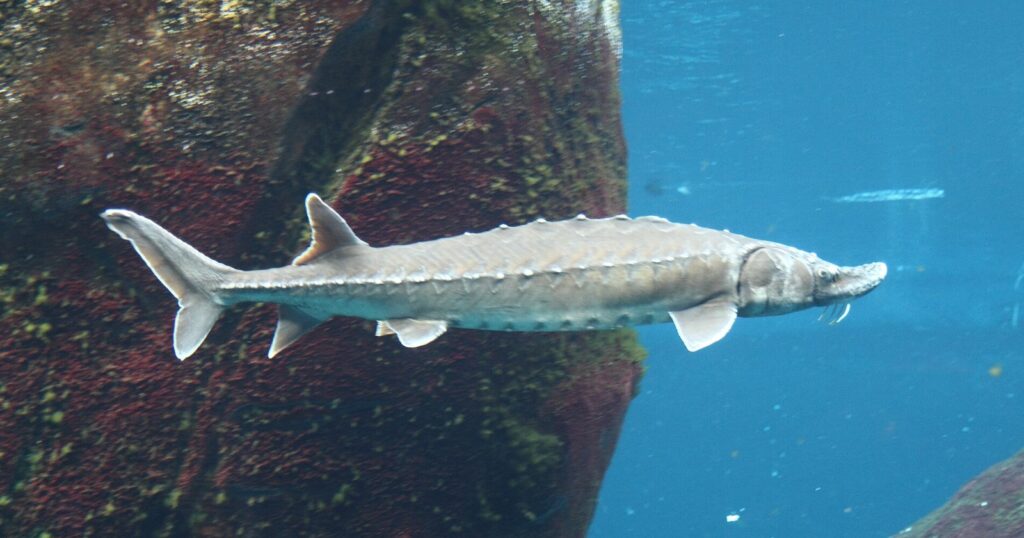
Swansea’s fishermen could not find a set of scales big enough for the fish Robert Davies brought in. “To be honest, I didn’t know what it was,” he said, the BBC reported. Fisheries officers and the coastguard came down, took pictures and told him it was a sturgeon, a fish rarely seen in British waters.
Davies, from Llanelli, had been fishing for three years. He caught the fish in Swansea Bay at about half past two on the afternoon of Wednesday 2 June 2004. The first guess at its weight was around 300lb; by the next day the BBC was giving almost 264lb (about 120kg), and accounts of its length ran anywhere from eight to 10 feet.
In England and Wales a sturgeon is a royal fish, and the Crown has first claim on one. Through the coastguard, Davies got in touch with the Receiver of Wreck, the official who handles that claim, and a fax went to Buckingham Palace. “Fairly quickly a return fax came saying the fisherman was free to dispose of it as he wished,” a Swansea Coastguard spokeswoman said.
The fish was driven to Plymouth, and on the Thursday, according to the BBC, it sold at auction for £650. The Telegraph’s version, relayed by Practical Fishkeeping, was that police had stopped the sale. Either way, officers impounded the sturgeon. A wildlife crime officer with Devon and Cornwall Police said it was a protected species, and that selling one, or offering one for sale, was an offence.
“We’re all ending up looking rather foolish, to be honest,” said David Pessell of Plymouth Trawler Agents. He listed the Department of the Environment, the South Wales Sea Fisheries Committee, the Master of the Royal Household and his own firm. None of them, he said, had known there was legislation preventing the sale.
Selling a protected species
The Crown’s claim and the wildlife law are separate things, and the fax dealt only with the first. Catching or keeping a sturgeon was not illegal, the BBC explained, provided it had first been offered to the Queen. Officers said no offence would have been committed if Davies had kept the fish or given it away for free. The trouble was the auction.
PC Jon Needham, the wildlife crime officer, told The Telegraph that anyone caught selling one could face up to six months in prison or a fine of up to £5,000. He was careful about what came next. “There is a great long string of potential offences,” he said. “We need to carefully look at the circumstances.”
A day earlier the BBC had said the fish could earn Davies more than £8,000, noting that the last sturgeon caught off Britain had sold for £27 a pound. Now his father, Kevin Davies, 44, also a fisherman, said: “We have really been left in the lurch.” Nick Henry of Moby Nicks fish sellers in Plymouth said the family “must have thought that they won the jackpot. But they’ll end up with nothing, I’ll end up with nothing.”
Which law applied may depend on which sturgeon it was. The Wildlife and Countryside Act 1981 makes it an offence to sell, or offer for sale, any wild animal listed in its Schedule 5. The schedule names one sturgeon only: Acipenser sturio, the European sturgeon.
Britain has had a second species, the Atlantic sturgeon, Acipenser oxyrinchus. A 2015 study in PLOS ONE, about an Atlantic sturgeon caught off northern Spain, gives the last known British record of that species as “a large specimen caught in Wales in 2004”. The paper does not name Davies or say how the Welsh fish was identified. In 2004 the Natural History Museum had not yet confirmed the species: its fish curator, Oliver Crimmen, quoted by the angling site Fishing Magic, spoke of what would happen “once the species has been confirmed”.
If the Swansea Bay fish was an Atlantic sturgeon, it was not the species the 1981 Act’s schedule names. The 2004 coverage we read did not say which law the officers were relying on, though one account put the ban on selling down to CITES, the convention on trade in endangered species. The Marine Management Organisation notes that CITES covers every sturgeon species. We found no report, then or since, of a charge or a court case.
The law behind the fax
The royal claim that started all this sits in chapter 13 of Prerogativa Regis, a short statute setting out the king’s rights. In the English text published on legislation.gov.uk, it says the King shall have “Whales and great Sturgeons taken in the Sea or elsewhere within the Realm”. It is still law in England and Wales. Its date is uncertain; tradition assigns it to the 17th year of Edward II’s reign, 1324.
The BBC said in 2004 that the sturgeon’s royal status had been granted by Edward II. William Blackstone told it differently in 1765, in the first volume of his Commentaries on the Laws of England. Whale and sturgeon, he wrote, when thrown ashore or caught near the coasts, belonged to the king “on account of their superior excellence”. He said the kings of Denmark and the dukes of Normandy had held the same privilege, and that the right was “expressly claimed and allowed” in the statute. On his reading, the statute wrote down a royal right. It did not invent one.
The sturgeon nearly lost its royal status in 1971. A bill drafted by the Law Commission to abolish the Crown’s old rights over wild creatures would have swept away the royal fish too, whales included. Peers worried about an arrangement, in place since 1914, under which stranded whales and dolphins were offered to the Natural History Museum. In the House of Lords, the Earl of Cranbrook moved amendments to keep the whales but still let the sturgeons go, and the Lords backed him by 53 votes to 30.
Twelve days later, at report stage, the Lords changed course and kept all the royal fish. The Act that passed abolished the Crown’s rights to wild creatures “except royal fish and swans”, and chapter 13 still names the great sturgeons. Today the Receiver of Wreck, part of HM Coastguard, administers the claim in England, Wales and Northern Ireland, where royal fish include all whales, porpoises, dolphins and sturgeons. In Scotland only whales over 25ft count.
The fish goes missing
Meanwhile, the fish itself had vanished. According to Fishing Magic, it disappeared a day after it was caught, and Devon and Cornwall Police treated its disappearance as theft. The coverage we read does not say how, or from where.
Later that week it turned up again. A police officer told The Scotsman, as Practical Fishkeeping relayed: “We have had a phone call and as a result we have seen the fish at a location which we are not going to release.”
It ended up in London. A Cornish fish merchant, Tim Alsop, handed it over to the Natural History Museum for its national collection. In the same Fishing Magic piece, Crimmen thanked Alsop for agreeing to give it and said: “Sturgeons are extremely rare fishes now, particularly in British waters, so this catch is hugely important.” On 30 June 2004 he was billed to show it off in a free talk at the Darwin Centre, under the title “Landed: 8ft Missing Fish“.
Country Life said in 2024 that the fish is still there, preserved in alcohol. The museum’s paid Behind the Scenes: Spirit Collection tour, for visitors aged 10 and over, goes into the collection kept in spirit. At the time of writing it cost £35 for 45 minutes; check dates before planning a visit. A 2025 Countryfile visit described one tank holding a mako shark, a common thresher, a swordfish and “a couple of enormous sturgeons”, without saying where those sturgeons came from.
In 2023 conservation groups led by ZSL launched a UK plan to bring Atlantic and European sturgeons back to British waters, and asked anyone who sees one to report it. If the plan works, more fishermen may one day haul one up, as Davies did. Along most of the coast of England and Wales, any that end up in a fisherman’s net still belong, in law, to the Crown.