
From 1946, George Orwell rented a remote farmhouse at the north end of Jura and finished Nineteen Eighty-Four there. The family that rented it to him still owns it.
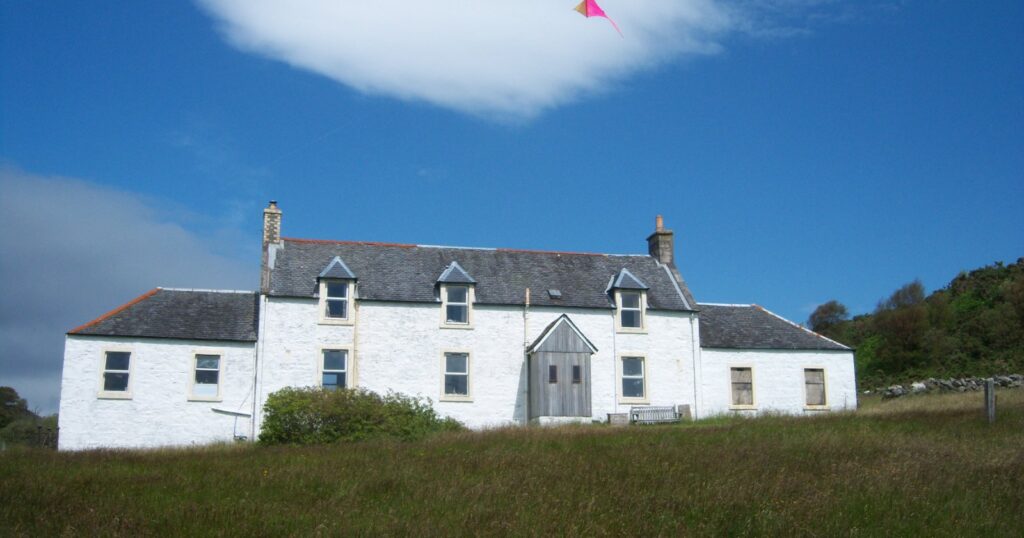
Margaret Fletcher remembered the day George Orwell turned up at Ardlussa, her family’s house on the Isle of Jura. He “arrived at the front door looking very thin and gaunt and worn … a very sick-looking man,” she recalled decades later.
The next day she and her husband, Robin, took him up to an empty farmhouse at the far end of the estate’s track. It was called Barnhill, and Orwell would finish Nineteen Eighty-Four there.
The house at the end of the road
Robin and Margaret Fletcher, who owned the Ardlussa estate, had moved there after the war. It covered some 20,000 acres at the northern end of Jura, according to a 2019 account in The American Scholar by David Brown. Barnhill was one of its houses. Orwell had first visited Jura in September 1945 on the suggestion of his friend David Astor, and he moved into Barnhill around May 1946.
Getting there was the hard part. The island had one shop, at Craighouse, 16½ miles south of Ardlussa. Mail came three times a week to Craighouse and was sent on once a week to Barnhill, seven miles north of Ardlussa. Orwell himself called it “an extremely un-get-atable place,” as Penguin’s history of the book notes. The journey meant two ferries, a 20-mile drive and then seven miles of dirt track.
He wanted out from under London’s demands. “You don’t know how I pine to get free of it all and have time to think again,” he wrote to Arthur Koestler in April 1946.
Room to spare, no electricity
Barnhill was roomy. Penguin lists five bedrooms, a sitting room, a dining room and a large kitchen. It had no electricity. Orwell cooked and heated water with Calor gas, burned peat and coal for warmth and read by paraffin lamp. Margaret Fletcher later said that “he had only his basic needs.”
His sister Avril joined him, and so did his young son, Richard. Life there was not always safe. On a boat trip near the Corryvreckan whirlpool, the boat overturned and Richard, then three, was pulled underwater. Everyone survived, picked up by a passing lobster fisherman.
Finishing the book
Orwell’s health was getting worse. He was diagnosed with tuberculosis in 1947. He finished a first draft of the novel in early November 1947, Brown writes, and worked on a second draft while in hospital in 1948.
He came back to Barnhill in July 1948, finished the revision that November and then retyped the whole manuscript himself, mostly from bed. Penguin dates the finished manuscript to December 1948.
Just after New Year’s Day 1949, Orwell left Jura for a sanatorium in England. “When he left it for the last time, in January 1949, he never again lived outside a sanatorium or hospital,” Brown writes.
Still in the family
The Fletchers never sold. In a 2012 essay for the Orwell Foundation, the writer Oliver Bullough noted that Barnhill is “still owned by the Fletcher family who rented it to him,” and that they have “steadfastly refused to modernise it.”
When he asked to rent it, Damaris Fletcher wrote back: “The generator is ancient and at best does a few light bulbs; fridge the size of a shoebox; shop two hours drive away.” Each morning, Bullough fetched coal for the Rayburn.
In Brown’s 2019 account, little had changed. The house still had a coal-fired stove, a generator for electricity and a gas refrigerator.
The Fletcher line on Jura has carried on as well. Brown notes that the current laird of Ardlussa, Andrew Fletcher, is the grandson of the couple who took Orwell up the track in 1946.