
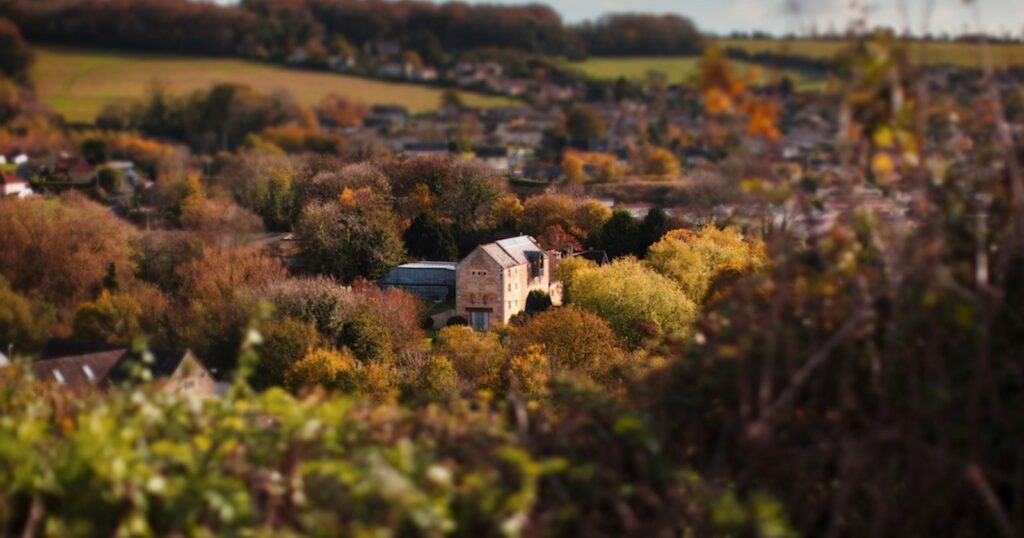
In 1987, Peter Gabriel bought a 200-year-old water mill in the Wiltshire village of Box, converted it, added a studio beside it, and in 1989 opened Real World Studios
When Peter Gabriel went looking for a permanent home for his recording studio, his first condition had nothing to do with equipment. According to the studio’s own history page, “chief among Peter’s requirements was that it had to be close to water.”
A mill on the By Brook
Gabriel and his team looked at several sites in the Bath area, most of them old mills. They settled on Box, a Wiltshire village less than eight miles from Bath, where they found “an office complex with a river running under it.” The river was the By Brook, and the offices had once been a mill. “A mill until the late 1950s,” the history page says, “this remarkable set of buildings had the scale and internal space Peter wanted.”
That mill had a long working past. According to the Box Heritage Trail, published by the Cotswolds National Landscape, Box Mill “may have been mentioned in the Domesday Book but has been greatly restored since.” For centuries it belonged to the Pinchin family, and over the years it ground corn, served as a fulling mill for the local cloth trade and produced animal feed. It “ceased production after the Second World War and in 1987 was bought by Peter Gabriel who developed some of the site into a recording studio.”
Gutted and rebuilt
The conversion was far more than a refit. “The offices were completely stripped and refurbished as studios,” Real World says. Heavy concrete went in to keep sound from leaking between rooms, and that meant “the whole building had to be underpinned and put on new foundations.”
In a 2017 profile of the studio, Sound On Sound reported that the main building work ran until the end of 1988. It was overseen by the studio team together with the architects Feilden Clegg Design and a small group of engineers and acoustic designers.
A room that didn’t exist
The part of Real World most people picture is the new building. “The Big Room didn’t exist at all until Peter commissioned its construction,” the studio’s history notes. Sound On Sound describes it as “a huge glass extension to the main mill building,” completed in the final stage of the work and prompted by Gabriel’s dislike of dark, isolated studios. A pond was dug out as an extension of the millstream during construction, so the room’s large window looks out over water. From the outside, the magazine says, the Big Room “resembles a vessel from outer space.”
Gabriel explained the idea in a 1989 interview with the music journalist Tony Bacon, recorded at the mill and later published by Reverb. “Basically, I wanted to create the room that I would most like to work in,” he said, “because it’s always seemed to me that studios are getting more focused around the needs of the engineer and the producer, partially to the expense of the artist.”
He was just as plain about the lead-clad exterior. “It’s quite chunky,” he said. “It has grunt.” The studio even had a slogan, he added: “High-tech and hand-made.”
Working by 1989
By the time Sound On Sound visited in 1989, the complex was up and running. The magazine’s September 1989 feature on Gabriel’s album Passion, now kept in the Muzines archive, described a studio “Built inside a 200 year-old mill.” Engineer David Bottrill told the magazine the Passion music had been prepared at the new studio, and Gabriel had just spent a month there mixing “Shakin’ The Tree.”
The 1989 piece gives a good picture of the place when it was new. It had three control rooms. One was Gabriel’s private room, and “the other two are fully commercial.” Glass floors let people look down at the stream running underneath, and musicians could set up and record almost anywhere in the building. The team had also replaced metal fittings with wood and ceramic, at considerable expense, because they believed metal gave off positive ions, which the article called “a no-no for clear thinking.”
Passion itself came out that year on Gabriel’s new Real World label.
The mill today
Some of the original layout has changed. According to Sound On Sound, the first studio room to be finished “is no longer used in that role, but serves as offices.” The Big Room is still in use, and the buildings on the By Brook now also house Gabriel’s other ventures, including Real World Records and the WOMAD festival.
A building that once ground grain now records music, and the reason it was chosen is still in plain view. The water that turned its stones still runs under the building, and the pond dug beside the Big Room fills the view from the window.