
In 1997, Jeremy Irons paid about 150,000 Irish pounds for a roofless 15th-century castle in West Cork and spent six years restoring it. Then he painted it peach, and the neighbors were horrified
Jeremy Irons bought a roofless tower on Roaringwater Bay, damp-proofed it with ten coats of limewash and ended up defending its colour in the Irish Times.
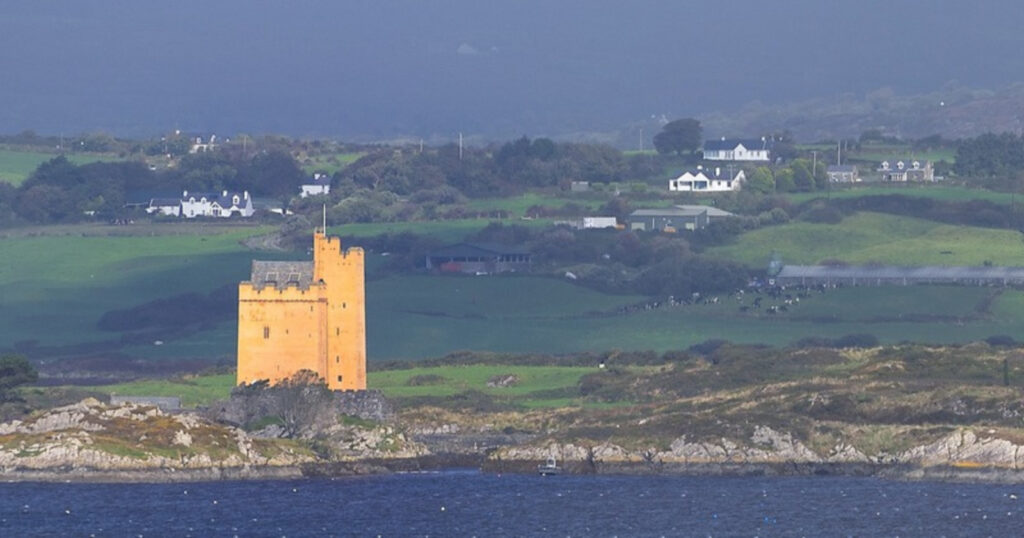
At the end of May 2001, the Irish Times gave an English actor an entire page to explain himself. He was not apologising for a film. He was defending a colour.
The actor was Jeremy Irons, and the colour was on Kilcoe Castle, a fifteenth-century tower on a rocky islet in Roaringwater Bay, West Cork. The Telegraph opened its report with a neat line: an Englishman’s home may be his castle, but in Ireland an English actor’s castle was being called an eyesore. The headline writers settled on “peach”.
From picnic spot to purchase
Irons knew Kilcoe long before he owned it. He and his wife, the actress Sinéad Cusack, had a cottage about ten minutes away, and the ruin became a family picnic spot where their young sons scampered up the walls, according to Vanity Fair’s 2017 profile. When he bought it, the tower had no roof, and its top floor was carpeted in grass and shrubs.
It was a tower house, the fortified home of a local chieftain, built by the Clan Dermod branch of the MacCarthys. Nobody recorded the date, but the archaeologist who excavated the site notes that the absence of gunloops points to the 1400s. It is also reputed to have been the last castle in the area to hold out after the Battle of Kinsale, falling in February 1603 to an English force under a Captain Flower.
Almost four hundred years later, in 1997, Irons bought the castle and its island. The figure usually reported is IR£150,000, which is roughly €190,000 at the rate fixed when the euro arrived. Cusack has said he had already bought it by the time he mentioned it, and that she “hyperventilated immediately”. Irons said he feared that “someone would come along with too much money and mess the place up”, as Celtic Tiger cash began to flow.
He was not the only famous owner to take on a wreck. Monty Don’s Herefordshire ruin had no roof either.
Why the walls had to be covered
The first plan was to leave the stonework grey and romantic. The Atlantic disagreed. Irons told the Telegraph that he tried repointing the walls “and then the storms came, and the water poured through the walls by the bucketful”. Bena Stutchbury, who acted as his de facto architect, recalled a puddle the size of a car on the floor of the solar, the main upstairs room.
The cure was harling, a thick coat of lime mortar over the stone, followed by ten coats of limewash. Irons said he took advice from Ireland’s heritage service. Then came the awkward question of what colour limewash should be.
He believed white was the castle’s original look, but worried it would seem stark against the landscape. A cream wash did not please him either. He settled on a trick borrowed from Scottish castles: stirring ferrous sulphate (copperas) into the lime, which goes on pale and slowly rusts into warm tones. He called the result “fresh rust”.
Peach, pink or ochre?
The newspapers said peach, and sometimes pink. Irons preferred rust. Years later he dismissed the pink stories as nonsense to Vanity Fair, whose writer added that you would need to be “lysergically loaded” to see pink in it.
Strictly speaking, it was never paint. It is limewash, and the shade moves with the weather and the light. Vanity Fair thought it made the castle look as if it sat in “a perpetual golden twilight”.
Did the neighbours have a point?
Some thought so. Mary Mackey, editor of the Mizen Historical Journal, told the Irish Examiner she was horrified, and that Irons had made no mention of painting it when they discussed the castle. A spokeswoman said he was “thrilled” with it and had no intention of changing it. The editor of the local Southern Star told the Telegraph that Irons had done “marvellous work”, but that “Nobody likes the colour it is now.”
Irons had an unlikely ally in the Middle Ages. A local history blog, Roaringwater Journal, argues that tower houses were generally rendered, often in colour, to keep the water out and to be seen from afar. On that view, the bare grey stone we think of as authentic is simply what is left once the render has washed away.
A caveat is needed here. Nobody knows what colour Kilcoe was in the 1400s, and an iron-oxide orange was Irons’s choice, not a documented medieval one. The blog’s case is an argument, and a plausible one.
Six years, and a castle you cannot enter
Vanity Fair says the work began in 1998 and finished in 2004, which is where the “six years” comes from. Other accounts vary. A plaque by the front door, dated 2002, says “Four years we worked”, and the Irish Examiner mentioned three years of work in May 2001.
The plaque goes on: “Many hearts lie in these walls… and we just did the best with what we knew. And what we did you see.”
The castle is private and not open to visitors, so there is no stepping inside. The island lies only about thirty metres (a hundred feet or so) off the shore, though, and the lanes and water around Roaringwater Bay give a good view. By 2017 Vanity Fair was calling the colour a “beloved West Cork landmark”. The plaque’s last line still holds, because it is hard to miss.