
For decades Londoners blamed their wild green parakeets on Jimi Hendrix releasing a pair on Carnaby Street in 1968. In 2019, scientists used criminal geographic profiling on more than 5,000 sightings and found the real culprits were ordinary escaped pets
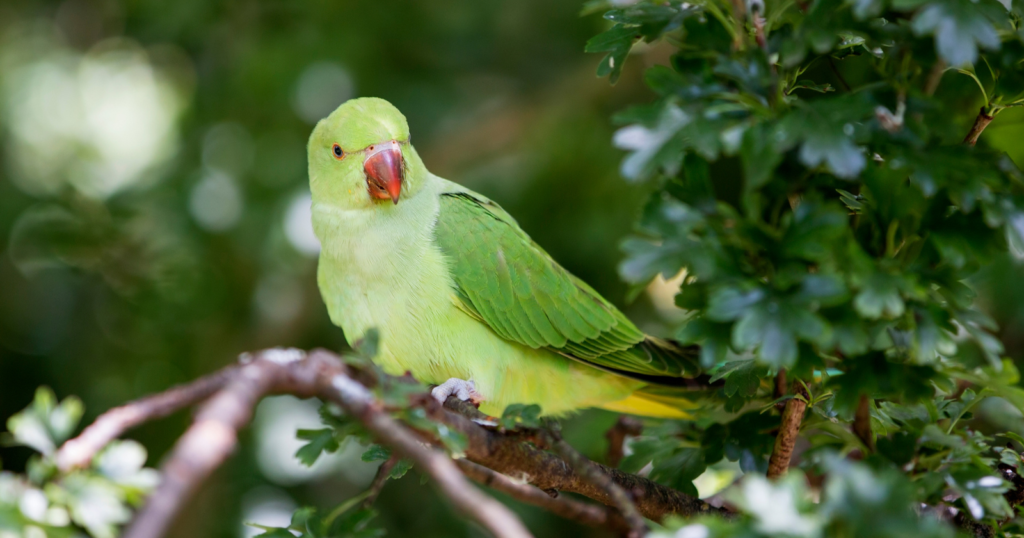
Walk through Hyde Park, Kensington Gardens or Richmond Park, and you’ll probably hear them before you see them. A loud, shrieking call, then a flash of bright green as a flock of parakeets swoops between the trees.
Ring-necked parakeets are now one of the most familiar birds in London. For years, people have loved to tell stories about how they got there, and the most famous involves one of rock music’s biggest stars.
A tropical bird in London
Ring-necked parakeets, also called rose-ringed parakeets, are native to parts of Africa and South Asia. They’re about the size of a pigeon, with long tails, red beaks and vivid green feathers. Males have a dark ring around their neck, which gives the species its name.
They were once popular cage birds in Britain. Today, wild populations live across much of south-east England, with the largest numbers in and around London. Estimates suggest there are tens of thousands of them, and they’ve spread to other parts of the UK.
The legends
Because tropical parrots seem so out of place in London, several colourful stories grew up to explain them. The best known says that Jimi Hendrix released a pair of parakeets on Carnaby Street in 1968, during the height of Swinging London.
Another legend claims a flock escaped from the set of the 1951 film The African Queen, starring Humphrey Bogart and Katharine Hepburn. Others blamed a plane crash that damaged an aviary at Syon Park, or the Great Storm of 1987, which wrecked many aviaries across southern England.
Using crime-fighting maths
In 2019, scientists from Queen Mary University of London, University College London and Goldsmiths decided to test the stories. They used a statistical method called geographic profiling. It was originally developed to help police narrow down where a serial offender is likely to live, based on the locations of their crimes.
Instead of crimes, the researchers used more than 5,000 parakeet sightings recorded between 1968 and 2018. The possible release sites from the legends, including Carnaby Street, the film studio and Syon Park, were treated as “suspects.”
If one of those places had been the true origin, it should have stood out clearly in the pattern of sightings. None of them did.
What the evidence showed
The researchers concluded that Britain’s parakeets most likely came from many small releases and escapes over a long period, from pet birds that got out of their cages or were deliberately let go. There was no sign that any single event, famous or otherwise, started the population.
A separate search of historic British newspapers backed this up. It found thousands of articles about parakeets, but none describing a release linked to Hendrix or the other legends. Parakeets had actually been seen in the wild in Britain as far back as the 19th century, long before Hendrix arrived in London.
The newspaper search also offered a clue about deliberate releases. Around 1929 to 1931, and again in the early 1950s, British papers ran alarming stories about “parrot fever,” a disease that can spread from birds to people. Researchers suggest some worried owners may have released their pets.
The study was led by Dr Steven Le Comber, who died in September 2019, shortly before it was published.
Why it matters
Parakeets might look charming, but they’re an invasive species in Britain. They compete with native birds, such as nuthatches and woodpeckers, for nesting holes in trees, and they can damage fruit crops.
Understanding how they arrived matters, because it shows how invasive species often spread. It’s rarely one dramatic release. More often, it’s lots of small, ordinary events adding up over time.
Seeing them yourself
If you want to see London’s parakeets, the big royal parks are some of the best places, especially Kensington Gardens, Hyde Park, Richmond Park and Battersea Park. They’re most active in the morning and late afternoon, and their loud calls make them easy to find.
If you keep pet birds, the lesson is simple: never release them into the wild. Escaped or released pets can struggle to survive, and the ones that thrive can cause lasting problems for native wildlife.