
Miles Russell of Bournemouth University argues that Verica, the Atrebates ruler who fled to Claudius and persuaded him to invade Britain in AD 43, was a woman, citing a name ending like Cartimandua’s and Boudica’s
Bournemouth University's Miles Russell argues the Atrebates ruler Verica, who urged Claudius to invade Britain in AD 43, was a woman, but others disagree.
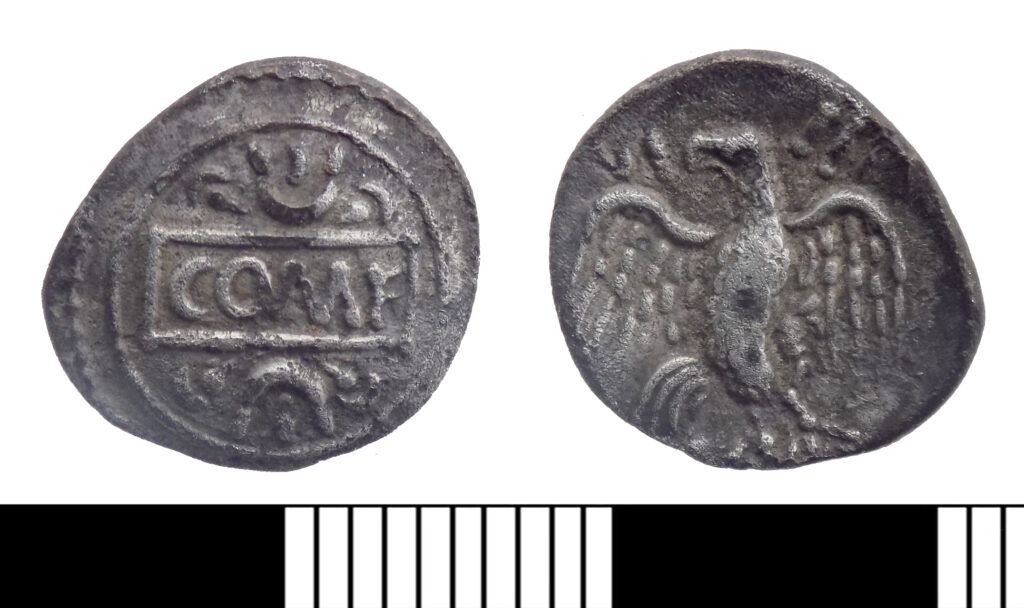
Miles Russell, Director of Archaeological Fieldwork at Bournemouth University, argues that Verica, the Atrebates ruler who fled to the emperor Claudius and, according to Cassius Dio, persuaded him to invade Britain in AD 43, was a woman. The case was set out by the university on 5 November.
Verica ruled the Atrebates, a tribe whose territory covered much of modern-day Hampshire and West Sussex. Around AD 40, after the death of the tribal leader Cunobelinus and the rise of his son Caratacus, Verica was ousted from power and fled Britain for Rome. The Roman landing in Kent three years later began nearly 400 years of provincial rule, the era that preceded Anglo-Saxon England.
The argument appears in Russell’s book Caratacus: Great King of Britain, published by Bloomsbury in January, and is discussed in the latest edition of Current Archaeology. Bournemouth headlined its announcement “New research reveals Iron Age King was female” and said the discovery “re-writes the history of early Roman Britain”.
“Verica is assumed to have been male because of the patriarchal mindset of 19th century, classical historians,” Russell said. “Verica was not only critical to the special relationship between Britain and Rome in the early first century AD but was indisputably female.”
The case from the name, the title and the coins
The first strand is the name. Verica ends in the letter “a”, which Russell says was common for female names of the period, citing Cartimandua of the Brigantes in Yorkshire and Boudica of the Iceni in Norfolk. Male names tended to end in “os” or “us”, as with Cunobelinus. The convention is “not a clear-cut rule”, Russell told New Scientist, but applies to “about 95 percent of Iron Age British names”, in remarks reported by Smithsonian magazine.
The second is the Latin title rex, which appears on Verica’s coinage. “People also assume she was a ‘he’ because of the term ‘rex’ on coins, but rex is a non gender specific title, both male and female kings were recognised by Rome, Cleopatra of Egypt being the most famous,” Russell said. Its use, he added, “shows that Verica ruled with the full authorisation of the emperor”.
The third is the imagery struck on the coins. “Whilst other coin producing British Iron Age leaders portray obviously male warriors, Verica is depicted as a slender, feminine, bare-breasted figure riding on horseback,” Russell said.
Some coins carry the abbreviation COM F, read as Commios filius, or son of Commios, the Atrebates leader who allied with Julius Caesar during his invasion of Gaul. Russell argues the same letters could stand for Commios filia, daughter of Commios. Writing in Current Archaeology, he said “the assumption that this powerful ruler must have been male reflects a degree of unconscious bias, and perhaps a hangover from the patriarchal mindset of early Classicists”, according to Smithsonian.
Where specialists dispute the reading
Roger Tomlin, a British archaeologist specialising in the translation of Latin text and epigraphy at the University of Oxford, told the Guardian that there were Latin men’s names ending in “a”, and that the existence of the masculine form “Vericus” was the best argument that “Verica” was feminine.
On the coin title, Tomlin said there was little evidence rex had been used for both male and female rulers. “Of course the Romans recognised client-queens as well as client-kings, but Russell must prove, by finding other examples, that they referred to them both as Rex,” he said. The apparently bare-breasted warrior on the reverse of the coin did not settle the matter either, he said: “It reminds me of the argument that Queen Victoria was really a man, because the reverse of her gold coinage depicts her as a male horseman killing a dragon.”
Cassius Dio, writing in the early third century, called the Briton who appealed to Claudius “Bericus” and took the ruler to be a man. Russell argues that could be a garbling of the name, given Dio wrote more than 200 years after the events and his work passed through generations of translation and transcription.
Daphne Nash Briggs, a British Iron Age archaeologist and coin expert, also voiced scepticism to the Guardian. Some coins bearing Verica’s name depicted a clearly male form on horseback, she said, others appeared to show a portrait of Verica in male priestly dress, and some showed Verica’s head and neck with an Adam’s apple. Russell argues the last of those depicts the emperor, and that it is not clear the figure in priestly dress is male or that it is Verica.
Katharina Rebay-Salisbury, an archaeologist at the University of Vienna, told New Scientist: “I find it a bit difficult to differentiate a naked female body from a naked male body in these very stylized images.”
What hangs on the identification
Russell told the Guardian the question goes beyond the label attached to one ruler. “It’s critical because … without Verica there probably would be no Roman invasion,” he said. “Also, it changes the politics, it changes the dynamics of iron age Britain.”
Roman writers treated Claudius harshly, portraying him as weak-minded and ineffective and his policy decisions as dictated by women and freed slaves. “The story of Claudius committing to something only because a woman told him to fits the trope of this emperor as being submissive and henpecked,” Russell said. “In effect, Dio was saying that the campaign was undertaken solely because of the whisperings of a barbarian femme fatale.”
The reading follows earlier work at Bournemouth. A study co-authored by Russell and colleagues, published last year, found Iron Age communities in southern Britain were matrilocal, with husbands moving in to live with their wives’ community.
Russell said he expected the conclusion to be contested. “If it does create debate and argument, I think that’s for the better,” he told the Guardian. “The one-sided story’s been there for so long. We need that to change. We need to have this discussion.”