
In 1986, David Gilmour spotted an ad for a 1911 Thames houseboat in Country Life while waiting at the dentist and bought it; he turned it into a floating studio where Pink Floyd recorded parts of their last three albums, and he still owns it nearly 40 years later
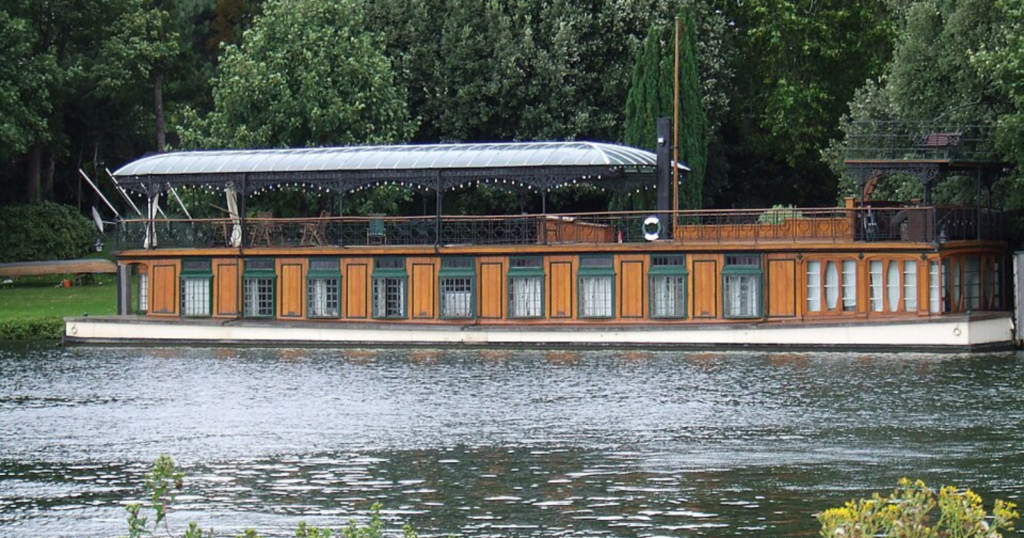
On a stretch of the River Thames near Hampton, in south-west London, a long white houseboat sits quietly against the bank. Its wooden decks and rows of tall windows look like something from the Edwardian era, which is exactly what it is.
The boat is called Astoria. For almost 40 years, it has belonged to David Gilmour, the guitarist of Pink Floyd, and some of the band’s later music was made on board. Gilmour found it by chance, while flicking through a magazine at the dentist.
Built for a showman
Astoria was built in 1911 for Fred Karno, one of the best-known theatre impresarios of his day. Karno ran a famous comedy troupe that gave early breaks to Charlie Chaplin and Stan Laurel, and his name lived on in the First World War phrase “Fred Karno’s Army,” used to describe anything chaotic.
Karno wanted the finest houseboat on the Thames. He had it moored beside his grand hotel, the Karsino, on nearby Tagg’s Island. The boat reportedly cost around £20,000, an enormous sum at the time, and its upper deck was designed to be big enough for a 90-piece orchestra to play.
A chance discovery
By the 1980s, Astoria had passed through several owners and was moored a little upstream from Tagg’s Island. Gilmour first noticed it while being driven along the river and was struck by how beautiful it was.
About two weeks later, he was sitting in his dentist’s waiting room and picked up a copy of Country Life. Inside, by pure coincidence, was an advert offering the same boat for sale. He called the sellers, went to see it and bought it in 1986.
A studio with a view
Gilmour turned Astoria into a recording studio. He had spent much of his life working in windowless studios, and the boat offered the opposite: natural light, views of the river and passing wildlife on every side.
The studio took shape at an important moment. Roger Waters had left Pink Floyd, and Gilmour was leading the band into a new era. Much of A Momentary Lapse of Reason, released in 1987, was recorded on Astoria between late 1986 and early 1987.
Pink Floyd on the river
The boat became the band’s creative base for the rest of its recording life. Sessions for The Division Bell, released in 1994, took place there, and the band’s live album Pulse was also mixed on board.
Pink Floyd’s final studio album, The Endless River, released in 2014, was built largely from music recorded during the Division Bell sessions, with further work done on Astoria. That makes the houseboat part of all three of the band’s last studio albums. Gilmour has also used it for his solo records.
A Grade-listed setting
Astoria’s surroundings add to its charm. Just along the river is Garrick’s Temple, built in the 18th century by the actor David Garrick as a tribute to William Shakespeare. Gilmour later bought the land on the bank beside the boat, including a garden and summerhouse overlooking the water.
The area is still home to houseboats today. Tagg’s Island, where Astoria was first moored, is now a private island with around 60 houseboats. Karno’s grand hotel, however, is long gone.
Still his, nearly 40 years on
Nearly four decades after that visit to the dentist, Astoria still belongs to Gilmour. He has continued to use it for recording and has described it as a beautiful, magical place.
Few famous recording studios have a story quite like it. A boat built for a music-hall showman in the Edwardian era became the place where one of the world’s biggest rock bands made its final albums. And it all began with an old magazine in a waiting room.