
In the early 1970s, Jimmy Page bought the Loch Ness house where the occultist Aleister Crowley once lived; after Page sold it, it burned down twice, and this year it opened to visitors after a seven-year rebuild
Aleister Crowley wrote that a beheaded lord's head was said to roll through Boleskine's corridors. Jimmy Page later bought the house. After he sold it, it burned twice, and in April it opened to the public.
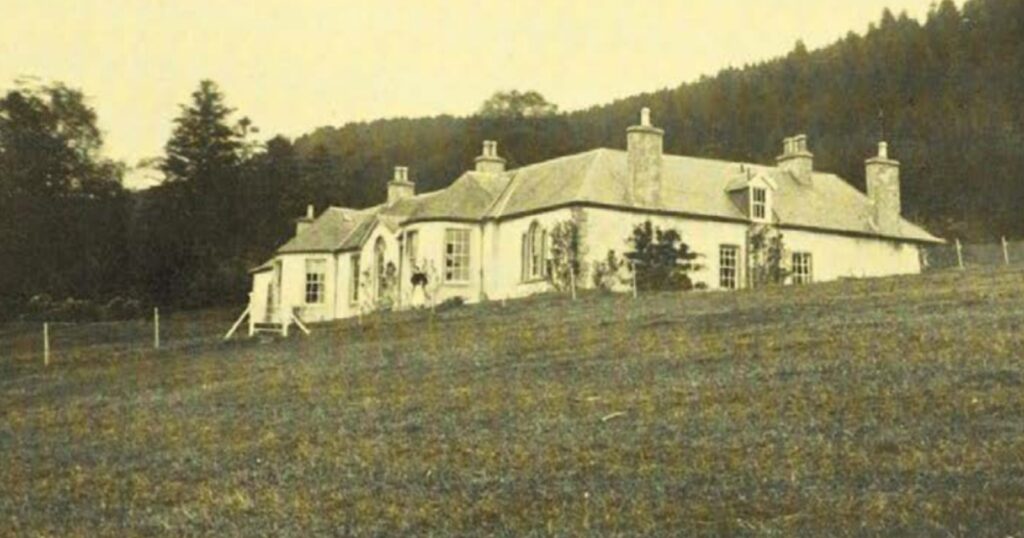
In November 1933, with the papers full of reports of a monster in Loch Ness, a Manchester Sunday paper ran a piece by a man who said he knew the loch’s darker side. “I have no knowledge of this monster,” Aleister Crowley wrote in the Empire News, “but I have knowledge of the Manor of Boleskine.” He had owned the house, on the south-east shore of the loch between Inverfarigaig and Foyers. Long before he bought it, he wrote, the head of old Lord Lovat, “who was beheaded after the 45, was believed to roll up and down the corridors of the rambling old place.”
Four decades later a rock star told the same story. “A man was beheaded there and sometimes you can hear his head rolling down,” Jimmy Page told Rolling Stone in 1975. He owned the house by then, having bought it in the early 1970s because Crowley had lived there. After he sold it, Boleskine burned twice, and it took a rebuild the BBC put at seven years before the house opened to visitors in April 2026.
The magician’s lodge
Boleskine began as a Fraser hunting lodge. Its first private owner, according to the Boleskine House Foundation and the BBC, was Archibald Campbell Fraser of Lovat, second son of Simon Fraser, 11th Lord Lovat. Lovat, nicknamed the Old Fox, backed Bonnie Prince Charlie and was executed in London. His son commissioned the house in the late 18th century, the foundation says, and it was not finished until 1809. Lovat never saw it. He had been dead for decades by then.
Crowley bought the house in 1899, paying £2,000, which the foundation calls twice its market value at the time. He wanted it for a long ritual from a 15th-century grimoire, the Sacred Magic of Abramelin the Mage. “It had to be a house in a secluded situation, with a door opening to the north from the room in which I was to make my oratory,” he wrote. He set aside the south-western part of “the long, low building” for the work and built a terrace and lodge outside its largest room. Inside that room he put up his oratory, a wooden structure lined with mirrors brought from his temple in London. The BBC reports that he had a window facing the loch turned into a door for the ritual.
The ritual was meant to take at least six months. In Crowley’s telling, the people around him began to crack. A fellow initiate who came to keep him company fled within a month. His lodge-keeper, “a life abstainer from any form of alcoholic liquor,” was “raving drunk for three days” and tried to kill his wife and children. A Cambridge friend left complaining of “presences in the place of an evil nature,” and Crowley “carried on alone.” Then a dispute with his order’s London chiefs took him to Paris, and a revolt in the order delayed the operation. After a spell climbing mountains in Mexico he came back, he wrote, to find that the locals “would not pass the house after dark.” He told all this in 1933, some three decades after the events, to a popular paper with the Loch Ness monster on its mind.
The guitarist’s retreat
Page collected Crowley memorabilia, the foundation’s history notes. Original pressings of Led Zeppelin III, released in October 1970, carried Crowley’s law, “Do what thou wilt,” inscribed in the run-off groove, Rolling Stone has reported. The foundation dates Page’s purchase of Boleskine to 1971 and lists Halbert Kerr, who had run the house as a guesthouse since 1967, as the owner before him. No source we found gives the price.
In 1975 Page told Rolling Stone that the house’s reputation was older than Crowley. “Yes, it was owned by Aleister Crowley,” he said. “But there were two or three owners before Crowley moved into it.” The house, he added, stood where a church had burned to the ground with its congregation inside. “Strange things have happened in that house that had nothing to do with Crowley. The bad vibes were already there.” He had never heard the head himself. A friend “who is extremely straight” had, and blamed the cats, until the staff told him the cats were locked in a room every night.
Asked what drew him to the place, Page answered: “The unknown. I’m attracted by the unknown, but I take precautions.” About his own beliefs he gave little away: “I don’t really want to go on about my personal beliefs or my involvement in magic.”
He was rarely there. Page set out to give the house a Crowley-like theme, according to the foundation, but left it in the care of friends. The best known was his childhood friend Malcolm Dent. Page may have visited only a handful of times, The Scotsman has reported, but Dent made the house his home, raising a family there until Page sold up. In 2006 he told the Inverness Courier that the family had loved living there despite the “curious” goings-on. “Doors would be slamming all night, you’d go into a room and carpets and rugs would be piled up.” When doors suddenly sprang open, the family had a joke ready: “We just used to say that was Aleister doing his thing.” Dent died in 2011.
Page sold the house in 1992 to Ronald and Annette MacGillivray. The MacGillivrays shared kin with the Frasers, and Ronald hoped to make Boleskine a Fraser estate again, the foundation says. After his death, Annette MacGillivray sold it in 2002 to a Dutch couple who used it as a holiday home.
Fire, twice
On 23 December 2015 the alarm was raised at 13:40. Flames could be seen from the far side of the loch, and the Scottish Fire and Rescue Service said a large part of the property had already been destroyed. The BBC later put the damage at 70% of the house. In April 2019 the ruin went on the market with more than 22 acres for more than £500,000. According to the foundation’s history, it was bought that July and the charity was set up shortly afterwards.
On the afternoon of 31 July 2019 fire crews were back, at two separate blazes in the house and the neighbouring coach house. Police said they believed the fire had been started deliberately. The Friends of Boleskine House said the coach house had been saved, but what was left of the house’s roof had collapsed.
“It was literally a ruin by the time the foundation purchased it,” Keith Readdy, the charity’s chairman, told the BBC in 2023. “Only granite walls were standing.” During the pandemic he, his wife and two volunteers shovelled 120 tonnes of charred rubble out of it by hand. A stonemason chiselled 29,000 grooves into a stone arch around a window so it would match the rest of the building. The roof went back on with Ballachulish slate recovered from derelict sites and other sources, because the slate is no longer quarried.
Inside, there was little to copy. “We didn’t have many historic photos of the interiors besides some 19th century kind of sepia tone, very grainy photos,” Readdy told the BBC, so the team built what he called a “reimagined historic legacy”. When the house opened, the BBC reported that the total cost had still to be calculated.
Six years or seven
How long all this took depends on who is counting. The BBC’s report on the opening said seven years, and Readdy spoke of “seven years’ hard work”. Before the opening, though, he told the Inverness Courier, as Classic Rock reported, that it had been a “six-year restoration”. From the July 2019 purchase to the April 2026 opening is six years and nine months.
Most of the house’s dates come in two versions. Page bought it in 1971 by the foundation’s account and in 1970 by Mojo‘s; the BBC says only “the 1970s”. Even the order of the sale and the second fire is unclear. The BBC’s 2023 and 2026 reports have the foundation buying the ruin after both fires, but the BBC’s own report of the second fire said it had already been sold earlier that year. The smaller dates wobble too: Page sold in 1992 or 1991, and Crowley’s ownership ended in 1913 or “by 1918”, depending on the source. And the foundation’s billing of the opening as the first time in 260 years that the house has been open to the public needs a footnote, since Kerr ran it as a guesthouse from 1967.
However the years are counted, the doors opened with a gala on the evening of Friday 10 April 2026 and an open day the next day. The foundation says more than 600 people came that weekend, and visitors now go round on self-guided tours, the BBC reports. None of them is promised the sound of a rolling head, and Page never claimed to have heard it either. Asked in 1975 whether that meant he had no contact with the spirits there, he would not deny it. “I didn’t say that,” he said. “I just said I didn’t hear the head roll.”