
A copper-alloy signet ring engraved with a reversed letter R, late 15th or 16th century and thought to have been worn by a merchant, has come out of the river silt just downstream of Powick Old Bridge, with a fired lead musket shot
Worcestershire County Council says archaeological works at Powick Old Bridge have recovered a merchant's signet ring, a fired musket shot and an 1899 ha'penny.
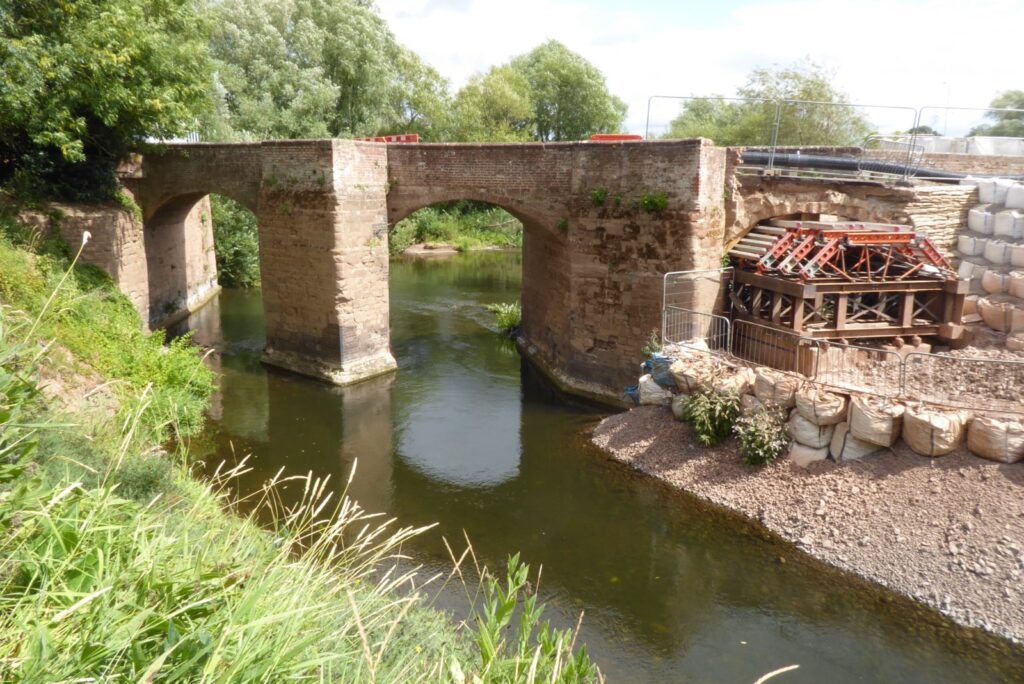
Archaeological works for the restoration of Powick Old Bridge have recovered a rare copper-alloy signet ring of the late 15th or 16th century, believed to have been worn by a merchant, Worcestershire County Council said on 13 November.
The ring came out of river silts immediately downstream of the Grade I listed bridge, a crossing of the River Teme that has been closed since a partial collapse in 2023. It is engraved with a reversed letter “R”.
The same announcement reported two further objects: a lead musket shot bearing the marks of impact after being fired, and a Queen Victoria ha’penny dating from 1899, found within the bridge’s downstream parapet wall.
Councillor Tom Wells, the council’s Cabinet Member with Responsibility for Highways and Transport, said: “These discoveries remind us that Powick Old Bridge is far more than a piece of infrastructure. It is a nationally important historic structure that has witnessed centuries of local and national history.”
The merchant’s ring and the reversed R
The ring would have been used to create wax seals on letters and important documents, the council said, giving a connection to Powick’s trading and commercial past. The reversed letter was impressed into the wax to form the seal.
The council’s project page records that the ring came from silts below 18th to 20th century elements of the later bridge rebuild. Archaeological work on the scheme is being carried out by Worcestershire Archaeology.
Contractors returned in September 2026 for about six weeks of advanced works, excavating behind the damaged section of the bridge. All that activity took place under an archaeological watching brief and had full approval from Historic England, the project page says.
Groundworks elsewhere have produced comparable small metal finds, among them the brooches recorded at a Roman settlement at Mancot. The Powick objects span more than 500 years of local history, according to the council.
A musket shot that cannot be tied to either battle
The lead shot is not fully spherical but squashed on one side, which indicates it was fired and struck something quite solid, the project page says. It was recovered from mixed layers of gravels and riverine silts below the present road surface.
The council said the discovery was of particular interest given the area’s connections with the English Civil War, including the skirmish at Powick Bridge in 1642, regarded as its opening clash, and the nearby Battle of Worcester in 1651.
The news release added: “It has not, however, been possible to confirm whether the shot is directly connected to either event.”
Other Civil War engagements covered on this site include the Battle of Edgehill. The city named in the 1651 battle, where the project page places the bridge, features in a day spent in Worcester.
The third find, the 1899 ha’penny, is thought to relate to rebuilding works carried out in the early 20th century, after the partial collapse and washing out of an earlier stone wall on the downstream side of the bridge.
Permanent restoration expected to begin in spring 2027
Wells said: “The archaeological investigations have uncovered remarkable artefacts that help tell the story of the people who crossed, worked and lived around the bridge over hundreds of years. It’s fascinating to think that items lost centuries ago are now being rediscovered as part of the bridge’s restoration.”
The archaeology forms part of a wider programme to restore the bridge permanently while protecting its historic significance. Original bridge materials have been recovered and stored, a temporary support structure installed, and foundation strengthening and piling works completed.
A preferred permanent repair solution has been selected and funding secured, taking the overall project budget to £6.336m, the project page says. Current work covers the archaeological investigations and site preparation, alongside detailed design and review by Historic England.
Milestones set for the end of 2026 include completion of the detailed design, final approval of the repair design by Historic England, and submission of the remaining statutory consents, among them a Flood Risk Activity Permit and Natural England permissions.
Subject to those approvals, permanent restoration works are expected to begin in spring 2027. The programme will include reconstruction of the damaged abutment and repairs to the bridge’s masonry arch, with removal of the temporary support structure set out for the 2027 to 2028 phase.
The bridge is currently expected to reopen during 2028, subject to the timely receipt of statutory approvals, utility works and unforeseen events such as flooding, the project page says.
The crossing is also recognised as a Scheduled Ancient Monument. According to Historic England, it was constructed before 1447 and partially rebuilt during the 17th century. It is built of stone with brick, is about 60m long and up to 7m wide, and has a brick parapet about 1m high with chamfered stone coping except on the west, where it is interrupted by a road.
Investigations showed that part of the supporting wing wall collapsed into the River Teme, resulting in loss of material and support for the main bridge section. The council says the collapse was likely caused by recent flooding and a build-up of debris.
It describes the scheme as one of the most complex heritage restoration projects it is currently undertaking. The Grade I listed status, the river setting and the environmentally sensitive location require extensive consultation, specialist engineering and careful planning, and the project has moved from emergency stabilisation into the design and approvals phase.