
A London taxi driver haggled a car boot painting down to £40, and three decades later bidders who recognised Amritsar and its Golden Temple in it took it to £75,000 at auction
It hung in his living room until he decided to redecorate. A specialist sale in south London estimated it at £500 to £1,000, and then seven phone lines went after it.
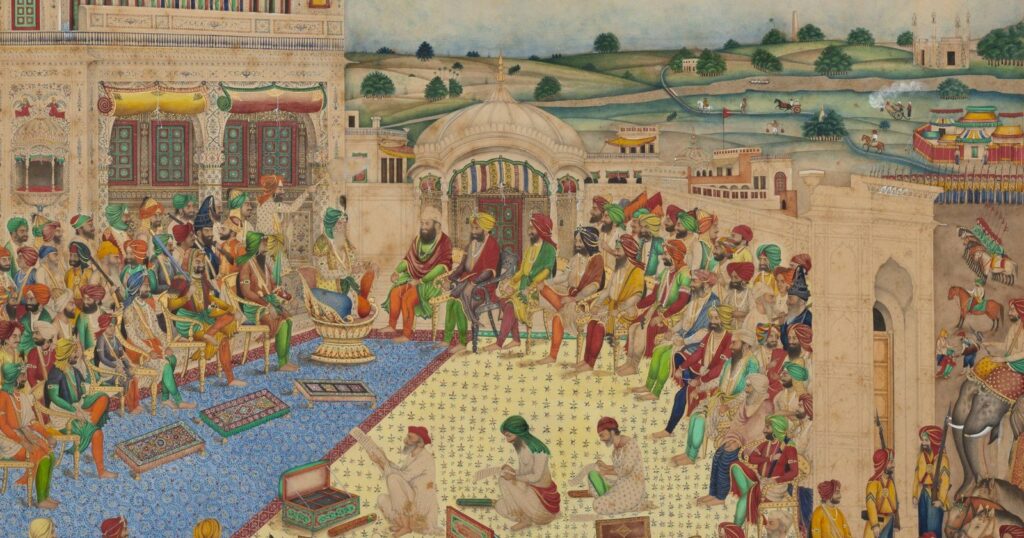
About 30 years before it came up for auction, a London taxi driver stopped at a car boot sale and found a large, crowded painting of a walled Indian town. The asking price was £60. He talked it down to £40, took the picture home and hung it in his living room, where, by an account artnet credited to the Daily Mail, it stayed until he decided to redecorate.
Early in 2016 he took it to Roseberys in West Norwood, south London, which entered it in a specialist sale with an estimate of £500 to £1,000. Bidders recognised the scene as the walled old town of Amritsar, with the Golden Temple (the Harmandir Sahib), the holiest gurdwara in Sikhism, in the background. The hammer came down at £75,000.
Lot 131 in West Norwood
Bill Forrest, a valuer at Roseberys, told artnet: “I just loved the scene.” The catalogue description the house gave the picture was rudimentary, the Antiques Trade Gazette reported. It went up as lot 131 in the Islamic and Indian Arts sale on Friday 15 April 2016.
According to Artlyst, bidding ran across seven telephone lines and in the room, and the winning bidder, on the phone, was not named. The £75,000 hammer price was 75 times the top of the estimate. With the 23 per cent buyer’s premium the bill came to £92,250, and headlines that spring used both figures.
Peter Greenway, a director and specialist at Roseberys, rang the vendor after the sale. The driver told him he had been having a bad day: his taxi had a flat tyre and he could not get to work. When he heard the price, he took the weekend off.
The man in the alcove
Nobody had signed the picture, a gouache on paper 59 by 85cm. Roseberys put a name to it anyway. “It wasn’t signed, but we believe it’s by Baba Bishan Singh,” Forrest said.
Bishan Singh was born in 1836, according to the Gazette, and died around 1900. He came from a family of painters who worked in Lahore and Amritsar in the second half of the 19th century and, the Gazette reports, looked after the murals and decorative motifs at the Golden Temple itself. If the attribution is right, he was painting a place his family knew from the inside.
He may even be in it. In the top left of the scene, in an alcove of one of the buildings, a figure sits with a portrait. The Gazette and Artlyst both took him to be the artist. The Gazette has him painting it; Artlyst described it as a portrait of an important Sikh figure.
Bishan Singh had been noticed long before collectors came looking. In 1864 he sent ten pictures to the Punjab Exhibition, where the paintings were judged by a six-man jury that included a British major-general, a Royal Engineers lieutenant-colonel and A. Raikes of the 93rd Highlanders. Its report, reprinted in B. H. Baden-Powell’s 1872 handbook to the manufactures and arts of the Punjab, began by lamenting that in scarcely any part of India were the fine arts in so low a condition as in the Punjab. It still found things to praise, and one name stood out. “The most clever and truthful paintings in this class,” the jury wrote, “are the work of Bishan Singh of Amritsar.”
It singled out three large pictures, of the courts of Maharaja Ranjit Singh and Maharaja Sher Singh and of the Municipal Committee of Amritsar, and called them “of great merit”. It admired their colour, their likenesses and their faces, and had one complaint. “The perspective of the buildings is incorrect,” the report said, “but the figure drawing is admirable.” The complaint was not aimed at him alone. The same report called ignorance of perspective and drawing the greatest failing of native artists, a want it thought “the most easy to supply”, and noted that the government was considering a school of design at Lahore.
How sure anyone can be
The attribution is an opinion. The painting carries no signature, and Roseberys’ own word was “believe”. The £75,000 was a vote for the picture, not proof of who painted it.
The Gazette also raised the possibility that this was one of the ten pictures shown in 1864. The jury report cannot settle that. Its entry describes the three large court and committee scenes and goes on to praise six smaller pictures of shawl-making. Whatever else Bishan Singh sent, the report does not describe it.
Almost everything known about the purchase comes from the driver himself, passed on by the auction house and the press, and none of the reports we read names him. They differ in small ways. artnet placed the purchase at “a nondescript yard sale” in north London and called the picture a canvas, where the Gazette says gouache on paper. None of the others says where the sale was, and none explains how a painting from the Punjab came to be on a car boot table.
Bishan Singh at auction
The 2016 price was not a record for the artist. The Gazette noted that a smaller Bishan Singh of Maharaja Ranjit Singh’s court had made $233,587 at Christie’s in October 2008, and that a view of Srinagar dated 1872 had failed to sell in 2015 against an estimate of £100,000 to £150,000.
Prices have climbed since. In March 2022 a Bishan Singh made £441,000 at Christie’s. Then, on 29 October 2025, Sotheby’s offered his Maharaja Ranjit Singh in Procession, Riding on an Elephant Through a Bazaar with an estimate of £200,000 to £300,000. Five bidders took it to £952,000 with fees, a record for the artist, and it went to an unnamed institution.
Set against that, the West Norwood result looks modest, and £40 looks like one of the great car boot buys. It also leaves one person out of the story: whoever stood behind the table that day, asking £60. Where had the painting been before that, and did they ever find out what they had let go?