
A woman paid £10 for a Harry Potter book from a bargain bucket in a remote Scottish bookshop café, and decades later it sold for £55,104 as one of the rare first hardbacks
She got a couple of pounds knocked off because the book had no dust jacket. The first 500 hardbacks of Harry Potter and the Philosopher's Stone were issued without one.
Only 500 copies of Harry Potter and the Philosopher’s Stone were printed in hardback for its first impression in 1997. Sotheby’s guide to the first editions lists the marks that give one away. The printer’s number line on the copyright page counts down from 10 to 1, and 1997 is the only date on that page. Bloomsbury’s name sits at the foot of the title page. “1 wand” appears twice in Harry’s list of school supplies on page 53, and on the back cover the title is misprinted “Philospher’s”. The book came in pictorial laminated boards, with no dust jacket.
In 1997 a Scottish woman on a family holiday found one in a wicker “bargain bucket” on the floor of a bookshop café in the north-west Highlands. Because it had no dust jacket, she got “a couple of pounds knocked off the price,” and Hansons says she paid £10. On 11 December 2023, Hansons Auctioneers sold it at its Library Auction at Bishton Hall in Staffordshire for £55,104 with buyer’s premium, to a private online buyer in the UK.
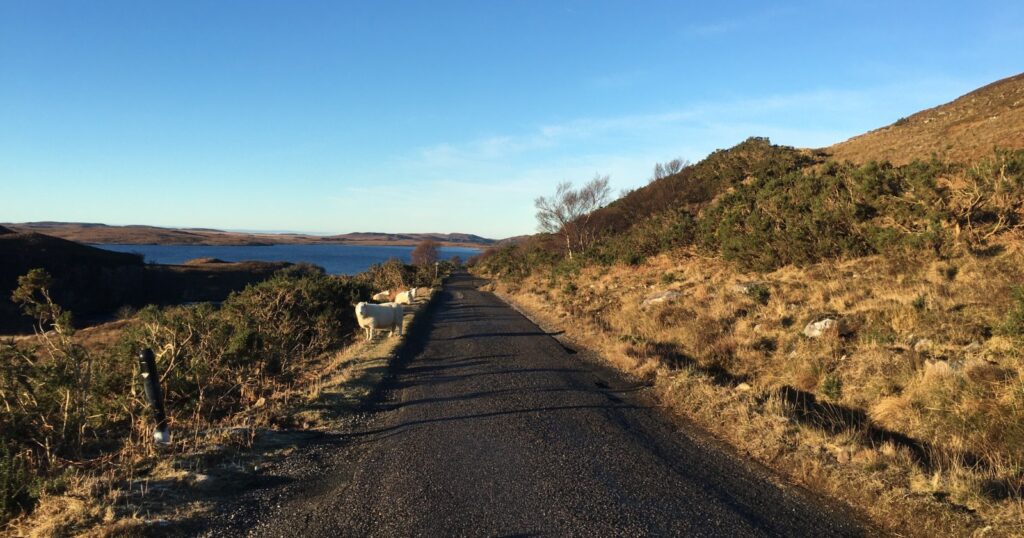
The single-track road
The seller, who was 58 at the time of the sale and recently retired from a management job in the voluntary sector, had learned about the book from one of the first interviews with J.K. Rowling, in The Scotsman. “I bought the Harry Potter book before anyone really knew much about it, or the author,” she told Hansons.
The family was touring the Highlands by caravan. “I discovered a bookshop café on an isolated peninsula after driving miles on a single-track road in the north-west of Scotland,” she said. She recognised the cover straight away. “Our two children enjoyed the wizard tale as a bedtime story all through that holiday in 1997.”
Hansons did not name the shop. Scottish Field‘s report of the sale puts the café at the end of a single-track road near Ullapool, in Wester Ross. Jim Spencer, the auction house’s Harry Potter books specialist, put the find down to that newspaper interview. “It’s astonishing it ended up on a remote Scottish peninsula,” he said after the sale, “and it was all down to an article in The Scotsman, and perhaps a dusting of magic, that encouraged the inquisitive and very lucky buyer to pluck it from the bargain bin.”
Later, her children read online how to spot a first edition and told her they thought the family had one. She waved it away, sure that a copy with no dust jacket was worthless. “Some time later I learned the book was never released with a dust jacket,” she said. “At that point, we stored the book away. It lived like the young Harry Potter did, in the cupboard under the stairs.”
She forgot about it for a long time, until she read about how rare the first editions had become and contacted Spencer, whom Hansons calls a world-renowned expert on Potter finds. By then her children were grown up, and she “thought it was time for someone else to have the pleasure of owning a rare piece of literary history.”
Two hundred for the shops
According to Spencer, 300 of the 500 first-impression hardbacks went to schools and libraries “in order to reach a bigger audience,” and the other 200 went to bookshops. The Edinburgh auction house Lyon & Turnbull gives the same split, with around 300 said to have gone to libraries. The Highlands copy was one of the shop 200.
That matters for price. Most copies that turn up are “quite badly worn,” Spencer said, ex-library ones above all, having often been shared among friends and carried around in school rucksacks. In some ways, he said, that history is “lovely, capturing the buzz of Harry Potter when it first gained popularity.” More traditional collectors, though, are “incredibly fussy about condition,” and condition is what helped this book fulfil its potential. After years in a cupboard, it was in his words “a genuine, honest first issue and a fantastically well-preserved example,” and before the sale he noted it had never been “paraded around salerooms or rare book fairs or been restored.”
Hansons estimated it at £40,000 to £60,000. Twenty-six years after the holiday, the hammer fell at £42,000, and the buyer’s premium took the total to £55,104. “It’s a great result for a great find,” Spencer said. It was the 19th of the 500 hardbacks he had found, according to the auction house, and his copies had sold for between £17,500 and £69,000 plus premium, depending on condition.
How much she paid
Hansons’ two releases are loose about the price. The pre-sale release says the book “cost a tenner.” The results release says she “bought it for £10 and even managed to get £2 knocked off the price.” Neither says what was written on the book. NationalWorld put the asking price at £12, which fits £10 paid. The seller’s own words were “a couple of pounds,” and no receipt has been published.
Most of this story comes from one place. The seller is unnamed, and her account reaches us through the auction house that sold her book, in a press release written to publicise the sale. The print-run figures of 500, 300 and 200 are the ones auction houses repeat. We did not see Bloomsbury’s own records, and Lyon & Turnbull’s wording, that around 300 “are said to have gone to libraries,” is the more careful form.
“These first issues are getting harder and harder to find,” Spencer said. This one, he said, “must be one of the few remaining copies that’s been in private hands since it was purchased in 1997.” Hansons does not say where the rest of the 200 shop copies went. In November 2024, Spencer, by then a director of Rare Book Auctions, said he had found 20 of the 500.