
The Tower House at 29 Melbury Road in Holland Park was William Burges’s own Gothic Revival home, built between 1875 and 1881, and Jimmy Page reportedly paid Richard Harris £350,000 for it in 1972
William Burges built the Tower House in Holland Park for himself in 1875-81; Jimmy Page reportedly paid Richard Harris £350,000 for the Grade I house.
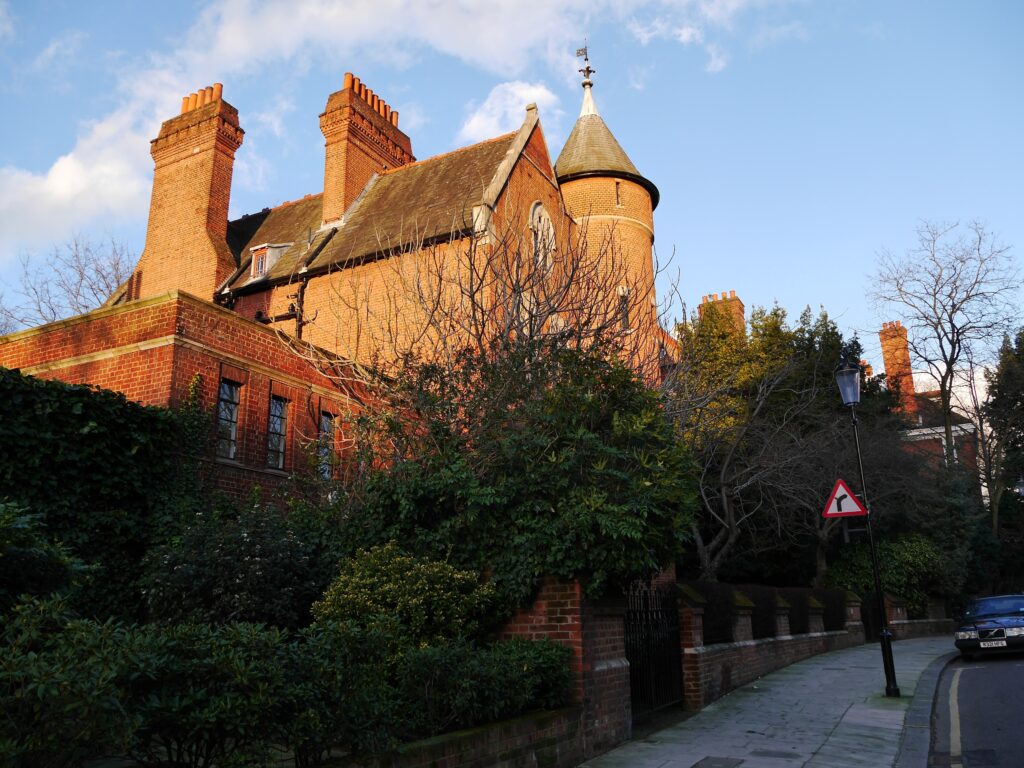
The Tower House at 29 Melbury Road, Holland Park, is the house the Victorian architect William Burges designed and built for himself. The Historic England list entry, reproduced by British Listed Buildings, dates it to 1875-81, names Burges as both architect and client, and records the house as Grade I, first listed on 29 July 1949 and last amended on 7 November 1984, under entry 1225632. Its best-known owner is Jimmy Page, the Led Zeppelin guitarist, who bought it from the actor Richard Harris in 1972 for a reported £350,000.
A Gothic house its architect built for himself
The official description is plain about what went up on the Kensington plot. It records a detached house of 1875-81, by William Burges, for himself: red brick with a slated roof, two main storeys over a basement, and a roof storey above, in an asymmetrical composition in the Gothic style. A wing is advanced to the left with its gable to the road; a second wing is set back at right angles to the right; and between the two stands a round tower with a conical turret. The entrance is on the right-hand return, under a projecting porch. The windows are mullioned and transomed, with leaded lights and stained glass, and there are lancet windows to the tower. The entry also lists tall chimneys and a garden wall, and ends with two words about what is inside: “important interiors”.
Published accounts fill in the detail behind that phrase. The walls are red brick with Bath stone dressings, the green roof slates came from Cumbria, and the design is French Gothic Revival, drawn up between 1875 and 1881 as Burges’s own home. The cylindrical tower and its conical roof are what fix the house in the memory of anyone who has walked past. The architectural historian J. Mordaunt Crook called the result “the most complete example of a medieval secular interior produced by the Gothic Revival, and the last” — a judgement that places the house at the end of a movement rather than in the middle of it.
The house passed to Burges’s brother-in-law, Richard Popplewell Pullan, and then through a run of private owners: Colonel T. H. Minshall, and from 1933 Colonel E. R. B. Graham. Much of the furniture Burges designed for the rooms — among it the Great Bookcase, the Zodiac settle, the Golden Bed and the Red Bed — is now in museum collections, including the Ashmolean in Oxford, the Higgins Bedford and the Victoria and Albert Museum in London. The movable pieces are scattered; the shell and the fixed decoration remain on Melbury Road.
The listing itself carries a trace of the address changing over time: the entry notes that the house was previously listed as No 9, and it is tied into the group value of the surrounding Melbury Road buildings. The 1984 amendment left the Grade I designation of July 1949 in place.
Empty and vandalised, then bought by an actor
The poet John Betjeman, a defender of Victorian buildings at a time when few people were, inherited the remaining lease in 1962 but did not extend it. The house then stood empty and was vandalised — an episode that puts designation into perspective, since the Grade I listing of 1949 did not keep the building occupied or its glass intact. Lady Jane Turnbull took on its restoration, and Harris came next in the sequence of owners.
Harris bought the lease in 1969 for a reported £75,000, a figure given in Michael Feeney Callan’s 1990 biography of the actor. The same account has Harris reading of the intended sale in the Evening Standard and buying the following day, after learning that the American entertainer Liberace had reportedly made an offer but had not put down a deposit. The speed of it belongs to its moment as much as the price does.
He was buying at a point when British actors and musicians with sudden money were taking on large houses that few others wanted. In the same year John Lennon bought a 72-acre estate at Ascot, and in 1970 George Harrison took on Friar Park, a crumbling Victorian mansion bought from a group of nuns. Melbury Road was a smaller proposition than either, and a stranger one: a complete Gothic Revival interior on a single Kensington plot.
Jimmy Page and the reported £350,000
Page bought the house from Harris in 1972. Callan’s biography puts the price at £350,000, and Crook’s study of Burges says Page reportedly outbid the musician David Bowie for it. Both come from published accounts rather than from documents in the public record, and they are best read that way: reported figures and a reported contest, repeated often enough to have hardened into the house’s folklore.
Page has held the house since. Quoted by BBC News, he said: “I was still finding things 20 years after being there – a little beetle on the wall or something like that; it’s Burges’s attention to detail that is so fascinating.” The remark fits a building in which the decoration, the carving and the fittings were designed as one scheme by the man who commissioned them.
Ownership has occasionally put Page into planning arguments. In 2015 he challenged a planning application by Robbie Williams, who had bought the neighbouring Woodland House in 2013. The Tower House remains a private home. What the listing protects is the whole of it: the gable to the road, the tall chimneys, the garden wall, the round tower with its conical turret, and the interiors that the list entry sums up in two words and that Crook judged the last of their kind.