
The 1908 fire at Burley on the Hill broke out during a party attended by Winston Churchill, who commandeered a fireman’s helmet and helped fight it, and the Great Stair and library it spared go to auction at Savills on 24 November, guided at £3.25m
Savills offers the Burley on the Hill Great Stair and Library on 24 November; Country Life reports a £3.25m guide for the rooms the 1908 fire spared.
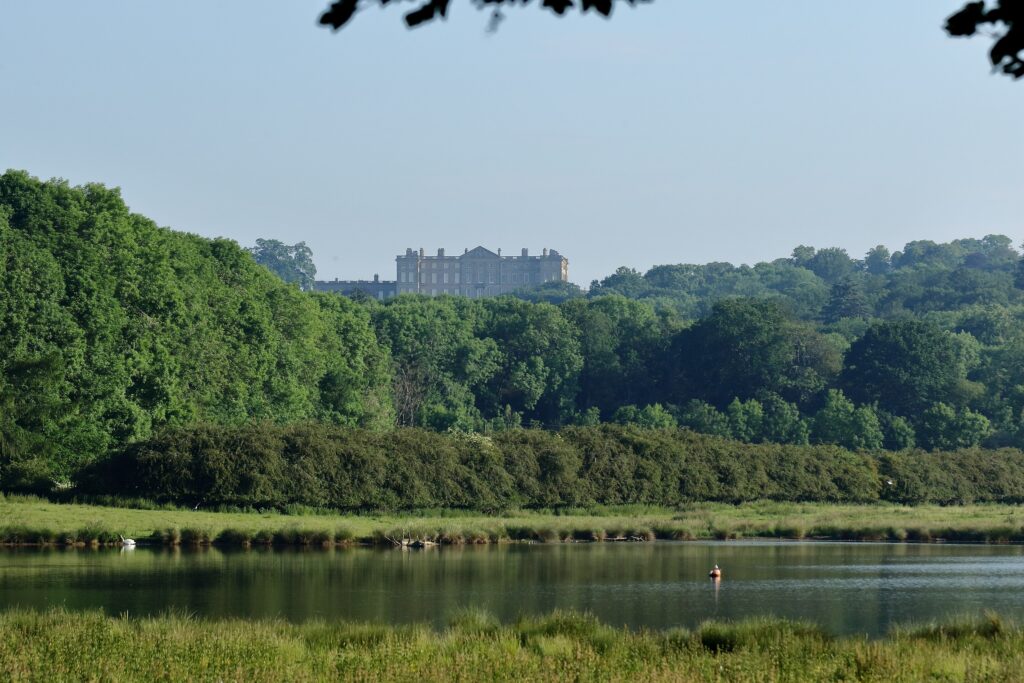
The Great Stair and Library at Burley on the Hill in Rutland, the section of the mansion the 1908 fire spared, goes under the hammer at Savills’ auction on Tuesday 24 November, with a guide price of £3.25m in Savills’ lot listing, a figure also reported by Country Life.
The same figure appears in LincsOnline, which gives it as £3.25 million, and in Oakham & Rutland News, which lists “Guide price £3,250,000”. The auctioneer says guide prices may change up to and including the day of the sale.
The lot is part of the house rather than the whole of it: a Grade I listed residence of about 12,083 sq ft over four floors, with seven bedrooms, six bathrooms, the Library, a run of state rooms, and access to about 67 acres of shared parkland and deer park with views south towards Rutland Water. Savills describes the Great Stair and Library as having survived “the disastrous fire of 1908, which destroyed much of the western half of the mansion”.
“Opportunities to acquire a home of this historical significance at auction are exceptionally rare,” said Gary Murphy, a director with Savills Auctions, in remarks quoted by LincsOnline. “The survival of the Great Stair and Lanscroon’s murals following the fire of 1908 makes it one of the most remarkable private residences to come to the market this year.”
The party, the dispatch box and the helmet
The fire broke out following a party attended by Winston Churchill, who had been appointed President of the Board of Trade a few months earlier, his first Cabinet post, Country Life reports. The house’s own history records that the blaze began “during a party attended by a young Winston Churchill”, destroying the interior of the west half of the house, including the Ball Room, while “the Great Stair and Library survived without damage, painted walls, ceiling and all”.
The fullest account of Churchill’s part in the night is in Dispatches, where Ric Carlyon draws on contemporary newspaper reports and Churchill’s own words. Churchill, then courting Clementine Hozier, was staying with his friend Freddie Guest, the International Churchill Society records. Dispatches places the gathering after his brother’s wedding, with guests staying on at the house once the couple had left. A newly installed heating system caught fire after the household had gone to bed; a maid raised the alarm, and guests fled to the lawn through smoke and falling debris.
Churchill first carried a ministerial dispatch box of papers to safety, then went back inside for artefacts, the last of them reported to be two busts, leaving a stateroom moments before a vaulted ceiling came down. “He worked like a Trojan,” a newspaper report said, “saving what he could until the flames beat him.”
Outside, the Oakham Fire Brigade had arrived with its manual appliance. In Churchill’s own words, quoted by Dispatches: “I commandeered a fireman’s helmet and assumed direction of operations. I was on the roof, shouting down orders, trying to quench the blaze with the tiny fire engine which had been brought from Oakham.”
In a letter he wrote that “the fire was great fun and we all enjoyed it thoroughly”, adding: “Alas for the archives. They roared to glory in about ten minutes.” The International Churchill Society records the fire in its chronology for the summer of 1908. Preliminary reports that the whole place had been destroyed alarmed Hozier until she read in The Times that all the occupants had got out safely, and the couple married a few weeks later, on 12 September 1908, beginning Churchill’s marriage to Clementine. The purchase of Chartwell, bought the week his daughter Mary was born, came later.
What the fire took and what it left
Gerard Lanscroon, the Flemish painter who had decorated Windsor Castle and Hampton Court Palace under Antonio Verrio, was employed between 1708 and 1712 to paint both the Great Stair and the Ball Room for Daniel Finch, 2nd Earl of Nottingham. The stair murals tell the story of Perseus and Andromeda, with Pegasus, one of the Earl’s crests, and a ceiling showing Mars rising into the sun and Juno driving a chariot drawn by swans. The Ball Room decoration was lost in 1908. The Ball Room is not included in the sale, although the buyer will have access subject to certain conditions, according to Country Life.
A house on the hilltop appears in the Domesday Book of 1086. Parliamentarian troops garrisoned at Burley set fire to the mansion in 1644 to keep it from Royalist hands, leaving only the stables on the east side of the Great Courtyard. Finch bought the estate in 1694, had the remains demolished in 1695 and spent almost 30 years rebuilding, at a cost of more than £80,000 against an initial budget of £25,000. The overrun forced the sale of Kensington House, his London property, to King William III.
The sale
Burley on the Hill ran into difficulties in the second half of the 20th century but avoided demolition. In the 1990s the architect Kit Martin converted the house, outbuildings and stables into 23 separate homes, work for which Country Life gave it the Country House of the Year award in 1996. The main house was divided into six residences, of which the Great Stair & Library is the largest and the only one with its original state rooms intact.
It is offered freehold with vacant possession. Common areas, the colonnades, the Cour d’Honneur and the terraces are maintained through an annual service charge, and there is garaging for four cars. The lot is marketed with scope to divide into two homes of about 6,000 sq ft, subject to consents. Oakham lies about two miles west, and its station has direct services to London St Pancras in about 90 minutes, while Peterborough, about 22 miles away, reaches London King’s Cross in as little as about 45 minutes. Viewing is by appointment through Savills, whose Stamford office and country department are joint auctioneers.