
In 1938, Agatha Christie and her archaeologist husband bought Greenway, a house above the River Dart she had known since childhood, for £6,000. Today it holds more than 12,000 objects collected by five generations of her family, from Max’s excavated pottery to her own first editions
Agatha Christie paid £6,000 for Greenway in 1938, the same year she sold Ashfield, her childhood home. Much of Ashfield's china came with her, and it is still there among more than 12,000 objects.
By 1938, Agatha Christie had fallen out of love with Torquay. The town she grew up in had been built up around her, and the sea view from Ashfield, the villa where she was born, was blocked by new houses. She and her second husband, the archaeologist Max Mallowan, started looking along the coast for somewhere else.
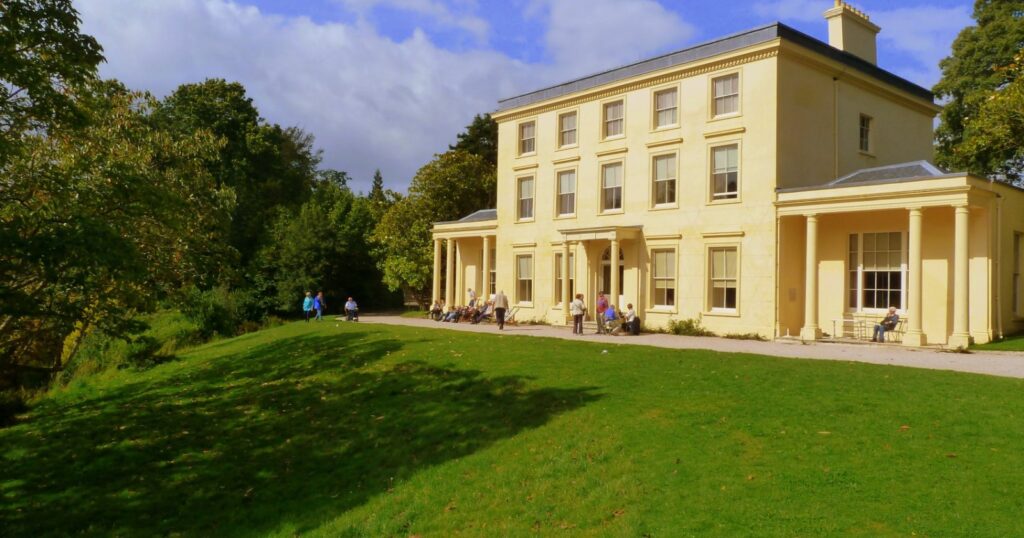
What they found was a house she already knew. “One day we saw that a house was up for sale that I had known when I was young,” she wrote in her autobiography. “A white Georgian house of about 1780 or 90, with woods sweeping down to the Dart below, and a lot of fine shrubs and trees – the ideal house, a dream house.”
Greenway, with 36 acres running down to the River Dart, was on the market for £6,000, a modest price for a house of that size on one of the finest stretches of river in Devon. The National Trust records that the couple bought it in 1938, and Historic England notes that the purchase went through in the name of “Mrs Max Mallowan”, presumably to keep her readers at a distance.
Cutting the house back to its Georgian shape
The house they bought was not quite the one Christie remembered. In 1892 a Victorian owner had added an east wing with a billiard room, a study and extra bedrooms. Christie and Mallowan had it pulled down. Working with the Australian architect Guilford Bell, they restored the Georgian character of the place and replaced the wing with a simple rear lobby.
It was never meant to be their main home. Greenway was a holiday house, somewhere for summers, Christmases and family. Christie called it “the loveliest place in the world”, and it was a place to relax rather than write. That did not stop it turning up in her fiction. The boathouse is where the first body is found in Dead Man’s Folly, and the battery overlooking the river is the scene of the murder in Five Little Pigs.
Where Ashfield went
The detail that is easy to miss is what else happened in 1938. Christie sold Ashfield that year, the house where she was born in 1890 and where she had grown up. It was not an easy decision, and she made it only after she had fallen for Greenway.
Not everything went with the sale. According to a National Trust curator, much of the family china came to Greenway instead, including the Dresden and Capodimonte porcelain that “Auntie-Grannie”, her step-grandmother and great-aunt, had brought to Ashfield, and Christie had to have new cupboards built to hold it all. Her father’s collection of European porcelain came too. The Drawing Room is still furnished with pieces from Ashfield, along with her Steinway piano. It was in this room that the family gathered to hear the first readings of her new manuscripts.
Ashfield itself was demolished in the 1960s to make way for new housing, and Christie, by one account, cried helplessly. Only a blue plaque marks the site. So the house a visitor can walk around today is, in a real sense, where Christie’s childhood ended up.
She knew exactly what she had inherited. “There is no doubt that we were a family of collectors and that I have inherited these attributes,” she wrote, adding, a little ruefully, that inheriting a good collection of china and furniture left you no excuse to start one of your own.
Max’s pottery
She started one anyway, with Max. They had met in 1930 at Ur, in Iraq, where he was working on Leonard Woolley’s excavation and she was a guest. They married that September. On his later digs in Syria and Iraq she took drawing lessons so she could record the ceramic finds, and she was known to mend some of the pots he dug up. Max used pottery to work out the dates of the sites he excavated, and some of his excavated material, including pottery sherds, is still at Greenway.
The finest object in the house came from that shared interest. The National Trust describes a Tang dynasty earthenware camel, made around 1,300 years ago and given to Agatha by Max, as perhaps the single most important thing at Greenway. They did not treat their treasures as museum pieces. The couple bought a Song dynasty dish and used it to serve rice, to the dismay of the Oxford dealer who sold it to them.
A war memorial in the library
The war soon took the house away from them. It was first used as a nursery for ten young evacuees from Paddington. Then, in January 1944, a flotilla of 24 American landing craft arrived in the Dart, and the house was requisitioned by the US Coast Guard for the build-up to D-Day.
The officers used the library as their mess, with a bar in the alcove. One of them, Lieutenant Marshall Lee, painted a frieze around all four walls in 12 coloured scenes showing the flotilla’s journey to Devon. When the Mallowans came back, the commanding officer offered to paint over it. The family said no. Christie called it her “living war memorial”, and it is still there. The Americans had also added a row of lavatories, and those she did fight to have removed.
Five generations in one house
In 1959 Christie sold Greenway to her daughter, Rosalind, though Rosalind and her husband Anthony Hicks did not move in for good until after Agatha and Max had died, in 1976 and 1978. They kept collecting. When Anthony’s parents sold their house in Wales, their collection of Swansea and Nantgarw porcelain came to Greenway, and more than 100 pieces are still there. Between them, Rosalind and Anthony also built up more than 100 pieces of studio pottery, including work by Bernard Leach, Lucie Rie and Shoji Hamada. It is the largest collection of modern studio pottery anywhere in the National Trust.
They tried making pots themselves at evening classes. One of Anthony’s efforts, with a green glaze that did not go to plan, was known in the family as the “vomit plate”. It is still in the collection.
Rosalind and Anthony gave the estate to the National Trust in 2000, and the garden opened that year. After they died, in 2004 and 2005, Christie’s grandson Mathew Prichard gave the contents of the house to the Trust as well. The building needed serious work, with cracked walls and ceilings, detached lintels and subsidence, and it opened to the public in February 2009 after a £5 million restoration.
What the house holds now
The Mallowans owned several houses, but Greenway is the only one that still has its original collection in place. The National Trust puts it at more than 12,000 items, gathered by five generations of the family: Christie’s grandparents and parents, Agatha and Max, Rosalind and Anthony, and Mathew. There are ceramics, glass and silver, more than 80 pieces of Tunbridge ware, watches, a Japanese skull jar that held Max’s tobacco, and souvenirs from decades of travel.
The library holds about 5,000 books. Upstairs, in the Fax Room, are first editions of Christie’s own novels.
Greenway has featured in British Heritage before, as the heart of Christie’s Devon. But the way the collection came together is the part that stays with you. Christie paid £6,000 for a house she had admired as a girl, in the same year she gave up the house she had actually grown up in. The china from Ashfield went into cupboards built for it at Greenway, where it still sits, a few rooms away from the pots Max dug out of the ground in Syria and Iraq and the first editions of the books that paid for all of it.