
Fifteen minutes into an evening of metal detecting in a Warwickshire field, Kevin Short found a gold posy ring inscribed “I live in hope”, which the British Museum dates to the 16th to 18th century and which goes to auction on 2 December.
A gold posy ring inscribed "I live in hope", found in a Warwickshire field, goes to auction on 2 December with an estimate of £2,000 to £3,000.
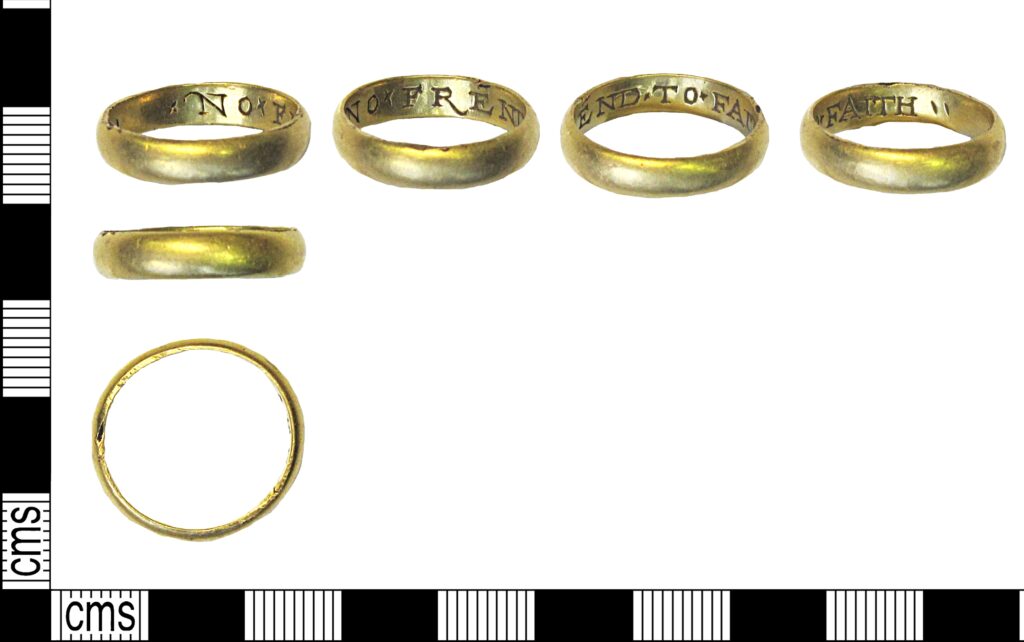
Kevin Short was about 15 minutes into an evening of metal detecting with friends in a Warwickshire field when he pulled a gold posy ring inscribed “I live in hope” out of the soil, BBC News reported on 12 November. The ring lay a couple of inches beneath the surface.
The British Museum dated the ring to the 16th to 18th century. It will be offered at Oxfordshire-based Holloways Auctioneers on 2 December with an estimate of £2,000 to £3,000.
“I was genuinely surprised to find something like this so quickly… I knew straight away it was gold, although I had no idea of its quality or how significant it might be,” Short said.
He gave a fuller version of the same account to the Banbury Guardian: “We’d only been searching for around 10 to 15 minutes. I saw it glinting and picked it out from the soil.”
“When we realised what we’d found, we did the gold dance! It’s certainly not bad for a day’s work,” he said. Short has been metal detecting for years and said this was his most exciting discovery.
The earring posted off the night before
The evening before the find, Short had put a photograph of an earring he had recovered while detecting on a metal-detecting Facebook group, hoping someone could identify it, the Banbury Guardian reported.
Someone replied to say it looked exactly like an earring that had belonged to their late sister, the original having been lost. Short offered to send it on free of charge and thought little more of it. He found the owner through Facebook and posted the earring off for nothing.
The ring turned up the following evening. Short said the sequence left him wondering whether a little good karma would come his way.
Single finds of this kind account for much of what detectorists record in Britain. One of the more unusual recent examples was the discovery by a father on the Isle of Man of the island’s only known pair of Viking women’s brooches.
What a posy ring is
Posy rings are known for having short inscriptions on the inside of the band, according to BBC News. National Museums Scotland has described them as some of the most evocative objects of love in its collections.
A Banbury Guardian caption sets out the Warwickshire ring’s inscription as it reads on the band, with crosses between the words: “x I x LIVE x IN x HOPE x”.
The British Museum assessed the ring and its report confirmed the piece’s authenticity, the Banbury Guardian reported. The museum’s dating gives a range rather than a single year.
Metal detecting has also produced some of the largest archaeological finds made in England, among them the Staffordshire Hoard of Anglo-Saxon gold and silver. Short’s ring came up within the first quarter of an hour of a search.
The sale at Holloways on 2 December
Amanda Butler, director at Holloways, said: “One of the things I love about pieces like this, is that they always carry so many unanswered questions. Who wore it? Was there a special reason for the inscription?”
“‘I Live In Hope’ is such a beautiful sentiment, particularly when you consider that it’s been carried through the generations.”
“There’s a whole story here that we’ll probably never know, but it’s lovely to imagine,” she said.
Who had the ring made, who wore it and how it came to be lying a couple of inches beneath a Warwickshire field are not recorded. The ring goes under the hammer at Holloways in Banbury on 2 December with an estimate of £2,000 to £3,000.