
Sissinghurst was a run-down Elizabethan mansion with farm workers’ housing, vegetables and hop gardens when Vita Sackville-West and Harold Nicolson bought it in early 1930, and by the late 1930s its garden was open to the public for a shilling
The National Trust records that Sissinghurst housed farm workers and grew vegetables in 1930, and that its garden opened for a shilling by the late 1930s.
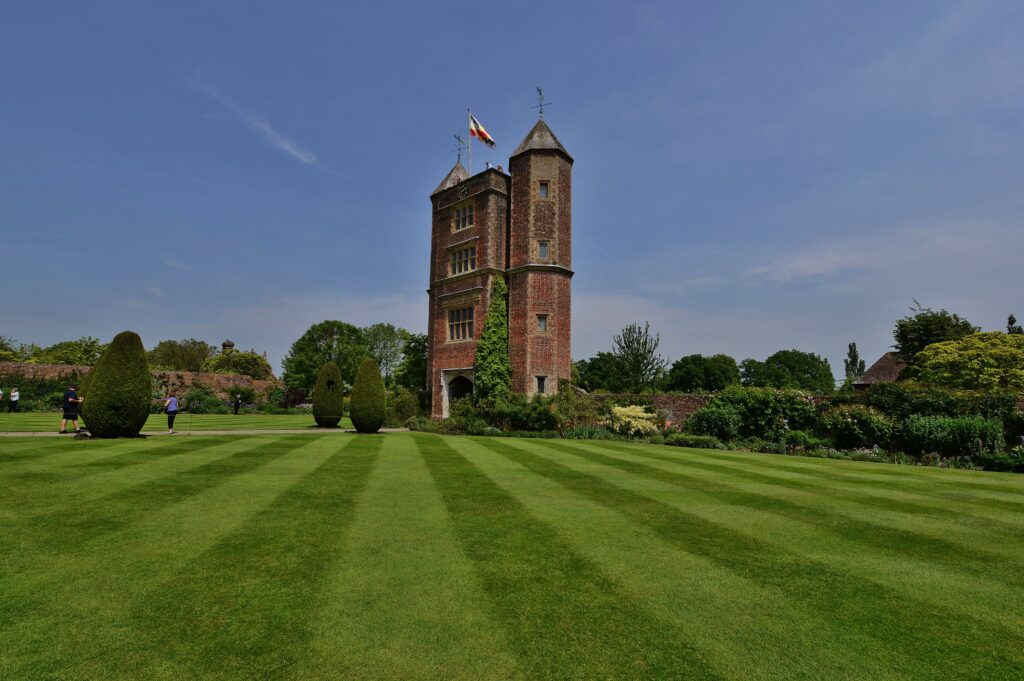
The National Trust’s history of Sissinghurst Castle Garden records that when Vita Sackville-West and Harold Nicolson bought the place in early 1930, the buildings were being used to house farm workers and the garden it is now known for “had yet to be laid out and was mostly used to grow vegetables for the workers”.
The surrounding farm was growing cereals and had well established orchards and hop gardens. On the Trust’s page on who Vita Sackville-West was, written by Allison Adler Inglis-Taylor of the University of Oxford, what the couple took on in 1930 is described as “a then run-down Elizabethan mansion in Kent”, and the pair “began immediately to renovate both house and garden”.
The state of the place was poor. None of the buildings were inhabitable, the Trust says, and the grounds were full of rubbish: old sardine tins, cabbage stalks and rusty bedsteads littered the ground. None of this mattered to Vita, who saw its great potential.
“I fell in love; love at first sight. I saw what might be made of it. It was Sleeping Beauty’s Castle…” – Vita Sackville-West on Sissinghurst
From Saxon pig farm to sale particulars
The site had already been several things. It was once a Saxon pig farm, originally called Saxenhurst, with “hurst” having meant woodland. A manor house stood there from the 12th century, probably in what is now the orchard, bounded on two sides by a moat, and a chapel to St John the Evangelist was founded in 1235. The present buildings are the remains of a mansion erected in about 1535-40, according to the Trust’s heritage record for Sissinghurst Castle, Cranbrook.
The Tudor buildings held up to 3,000 French sailors captured by the British during the Seven Years War, between 1756 and 1763. The prisoners were kept for months at a time in vile, stinking conditions, in cells with little access to fresh air, clean water or adequate food. The sailors referred to the place as “le chateau”, which is how “castle” was adopted into the name, although not as a direct translation.
In 1796 the Cranbrook “Councillors” took out a lease on Sissinghurst from the Mann-Cornwallis family and ran it as a poor house for the able-bodied, with around 100 men offered housing, employment and food. The owners repaired many of the buildings, and the weathervanes still carry the markings MC 1839. The estate reverted to the Cornwallis family in 1855, at the start of a period of Victorian high farming, and the Sissinghurst farm was deemed the best on the whole of the substantial Cornwallis estate.
The heritage record notes that the property was put up for sale in 1903 and again in 1927 before being purchased in 1930 by Sackville-West and Nicolson. The Trust’s pages give no purchase price. Other English houses were bought and remade by private owners in the same century, among them Chartwell, bought by Winston Churchill.
A garden laid out in rooms
Vita loved old roses, and at Sissinghurst she finally had the space to indulge the passion. Her vision, the Trust says, was for “a tumble of Roses and Honeysuckle, Figs and Vines”. She and Harold made the Rose Garden in what had once been a kitchen garden, and filled it lavishly with her favourite old roses.
The two worked differently. Vita is described as a gifted amateur who gardened instinctively and without the desire for perfection, wanting flowerbeds bursting with colour rather than visible soil. Harold took a more classical approach, feeling more comfortable with straight lines that could create a framework for planting. Together they made spaces that gave views for miles around, in the Weald of Kent.
The Trust’s visitor page for Sissinghurst dates the garden to the early 1930s and describes it as “designed in a series of ‘rooms’ with summer highlights including the Rose Garden and the White Garden”. Gardens made by their owners and later opened to visitors include Highgrove, King Charles’s Duchy of Cornwall garden.
Vita and her ‘shillingses’
The garden at Sissinghurst Castle opened to the public in the late 1930s. The admission fee was one shilling, “hence Vita’s name for visitors to the garden: shillingses”. Visitors would often leave their admission charge in an old tobacco tin on a table under the entrance archway.
The buildings went on changing around them. A photograph in the Sissinghurst collection shows the library as it appeared in the 1940s; before conversion, the large, long room had formed part of the stables. Vita and Harold added a large window, built a stone fireplace using fragments found in the garden and panelled the walls in dark oak. The room was not used often unless there were important and grand guests.
During the Second World War the shorthorn dairy cow enterprise continued, with members of the Women’s Land Army waking at 5.30am to milk the cows. Vita was heavily involved in the organisation and welfare of the Land Army in Kent. By the 1950s Sissinghurst was a working farm with a yard and machinery all over the site. Several buildings no longer exist; of those that remain, the gift shop was once the piggery and the restaurant the granary.
Sackville-West died in 1962. The Trust’s page on her life says Sissinghurst became a Trust property upon her death; the heritage record dates the donation to 1967. Sissinghurst Castle is a Grade I registered park and garden.
The shilling is long gone. The visitor page lists adult admission at £15.40 with Gift Aid and £14 without, a child ticket at £7.70 and £7, and parking at £4.50 for non-members, with tickets bought on arrival rather than booked. The site is closed on 24 and 25 December, which is worth checking against a festive holiday in a Kent garden.