
In 1964, an Edinburgh antiques dealer paid £5 for a small walrus-ivory figure and his family kept it in a drawer for 55 years; in 2019 Sotheby’s identified it as a missing Lewis Chessman and sold it for £735,000
An Edinburgh dealer bought a battered walrus-ivory warrior for £5 in 1964, and his family kept it in a drawer. In 2019 Sotheby’s attributed it to the Lewis Chessmen hoard found in 1831, and it sold for £735,000.
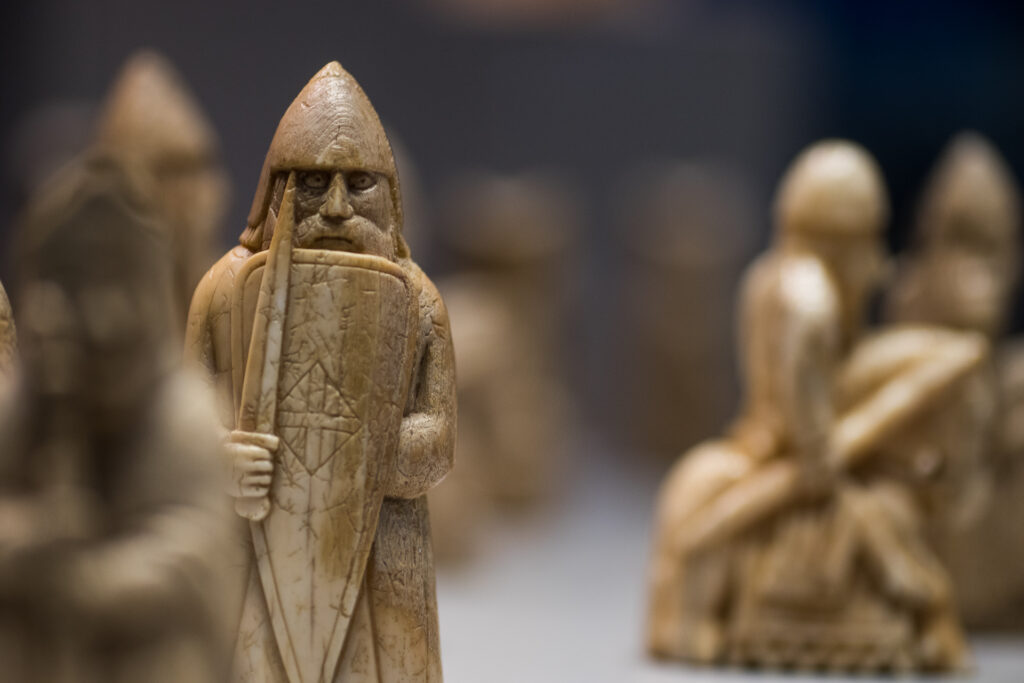
In 1964 an antiques dealer in Edinburgh paid £5 for a small, battered figure of a warrior carved from walrus ivory. It stood 8.8cm tall, held a sword and a shield, and had lost its left eye. He wrote it into his records as an “Antique Walrus Tusk Warrior Chessman” and took it home.
Nobody in the family connected it to anything famous. When the dealer died it passed to his daughter, who kept it in a drawer, wrapped in a small bag. She was fond of it. Her family later said she “believed that it was special and thought perhaps it could even have had some magical significance”.
In 2018, more than half a century after the £5 purchase, the next generation took it to Sotheby’s in London to find out what it was. The answer, according to Sotheby’s, was that it was probably one of the most famous lost objects in British archaeology: a missing piece of the Lewis Chessmen.
A hoard from the sand
The Lewis Chessmen were found in 1831 on the west coast of the Isle of Lewis in the Outer Hebrides, most likely near the beach at Uig. Accounts of the discovery disagree. One describes a ruined building, another a small stone structure buried in the sand. The exact spot has never been confirmed.
What came out of the ground was extraordinary. According to Sotheby’s count, the hoard held 93 objects: 59 chessmen, 19 pawns, 14 flat round pieces for another board game, and a belt buckle. Nearly all were carved from walrus ivory, with a few from sperm-whale teeth. The kings sit on thrones with swords across their knees, the queens rest their cheeks in their hands, and some of the warders, the pieces that take the place of rooks, bite the tops of their shields like Viking berserkers. They are usually dated to the late 12th or early 13th century and are thought to have been made in or around Trondheim, in Norway, though some scholars argue for Iceland or the Hebrides themselves.
The hoard was split up almost at once. The Stornoway merchant Roderick Ririe showed the pieces to the Society of Antiquaries of Scotland in Edinburgh on 11 April 1831. He sold ten to the collector Charles Kirkpatrick Sharpe and the rest to the Edinburgh dealer T. A. Forrest, who sold them to the British Museum. The dealer asked 100 guineas, and the museum’s Edward Hawkins talked him down to 80. That bought the museum 82 pieces. Sharpe’s pieces, which eventually numbered 11, passed through the collection of Lord Londesborough before reaching what is now the National Museum of Scotland in 1888.
Counted up, the figures make four chess sets, except that one knight and four warders are absent. For almost 190 years, nobody knew what had become of those five pieces.
What the expert saw
The family’s figure landed with Alexander Kader, Sotheby’s co-worldwide head of European sculpture and works of art. He spent about a year on it, comparing it piece by piece with the Lewis warders in the British Museum and the National Museum of Scotland.
The match was close. In its catalogue entry, Sotheby’s pointed to the ear flaps of the helmet, the way the hair and beard are cut, the cross on the shield, the placing of the sword and the shoulder strap. At 88mm it sits comfortably in the range of the known warders: smaller than seven of them and larger than five. Its ivory also carries the same network of fine channels seen on the Lewis pieces, which the catalogue linked to long burial in sandy soil.
In one way it was unlike every other Lewis piece. The museum pieces have all been cleaned at some point. This one never was. It is dark, crusted in places and worn, with losses to the left eye, the head, the sword and the right hand.
The paper trail helped too. The catalogue traced the figure to an Edinburgh owner named B. Dick before 1964, and suggested it may have passed through the hands of Ririe and Forrest, the same two men who sold the original hoard. Since the 1831 find, no other warder of the Lewis type had ever surfaced.
The caveat in the small print
Sotheby’s did not sell it as a certainty. The lot was catalogued as “attributed to the Lewis Chessmen workshop”, and the catalogue said only that it was “a logical deduction” that this could be one of the lost pieces, adding that “there is and will continue to be healthy scholarly debate on this subject”.
The science was not entirely tidy either. A radiocarbon test dated the walrus ivory to between AD 1328 and 1434, later than the date usually given for the hoard on the basis of its style. The catalogue noted that the range was wide and could have been affected by contamination, and suggested the hoard itself might be later than assumed. That question has not been settled.
From £5 to £735,000
The warder went under the hammer as lot 7 of Sotheby’s Old Master Sculpture & Works of Art sale in London on 2 July 2019, with an estimate of £600,000 to £1 million. The hammer fell at £600,000, and with the buyer’s premium the total came to £735,000. The buyer was not named. It was a record for a medieval chess piece at auction.
“This is one of the most exciting and personal rediscoveries to have been made during my career,” Kader said. The comparison with 1831 is hard to ignore. The British Museum paid 80 guineas for 82 pieces. A single warder, bought for £5 and kept in a drawer, sold for 147,000 times what the dealer paid.
It is also a reminder of how much can sit unnoticed in British homes. It is not the only story of its kind on this site: a ring bought for £10 at a car boot sale was worn for 30 years before it turned out to be a 26-carat diamond.
And the Lewis hoard is still not complete. If the Edinburgh warder is one of the five, then a knight and three warders are still unaccounted for. Most of the hoard can be seen in Room 40 of the British Museum and in the National Museum of Scotland, with six pieces on loan to Museum nan Eilean on Lewis itself. The others, if they survive at all, could be anywhere, including a drawer.