
In 1972, Jimmy Page paid £350,000 for a Gothic mansion in Kensington, outbidding David Bowie for it; more than 50 years later, the Led Zeppelin guitarist still lives there, and he has fought his neighbor Robbie Williams to protect its fragile interiors
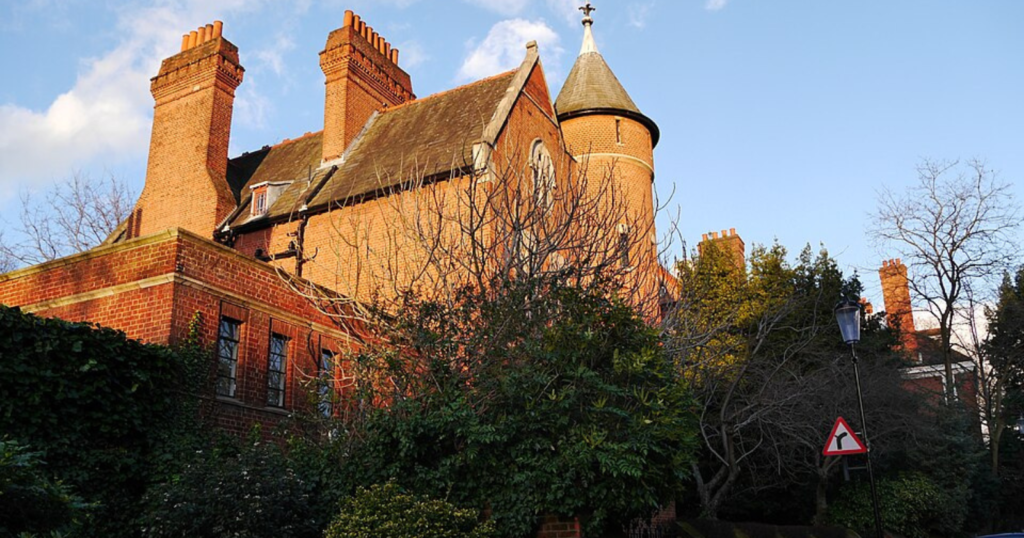
On Melbury Road, a quiet street near Holland Park in west London, stands a house that looks like it has wandered out of a medieval fairy tale. It’s built of red brick, with a round tower topped by a conical roof, narrow Gothic windows and carved stonework.
Inside, almost every surface is decorated, from painted ceilings to carved fireplaces, stained glass and tiled walls. Since 1972, it has belonged to one of the most famous guitarists in rock history.
A Victorian architect’s dream house
The Tower House was designed and built between 1875 and 1881 by William Burges, one of the most imaginative architects of the Victorian era. Burges loved the Middle Ages, and he designed the house as his own home, in the style of 13th-century French Gothic architecture.
Each room has its own theme. There’s a Zodiac-themed ceiling, a bedroom based on the sea with fish and mermaids, and a library decorated with references to literature. Burges designed much of the furniture himself. It’s often described as his domestic masterpiece.
Neglect and rescue
After Burges died in 1881, the house passed through several owners. By the mid-20th century, it had fallen into poor condition, and some of its original contents had been removed. It was listed as a Grade I building in 1949, the highest level of protection for historic buildings in England.
In the 1960s, the house was restored, and it later belonged to the actor Richard Harris, star of A Man Called Horse and later Dumbledore in the first Harry Potter films. In 1972, Harris put it up for sale.
Outbidding David Bowie
Jimmy Page was then at the height of his fame with Led Zeppelin. He’d long been fascinated by the house and by Burges’s work, and he bought it from Harris for £350,000, a huge sum at the time.
He’s widely reported to have outbid David Bowie for the property. More than 50 years later, Page is still living there and has described himself as the custodian of the house, responsible for protecting it for the future.
A celebrity neighbor moves in
In 2013, Robbie Williams bought Woodland House, the large property next door, which had previously belonged to film director Michael Winner. He soon drew up plans for major works, including a basement with a swimming pool and gym.
Page objected strongly. He argued that vibrations from digging and construction could damage the fragile decoration of the Tower House, including its painted ceilings, plasterwork, tiles and stained glass, which can’t be replaced.
Years of planning battles
The dispute dragged on for years through Kensington and Chelsea Council’s planning process. Page wrote letters, commissioned expert reports and, in 2018, appeared in person before a planning committee, telling councillors his home was the work of one of the greatest architects of the 19th century.
Williams’s team argued the effects of the work would be negligible. After several rounds, the council approved a revised scheme in 2019 with conditions designed to limit vibration and protect the neighboring building. The case drew wide attention as an example of London’s “basement wars,” in which wealthy residents dig deep extensions beneath their homes.
Why it matters
The Tower House is one of the most important Victorian homes in Britain. Burges built only two such town houses, and few interiors of the period survive so completely.
That makes it a striking example of how heritage protection works in practice. Even a Grade I listing doesn’t automatically stop work nearby, so owners and conservation groups often have to make their case through the planning system.
Can you visit?
The Tower House is a private home and isn’t open to the public. You can see its exterior from Melbury Road, close to Holland Park and the Leighton House museum, the former home of painter Frederic Leighton, which is open to visitors.
Other examples of Burges’s work can be visited, including Cardiff Castle and Castell Coch in Wales, both of which show his colorful, medieval-inspired style in full.