
In 1843, Henry Cole had 1,000 Christmas cards printed to save himself writing letters, then sold the spares for a shilling each. 158 years later, one sold at auction for a record £22,500
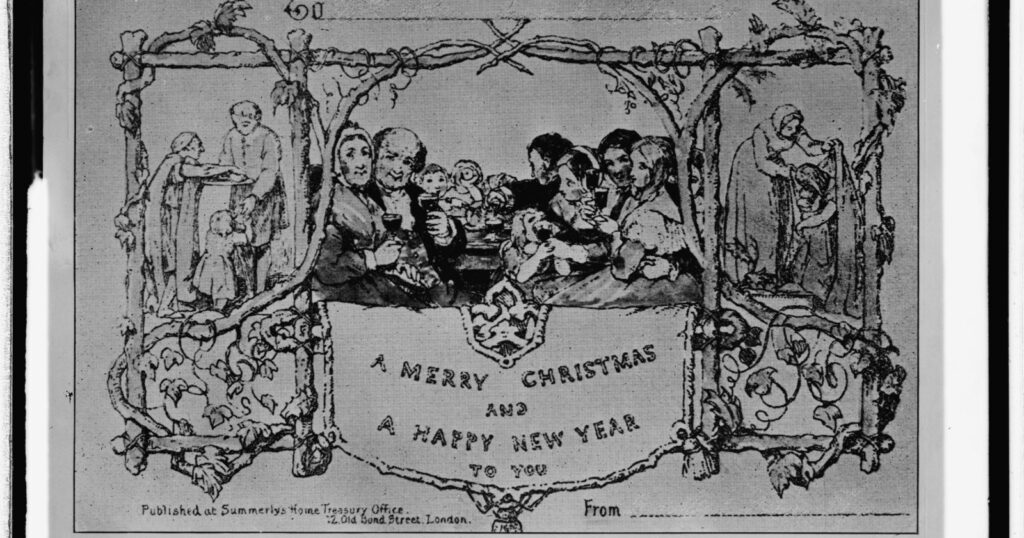
In 1843, a busy London civil servant named Henry Cole had a problem familiar to anyone who has faced a stack of blank Christmas cards. He did not have time to write his usual seasonal letters to all his friends and acquaintances. His solution was to have one message printed and send that instead.
The result is usually described as the first commercial Christmas card. Most of its print run has disappeared. However, in 2001, one surviving copy set a record at auction.
A card instead of a letter
Tim Travis, a curator at London’s Victoria and Albert Museum, explained the story in an interview with Culture Trip. Cole asked his friend, the artist John Callcott Horsley, to design a card he could send in place of letters. A London firm, Jobbins of Warwick Court in Holborn, printed the design by lithography in an edition of 1,000, and a professional colorer called William Mason painted them by hand.
Cole used the cards he needed. Those left over were sold by his business partner, Joseph Cundall, at their shop, Summerly’s Home Treasury, for one shilling each.
Cole was well placed to see the idea’s potential. According to The History Blog, he had worked as assistant to Rowland Hill, the leader of the campaign for postal reform, and the Uniform Penny Post had arrived across Britain in January 1840. Cheap postage made sending a card to everyone you knew far more practical. The card also appeared the same year Charles Dickens published A Christmas Carol.
What was on it
The card was about the size of a modern postcard. In the center, three generations of a family raise their glasses toward the person receiving it, above the greeting “A Merry Christmas and a Happy New Year to You.” Side panels show people feeding and clothing the poor, and the whole scene is framed by a trellis of vines.
That central toast caused trouble. Travis says critics complained the scene would encourage drunkenness. The History Blog points out that even a small child at the table is shown with a wine glass.
Not an instant hit
According to Travis, the cards did not sell well: the price was high. He puts a shilling at about a day’s wage for a working-class person at the time, so this was a luxury item, not a stocking filler.
The habit took time to catch on. The History Blog notes that five years passed before the second commercially printed Christmas card appeared.
The £22,500 copy
Because so few were sold, few survived. According to the History of Information timeline, a census published by Kenneth Rowe in 1977 located 21 surviving examples.
On November 24, 2001, one of them was sold at Henry Aldridge and Son, an auction house in Devizes, Wiltshire, for £22,500, the timeline reports. This copy carried extra appeal: The History Blog says it was the card Cole himself signed and sent to his grandmother and aunt.
The price is not reported the same way everywhere. Guinness World Records lists the same sale, on the same date in Devizes, as the most expensive greeting card sold at auction, but gives the figure as £20,000 and says it went to an anonymous bidder. As far as we can tell, the auction house has not published a breakdown showing whether the higher figure includes fees.
Where the card ended up
Original copies still turn up in public. In 2019, one went on show at the Charles Dickens Museum in London, on loan from a San Francisco book dealer, as part of an exhibition about the commercial side of Christmas, The History Blog reported.
The V&A now holds Britain’s national collection of greetings cards, more than 30,000 of them, from Cole’s era to the present. In the same interview, Travis said he expects the paper Christmas card may eventually fade, squeezed by social media, cost and environmental concerns. If so, it will end the way it started, with people looking for an easier way to say Merry Christmas to everyone at once.