
In 1992, a Suffolk farmer lost a hammer in a field and asked a friend with a metal detector to help find it; the friend found 14,865 Roman coins, shared the £1.75 million reward with him, and the hammer is now in the British Museum too
Eric Lawes went looking for his friend’s lost hammer in a Suffolk field in 1992 and found the Hoxne Hoard: 14,865 Roman coins and about 200 gold and silver objects. He split the £1.75 million reward with the farmer, who gave the hammer to the British Museum.
On 16 November 1992, Eric Lawes went into a muddy field near Hoxne in Suffolk to look for a hammer. His friend Peter Whatling, a tenant farmer, had lost an old lump hammer in the field and asked him to bring his metal detector over and help find it. Lawes, a retired electricity board worker, had been given the detector as a retirement present.
The detector picked up a strong signal. Lawes dug a small hole and found gold chains, silver spoons and coins. According to Current Archaeology, he filled two carrier bags, then stopped. He and Whatling reported the find to the landowner, Suffolk County Council, and to the police, and left the rest in the ground.
That decision meant archaeologists could record the hoard almost exactly as it had been buried.
Dug up in a single day
The next morning a team from the Suffolk Archaeological Unit, including the archaeologist Jude Plouviez, carried out an emergency excavation. The whole hoard came out in a day, with some of it lifted in large blocks of soil so it could be taken apart in a laboratory. The work was meant to be secret. It did not stay that way: on 19 November The Sun ran the story on its front page and offered a metal detector as a quiz prize.
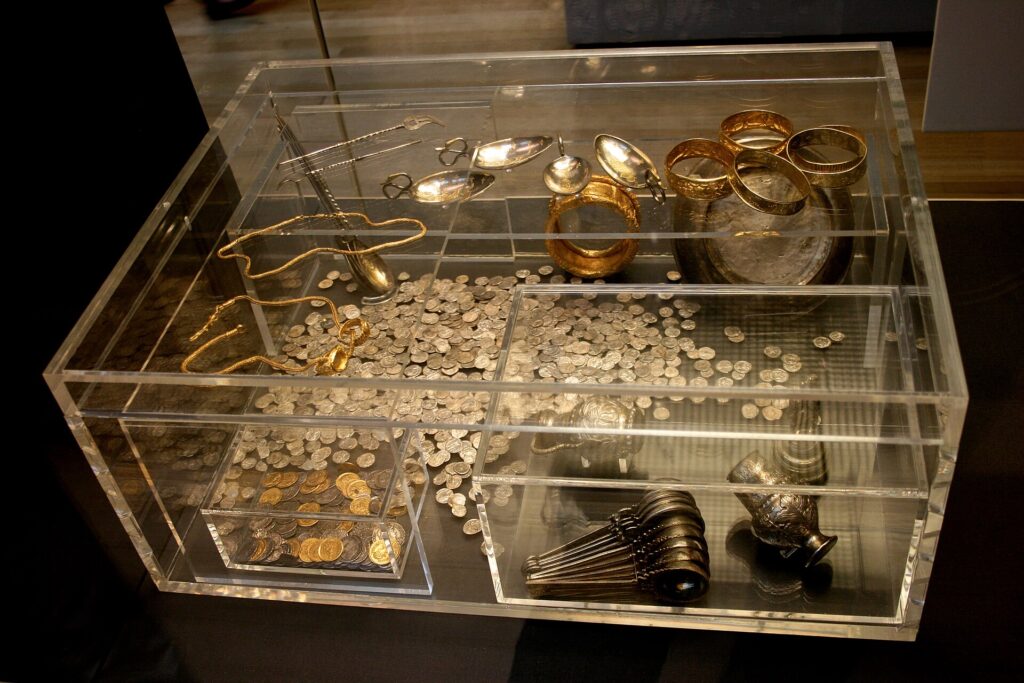
Because Lawes had stopped digging, the archaeologists could see how the treasure had been packed. Everything lay together in the remains of a wooden chest that had long since rotted away. Bowls and ladles were nested inside one another, and some smaller pieces seem to have been kept in an inner box. When the British Museum later put the hoard on show, it rebuilt the packing inside a clear perspex box so visitors could see it as it was found.
The ground around the find was also swept with metal detectors, and among the things that turned up was Peter Whatling’s hammer.
What was in the chest
The hoard held 14,865 Roman coins: 569 gold solidi, 14,272 silver coins and 24 bronze ones. With them were about 200 pieces of gold jewellery and silver tableware, including nearly 100 silver spoons. In all there was about 3.5kg of gold and 23.75kg of silver.
Some of the objects are famous in their own right. There is a silver pepper pot with gilded details in the shape of a Roman lady, known as the “Empress”. There is a silver tigress that once served as a handle for a vessel, and a gold body chain whose central plaque holds a large amethyst ringed by four garnets. One gold bracelet is inscribed VTERE FELIX DOMINA IVLIANE, roughly “Use this happily, Lady Juliane”. The name Aurelius Ursicinus appears on some of the spoons.
The latest coins were struck under the emperor Honorius and the usurper Constantine III, which means the chest went into the ground no earlier than about AD 408. That is just as Roman rule in Britain was coming to an end. Nobody knows who buried it or why they never came back. Many of the objects were old, worn or damaged, which has led some archaeologists to suggest it was the hoarded wealth of a single rich family.
The £1.75 million reward
A coroner’s inquest at Lowestoft declared the hoard treasure trove on 3 September 1993. Under the law at the time, that meant it belonged to the Crown, and a museum that wanted it would pay the finder a reward equal to its full market value. In November 1993 the Treasure Trove Reviewing Committee valued it at £1.75 million. The British Museum raised the money, with help from the National Heritage Memorial Fund, the Art Fund and the J. Paul Getty Trust, and acquired the hoard in April 1994.
The whole reward went to Lawes as the finder. He chose to split it equally with Whatling, even though the law of the day did not require him to. His Guardian obituary records that he used his share to build a bungalow in nearby Denham and enjoyed the brief fame, including trips to London and a meeting with Prince Charles.
The find, and the publicity it attracted, helped change the old common-law rules on treasure trove, which the Treasure Act 1996 replaced in England, Wales and Northern Ireland. Under the new law, a reward can be shared between the finder, the landowner and the occupier of the land, so a farmer in Whatling’s position no longer has to rely on the finder’s generosity.
The hammer in the museum
Whatling donated the hammer to the British Museum in 1994, the same year the museum acquired the hoard. Its collection record describes a “modern iron hammer, wooden haft”, 393mm long, and notes that it is “associated with, but not part of, the Hoxne hoard”. It has its own museum number, 1994,0408.410.
The hammer has had its moment in the spotlight. When the museum opened its Buried Treasure exhibition in November 2003, the Guardian reported that “a dirty old lump hammer” sat among the gold and silver and called it a star exhibit. The show then toured to Cardiff, Manchester, Newcastle and Norwich, and the hammer went with it. Today it is not on display.
The treasure it led to is easier to see. The most important pieces have been on permanent display in Room 49, the British Museum’s Roman Britain gallery, since 1997.
The finder who did it right
Eric Lawes was born in Hoxne (pronounced “Hoxon”), the son of a gamekeeper. He was working as a gardener when he was called up to the Royal Marines in 1942, and after the war he worked for the Eastern Electricity Board for 30 years. He died in May 2015, aged 92. The local Hoxne history group recorded that he died in his sleep.
Archaeologists, who have not always had kind words for metal detectorists, held him up as an example. By reporting the find at once and leaving it in the ground, he made it possible to record exactly how a fortune had been packed away at the end of Roman Britain. Other great hoards have been found since, including the Anglo-Saxon Staffordshire Hoard, but Hoxne remains the largest hoard of late Roman gold and silver ever found in Britain.
And it all started with a hammer that was worth, at most, a few pounds.