
In 1968, Mick Jagger and Marianne Faithfull moved into 48 Cheyne Walk in Chelsea, the riverside street where J.M.W. Turner died and Dante Gabriel Rossetti was banned from keeping peacocks because of the noise; Keith Richards lived a short walk away at number 3
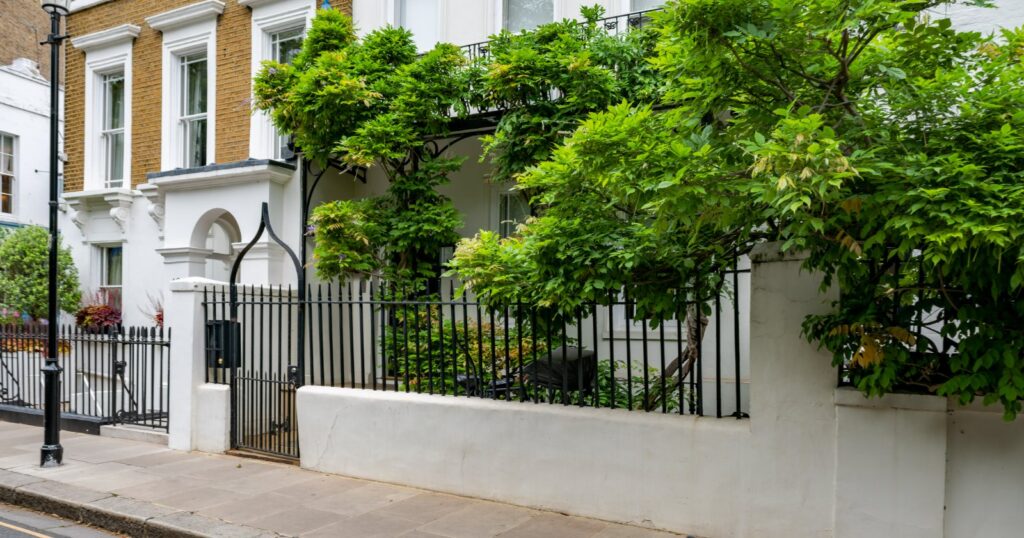
Cheyne Walk runs along the north bank of the Thames in Chelsea, a line of tall brick houses facing the river across a strip of gardens and a busy embankment road. It has been one of London’s most sought-after addresses for about 300 years. In the late 1960s, two Rolling Stones added their names to it.
Turner’s rooftop
Long before rock stars arrived, painters came for the light on the river. J.M.W. Turner spent his last years in a small house at the western end of the street, number 119. According to the Survey of London, he moved there some time in the 1840s and lived under a borrowed name, taking that of his landlady, Mrs. Booth, “to conceal his identity.” The balustrade on the roof is “commonly said to have been placed there by Turner, as he used the roof as a place of vantage for his work.” He died in the house on December 19, 1851.
Rossetti’s menagerie
A decade later, the poet and painter Dante Gabriel Rossetti moved into number 16. He lived there for about 20 years from 1862, and it became, in the words of London x London, “the rather zany abode” of the artist. Rossetti filled the garden with animals. He is widely believed to have kept kangaroos, wombats and armadillos.
The birds caused the most trouble. Rossetti kept a peacock, and its screeching irritated the neighbors. According to Country Life, “the ground-landlord, Lord Cadogan, subsequently banned residents from keeping the birds.”
Other writers came and went. George Eliot moved into number 4 in 1880 and died there only a few weeks later.
Two Stones on the river
By the 1960s, Chelsea was the center of a different kind of artistic life. The King’s Road, a few minutes’ walk inland, was full of boutiques, and young musicians and actors were buying up the old houses by the river.
Keith Richards was one of them. A walking map of Sixties London produced by the Victoria and Albert Museum says that in 1968 he bought number 3, near the eastern end of the street, and “lived here with his girlfriend Anita Pallenberg.”
Mick Jagger was another. According to the V&A, he “bought the house at number 48” soon after, and had it redecorated by the designer Christopher Gibbs “in a Moroccan style.” Jagger moved in with Marianne Faithfull, the singer and actress who was then his girlfriend. The two houses sat a few minutes’ walk apart along the same stretch of river.
The raid
Number 48 did not stay quiet for long. On the evening of May 28, 1969, police raided the house. Rolling Stone reported at the time that Jagger and Faithfull were taken to a nearby police station and that officers removed “some substances for analysis.” Both were released on bail. Jagger’s response was brief: “I’m going back to work now to make a record.” The V&A map records it simply as the house being “busted by the Chelsea Drugs Squad in a 1969 raid.”
Faithfull and Jagger split up in 1970. Bianca Jagger, whom he married the following year, also lived at number 48, according to the V&A. Jagger sold the house in the 1970s, though London x London reports that he later returned to the area.
A street that keeps its residents’ stories
Walk along Cheyne Walk today and the layers are still visible. There is a blue plaque for Rossetti at number 16, and the house where Turner is said to have used the roof as a vantage point for painting still stands at 119, now part of a larger house with No. 118.
The draw has barely changed in two centuries: big old houses, the river out front and central London a short ride away. A painter hiding under his landlady’s name, a poet whose peacock got the whole street a ban and a rock star whose house was raided by the drugs squad all ended up with the same view of the Thames.