
In 1952, the Queen Mother bought a semi-derelict castle on Scotland’s north coast, six miles from John o’ Groats; she gave it electricity and running water for the first time and spent summers there for the rest of her life
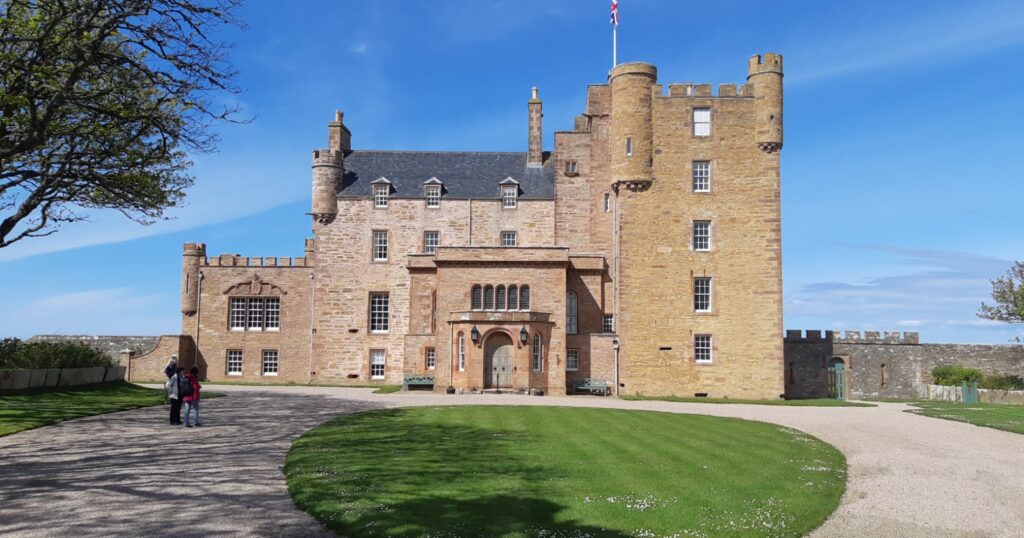
On the far north coast of mainland Scotland, looking out across the Pentland Firth toward Orkney, stands a pale stone tower house with turrets and a walled garden. For half a century it was the private retreat of Queen Elizabeth the Queen Mother. When the Queen Mother first saw it, in the summer of 1952, it was close to falling down.
King George VI had died in February 1952, and his widow, aged 51, was suddenly out of a role she had held for 15 years. That June she traveled to Caithness to stay with friends, Commander Clare Vyner and Lady Doris Vyner, at their house near Dunnet Head.
According to Country Life, while driving nearby she spotted a battered castle on the coast and asked her hostess, “Do you think it would suit me?” It was called Barrogill Castle. Within three months, she had bought it.
The castle sits about six miles west of John o’ Groats, according to the Gazetteer for Scotland. It was probably built between 1566 and 1572 by George Sinclair, 4th Earl of Caithness, as the family seat, and later remodeled in the Scottish baronial style.
By 1952 it was in a sorry state. Country Life notes that photographs from around 1950 suggest “only the tower was habitable”.
The royal biographer Sally Bedell Smith writes that the castle reminded the newly widowed Queen Mother of herself. “How sad it looks,” she said, “just like me.” She bought it “on impulse,” Smith says, “for a token £100.”
Lights on for the first time
The restoration took several years. The Castle of Mey Trust says that between 1953 and 1955 “the castle, gardens and policies were all in a poor state and were renovated and restored by Her Majesty.” The estate covered about 30 acres.
Much of the work was basic modernization. Royal Central says she “added electricity and fresh water supplies.” Country Life says the architect Hugh Macdonald oversaw the project, and that by 1953 the house had been made “weathertight and habitable.”
She also changed its name. Barrogill became the Castle of Mey, which she regarded as a return to the building’s original name.
From 1955, the castle was a fixed part of her year. According to Royal Central, she usually visited “in August and October from 1955 until her final visit October 2001.” The Castle of Mey Trust says she “spent three weeks in August at the castle, returning for about ten days in October each year.” She also opened the gardens to the public through Scotland’s Gardens Scheme, a tradition the Trust has kept going.
The visits continued for almost half a century. Undiscovered Scotland says she “holidayed at the Castle of Mey every year for nearly 50 years,” making her last visit in October 2001, at the age of 101. She died the following March.
The castle today
In 1996, while she was still alive, the Queen Elizabeth Castle of Mey Trust was set up to look after the castle and its estate. The Trust says the King, as Prince of Wales, “showed great commitment to furthering the Trust objectives as President.”
The castle now opens to visitors each summer. A near-ruin that a grieving widow bought for £100, wired up and kept going for nearly 50 years is now one of the best-known houses on Scotland’s north coast.