
George Harrison bought an Esher bungalow for £20,000 in 1964, he and Pattie Boyd painted it in psychedelic swirls, and the Beatles recorded White Album demos there
It was "the most dull bungalow you can imagine", Pattie Boyd said, so they covered it in paint. Nearly four years after George Harrison bought it, the Beatles gathered there to tape 27 songs on a four-track machine.
Before the Beatles made the White Album, they gathered in a bungalow in Esher, Surrey, to record acoustic demos of the songs they had been writing. The bungalow was Kinfauns, which George Harrison had bought for £20,000 in 1964, and he and Pattie Boyd had painted its outside walls in psychedelic colours. In the last week of May 1968 the band taped 27 songs there, and 19 of them made the finished record.
The first house he viewed
Harrison bought Kinfauns on 17 July 1964 for £20,000, according to Get Surrey‘s report on the blue plaque unveiled at the site in 2017. Fans were making life in London difficult, and the Beatles’ accountant, Walter Strach, suggested moving out to Weybridge and Esher. John Lennon and Ringo Starr moved to the St George’s Hill estate at Weybridge. Harrison “decided on Kinfauns in Esher, the first house he viewed,” said Diana Hatfield, who coordinated the plaque for the Esher Residents Association.
The fans found it anyway, and carved messages to him on the large wooden gate.
Boyd had met Harrison earlier that year, on the set of A Hard Day’s Night, where she had a single line. She moved into Kinfauns in 1965, and after their wedding on 21 January 1966 the couple held the reception at the house.
Tins of paint
The house itself did not impress her. “It was the most dull bungalow you can imagine,” Boyd recalled in a 2022 People feature, “so, so ghastly. We had to do something to it. So we bought lots of tins of paint and spray paint and we painted it. Whoever came over helped us paint the outside of the entire place.”
The residents’ association dates the transformation to 1967, when, in Hatfield’s words, the couple covered the outside “in psychedelic patterns and colours with flowers and doodles”. Brian Jones and Anita Pallenberg came to visit. So did Mick Jagger and Marianne Faithfull, who once found nobody home and left a message on the front wall in paint: “Mick and Marianne were here and we love you.”
“There was lots of smoking dope and drinking wine,” Boyd said. “It was just a really fabulous, happy place.”
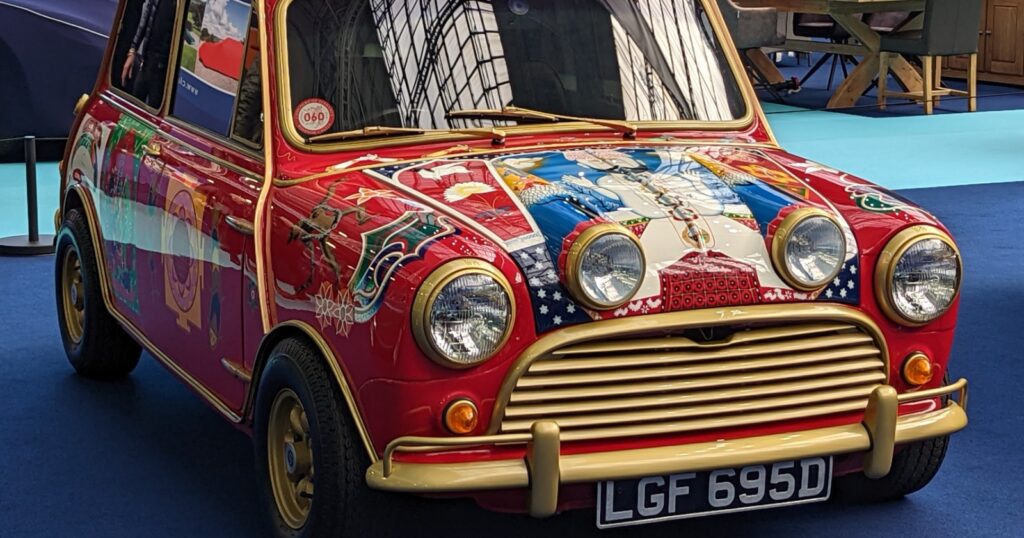
The paint did not stop at the house. In 1967 Harrison also had the Fool, a pair of Dutch artists, repaint his black Mini Cooper S bright red with mystical signs copied from a book on Tantric art, Hagerty reports. The car went on to a starring role in the Beatles’ 1967 film Magical Mystery Tour.
Twenty-seven songs on a four-track
Most of the songs were written in Rishikesh, India, where the Beatles spent part of February to April 1968 on a course at the Maharishi Mahesh Yogi’s academy of Transcendental Meditation. Lennon wrote to Starr, who had gone home early, that they had “about two L.P.s worth of songs now so get your drums out.”
The band’s own announcement for the 50th-anniversary edition says they gathered at Kinfauns in the last week of May and recorded acoustic demos of 27 songs on four-track tape. Rolling Stone‘s guide to the demos describes acoustic guitars, light percussion and an Ampex four-track machine. Lennon brought 15 of the songs, Paul McCartney seven and Harrison five. Afterwards Harrison made a mono mix and gave each of the others a copy to work from.
Studio sessions for the album began at Abbey Road on 30 May 1968. Of the 27 songs, 21 were taken into those sessions, and 19 made it onto the double album released that November. Two more, “Mean Mr. Mustard” and “Polythene Pam”, turned up on Abbey Road the following year.
Loose ends
None of the accounts we read gives the exact day. The band’s announcement says only “the last week of May”. McCartney, speaking in 1968, said the band had hoped to do a lot of rehearsing before the studio, “but, as it happens, all we got was one day.” The Beatles Bible, a long-running fan history, files the session under 24 May but says plainly that the precise date is unknown.
The tapes themselves took a long time to surface. According to the Beatles Bible, the public first heard them in the late 1980s on the radio series The Lost Lennon Tapes, and 23 had entered general circulation by the early 1990s. A handful were released officially on Anthology 3 in 1996, but the full set of 27 did not come out until 2018.
Even Giles Martin, who remixed the album for that 50th-anniversary edition, did not recognise the name at first. “I had no idea what the ‘Esher Demos’ were,” he said at a playback, “and then they sent me this CD bootleg that had been out.” NME reported that he went through the original tapes at the Harrisons’ home, where he had heard them before while working with Harrison’s widow, Olivia, on an earlier project. Finding what he called “a template for an album” made the job “a lot easier”. “To me,” he said, “it’s like ‘The Beatles Unplugged.'”
The £20,000 price and the July 1964 date come from Get Surrey‘s report of the plaque unveiling; we did not see a deed. And the painting was not a two-person job. In Boyd’s own telling, whoever came over helped.
Two round windows
Harrison and Boyd left Kinfauns in 1970 for Friar Park, a Victorian mansion in Henley-on-Thames. In 2003 the bungalow was substantially demolished and replaced with a two-storey house. The two round windows of the old studio were kept and built into the new one.
Boyd came back on 23 May 2017 to unveil the plaque, which marks the site of Harrison’s home from 1964 to 1970. Driving there, she said, she was “overcome with amazing memories of such a happy time”. Then she turned into the drive. “It’s not like the house I remember at all.” The paintings she, Harrison and their friends had done were gone, she said, “washed over and demolished.”
“It is sad,” she said, “but maybe I can’t cling onto the past, because it was full of joy for me.”