
The man buried inside the Colchester Vase, the Roman pot decorated with gladiators and animal hunts, had Mediterranean origins, say scientists studying Britain’s first Roman capital, and he may have trained fighters or paid for the games
A Durham University study of 22 cremations at Camulodunum finds three people raised in the Mediterranean, and Mediterranean origins for the man in the vase.
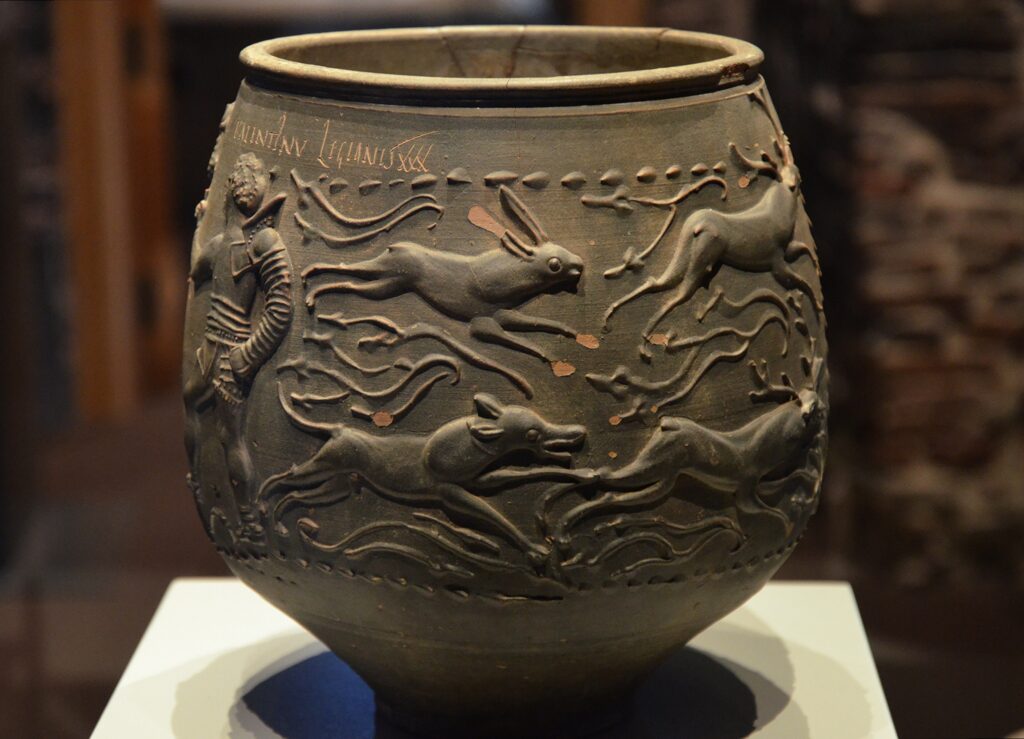
Three of the people buried in Roman Colchester grew up around the Mediterranean, a Durham University-led study of cremated remains from 22 burials has found, and the man whose remains were buried inside the Colchester Vase had Mediterranean origins.
The work was announced in a Durham University release on 18 November 2026 and is published in the journal Royal Society Open Science. It forms part of the wider ‘Decoding the Roman Dead’ project.
“Three had chemical signatures suggesting they spent their childhood in Mediterranean regions, such as Italy, Spain or Lebanon,” the release said.
The man in the vase
Durham called the vase burial “one striking discovery”. The pot “depicts scenes of gladiatorial combat and animal hunting”, and “analysis indicated that the man buried inside had Mediterranean origins”, the university said.
Who he was is not settled. Durham said the fact that the remains were buried in the decorated vase suggests the individual “may have trained gladiators or been a wealthy patron who funded fights”. The release does not name him and does not present his occupation as proven.
The university said the find “provides a rare link between scientific evidence of migration and the cultural world of Roman entertainment”.
A hunt cup from a grave at West Lodge
The vase is catalogued as RIB 2503.119, a colour-coated cup in red fabric, 216 mm high. It is described there as a hunt cup with figures of two venatores, or huntsmen, and two gladiators, with additional gladiatorial figures in colour-coated barbotine, raised clay relief.
It was found in 1848 in a grave at West Lodge, associated with Antonine pottery, and is now in the Colchester Museum. It is generally accepted as a product of the Colchester kilns.
Graffiti cut into the pot after firing name the figures: ‘Secundus (et) Mario’, or Secundus and Mario; ‘Memnon sec(utor) viiii’, read as Memnon the secutor, perhaps victor nine times; and ‘Valentinu(s) Legionis XXX’, Valentinus of the Thirtieth Legion.
A secutor was a light-armed gladiator who fought a retiarius armed with a net and trident. On the cup the retiarius has lost his net, has dropped his trident and raises a finger in token of defeat. One huntsman brandishes a whip over a bear. Of the names, Mario is Celtic and Memnon Greek.
Reading the ashes
Cremation was the main burial practice in Britain during the first century of Roman rule, Durham said, and the intense heat of a funeral pyre destroys much of the evidence researchers normally use to establish where someone came from.
Dr Joanna Moore and Professor Janet Montgomery of Durham’s Department of Archaeology worked with Dr Geoff Nowell in the university’s Earth Sciences Department, alongside researchers from the University of Reading and York Museums Trust, to get round that.
For the first time, the team combined two chemical markers, strontium and lead isotopes, in Romano-British cremated remains, which Durham said allowed them to find clues that traditional examination approaches could have missed.
Colchester, known at the time as Camulodunum, became the first capital of the new Roman province of Britannia following the invasion of AD 43. It attracted traders and administrators and had strong connections with continental Europe.
Durham said the technique could help researchers uncover the stories of many more people whose remains were cremated, where conventional analysis methods have been limited.