
An English baronet’s family sold a damaged painting of Christ at a London auction for £45 in 1958, believing it was the work of a pupil; 59 years later, attributed to Leonardo da Vinci, it sold for $450 million
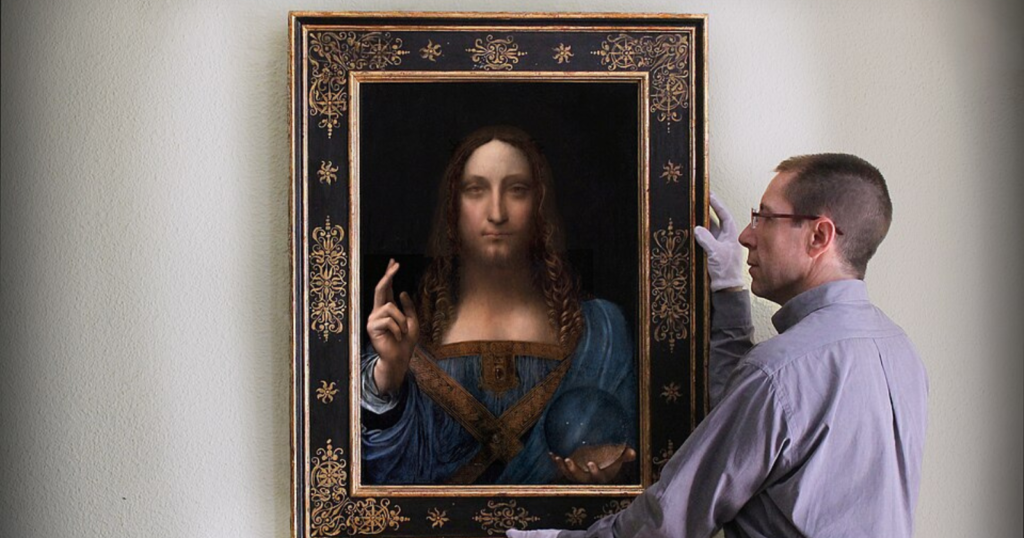
On 25 June 1958, Sotheby’s in London sold off 136 paintings from one of Britain’s great private art collections. Among the lots was a dark, battered picture of Christ holding a crystal orb and raising his hand in blessing.
The catalogue listed it as a copy after Giovanni Antonio Boltraffio, one of Leonardo da Vinci’s pupils. It sold for £45. Nearly six decades later, the same panel would become the most expensive painting ever sold.
A Victorian collector’s purchase
The painting’s documented history begins in 1900, when it was bought for the collection of Sir Francis Cook, a wealthy textile merchant who had been made a baronet. Cook filled the gallery of Doughty House, his home on Richmond Hill, with hundreds of Old Masters.
When the painting arrived, it was believed to be by Bernardino Luini, another of Leonardo’s followers. It was already in poor condition, with large areas painted over. A 1913 catalogue of the collection dismissed it as a “free copy” of a Boltraffio, with damage from both over-cleaning and repainting.
Sold off for the price of a sofa
The Cook collection was gradually broken up in the decades after the Second World War. When Sir Francis Cook, the 4th Baronet and great-grandson of the original collector, sent the remaining pictures to Sotheby’s in 1958, the Salvator Mundi, Latin for “Saviour of the World”, was treated as a minor work.
The buyer was recorded only as “Kuntz”. Decades later, researchers traced it to a New Orleans family who bought antiques on their European holidays. The painting then disappeared from public view for almost 50 years.
Rediscovered in New Orleans
In April 2005, the painting turned up at a small auction house in New Orleans, catalogued as “After Leonardo da Vinci”. Two dealers, Robert Simon and Alexander Parish, bought it, reportedly for $1,175, though some accounts give a higher figure of up to $10,000.
They sent it to conservator Dianne Modestini in New York. As she removed layers of later paint, she found details she believed showed a master’s hand, including an earlier position of Christ’s thumb that had been painted over. Changes like that suggest an original work rather than a copy. A number and the letters “CC” on the back linked it to the Cook collection.
From the National Gallery to the record books
After years of research, the painting was shown as a Leonardo at the National Gallery in London in 2011, in a major exhibition of his work from his years in Milan. Its inclusion gave it enormous credibility.
In 2013, Swiss dealer Yves Bouvier bought it for around $80 million and sold it on to Russian billionaire Dmitry Rybolovlev for $127.5 million. The deal led to a long-running legal dispute between the two men. Then, on 15 November 2017, Rybolovlev sold it at Christie’s in New York. With fees, the price was $450.3 million, the highest ever paid for a work of art at auction.
The buyer was a Saudi prince acting, according to later reports, for Crown Prince Mohammed bin Salman. A planned unveiling at the Louvre Abu Dhabi was cancelled, and the painting has not been seen in public since.
Is it really a Leonardo?
The attribution has been questioned from the start. Some scholars believe Leonardo painted most or all of it. Others think it is mainly the work of his studio, perhaps with some touches by the master, or by a pupil such as Boltraffio or Luini.
Critics point to the heavy restoration, which they say makes it hard to judge how much of what we see is original. The Prado museum in Madrid listed it as a workshop piece in a 2021 exhibition catalogue. The Art Newspaper has published a detailed timeline of the painting’s owners, sales and disputes.
The picture that got away
For the Cook family, the 1958 sale was a routine clear-out of an inherited collection, based on the expert opinion of the day. Nobody at Sotheby’s saw anything special under the overpaint.
Whether the painting is a true Leonardo or a studio work touched by his hand, its journey from a Richmond gallery to a £45 sale, a New Orleans auction house and finally a record-breaking price is one of the strangest in art history. It is also a reminder that, in the art world, a single change of attribution can be worth millions.