
In 2005, Damien Hirst paid about £3 million for Toddington Manor, a Grade I Gothic pile in Gloucestershire he planned to fill with his art; 17 years later it was still empty and wrapped in scaffolding
Damien Hirst bought Toddington Manor for about £3 million in 2005 and planned a gallery there. Seventeen years on, the Gothic house was still empty.
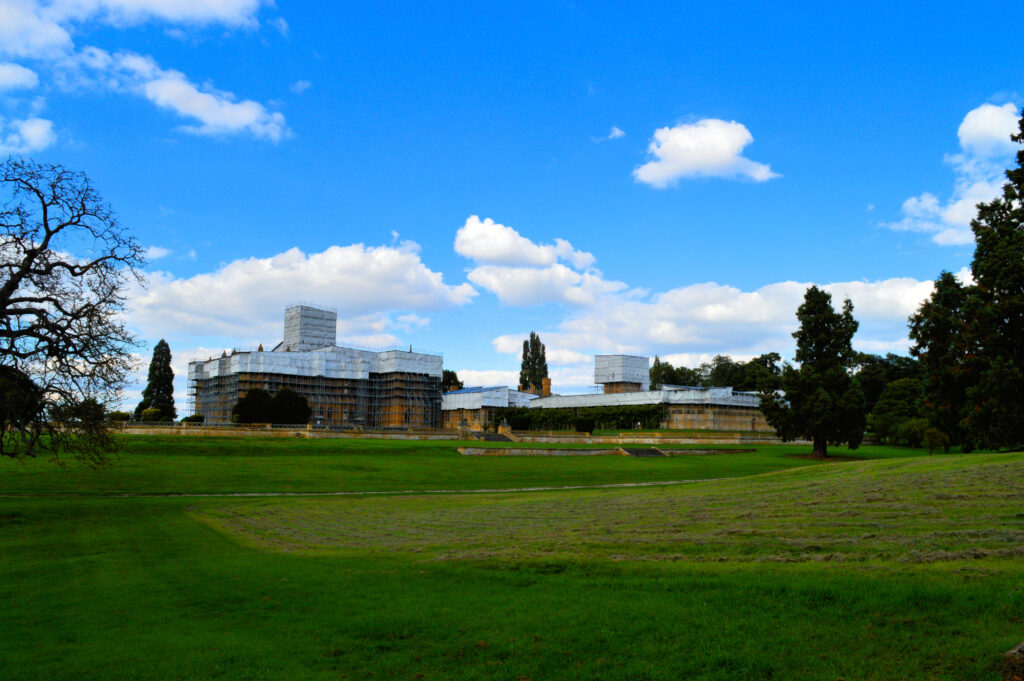
In 2005 Damien Hirst bought Toddington Manor, a Grade I listed Gothic house in Gloucestershire about 10 miles east of Tewkesbury, planning to restore it as a family home and a museum for his own art and that of other artists.
Reporting the purchase on 1 September 2005, The Guardian said he was “believed to have spent about £3m to acquire the 124-acre estate and may need as much as £10m to refurbish it”. Hirst “fell in love with the grade one listed building as soon as he saw it and now regards it as a lifetime’s work to restore the mansion and grounds, which have fallen into serious disrepair”, the paper said. A caption on the same page put the house at 300 rooms.
Villagers and conservationists welcomed the sale. The previous year local people had campaigned against a plan to turn the manor into a luxury hotel, a Warner Hotels scheme called off in August 2004 after local opposition, according to the DiCamillo Companion. The historian and archaeologist Adam Stanford told the Guardian in 2005: “It’s the sort of building which needs someone with vision to restore it. The fear was that it would be turned into some sort of corporate venue.” He also called it “an eerie sort of place which I could imagine would chime with Hirst’s imagination”.
The house Charles Hanbury-Tracy built
Toddington was built in the early nineteenth century for Charles Hanbury-Tracy MP, later the first Lord Sudeley. The dating varies between sources. DiCamillo gives 1819 to 1835. The Guardian, writing in 2022, said the house was completed in 1840 and took 21 years to construct.
Hanbury-Tracy had a hand in one of the best known buildings in the country. DiCamillo records that he chaired the commission in 1836 that chose Sir Charles Barry’s design for rebuilding the Houses of Parliament, “supposedly based on Toddington”, and that while the manor was originally attributed to Barry, the view today is that Hanbury-Tracy was probably his own architect. The Guardian in 2022 called Toddington one of the earliest examples of what became known as Victorian gothic.
The plan is a quadrangle ringed by cloisters. Inside there is a large entrance hall, a grand staircase, a 40ft-long oak-panelled dining room and two libraries, with detailed stone and wood carving. An earlier Jacobean house on the site was partly destroyed by fire in 1800 and pulled down, DiCamillo records, leaving a Grade II* remnant of the Tudor gatehouse. The park is listed Grade II.
Building on that scale ruined the family. The Guardian put the bankruptcy at 1893 and DiCamillo at 1894, and the Hanbury-Tracys sold up in 1901. A long run of owners and uses followed: tycoons, soldiers during the second world war, the Order of Christian Brothers from 1948 to 1972, David Wickens from 1972 and a school run by the Avicenna Foundation in the 1980s. In September 2000 the estate was listed for sale at £3.2 million, taking in the house, a service wing, three cottages, stables and 124 acres.
Seventeen years of scaffolding
Work started. In June 2006 Hirst announced that the house had been covered in scaffolding and treated for dry rot, DiCamillo records, which puts the estimated cost of the restoration at £10 million and says Hirst intended to work with Historic England. In 2018 Historic England put Toddington Manor on its Heritage at Risk Register.
By early 2022 residents were pressing for action. In a report published on 8 January 2022, the Guardian said that “17 years after its purchase, the property remains uninhabited and covered in scaffolding and tarpaulin”, and that locals had branded it an “eyesore”, a “white blob” and “a blight on the countryside”. The parish council was due to meet that week to come up with a plan.
Nigel Parker, chairman of Toddington parish council, told the paper: “It is one of the biggest eyesores in the area. People are fed up with it. Damien Hirst has had this property for 17 years now, but it is still clad in scaffolding and tarpaulin, and as far as we can tell there is no restoration in sight.”
Malle Hague, who lives near the manor, said: “I wish he would bloody well get on with it. It would be nice if he could at least camouflage this white blob.” She added: “It is a blight on the countryside. This is an area of outstanding natural beauty but you can see this for miles. At the start he did a lot of good work but this has gone on too long now.”
John Evetts, then chair of Tewkesbury council’s planning committee, said: “It’s been a hell of a long time since he bought it. I am told Hirst has never applied for planning permission.” His own estimate of the work was: “I work in restoration and conservation and I think it could cost £50m to restore and still not be finished.” He called the house “the biggest white elephant I have ever seen”.
A Tewkesbury council spokesman said the authority was “satisfied there are intentions to repair it”, while confirming there was no current planning application listed and that “we are not aware of any work that has taken place”. Historic England said it intended to work with the borough council “to encourage the owner” to press ahead with the restoration. Hirst’s representative did not respond to requests for a comment. The 2022 report linked the stalling of the project to Hirst’s split in 2012 from his long-term partner Maia Norman, the mother of his three sons.
The wrapping comes off
The DiCamillo Companion records: “The scaffolding, which encased the house for 18 years, was removed in 2024, after years of protests from local residents”.
DiCamillo lists Hirst as the owner since 2005 and the house as not open to the public. British Heritage has also covered another Gloucestershire country house, Gatcombe Park, and Sudeley Castle at Winchcombe, a few miles away.