
On a snowy Christmas Eve in 1956, a BBC cameraman named Michael Bond felt sorry for a lone teddy bear left on a shelf at Selfridges and bought it for his wife, and the bear he named after a nearby station became Paddington
It was Christmas Eve 1956, and snow had begun to fall on Oxford Street in London. A 30-year-old BBC cameraman named Michael Bond ducked into Selfridges to get out of the weather and still needed a small present for his wife’s Christmas stocking.
Wandering into the toy department, he noticed a single teddy bear sitting alone on a shelf. Bond later said it looked rather forlorn. Had there been two bears, he might have walked past, but he couldn’t bear to leave one sitting by itself over Christmas.
A stocking filler for Brenda
Bond bought the bear for his wife, Brenda. The couple lived in a tiny one-room flat near Paddington Station in west London, so small that the bed folded into the wall. They named the bear Paddington and put him on the mantelpiece.
At the time, Bond was working as a cameraman on BBC programmes such as Dixon of Dock Green and, later, Blue Peter. He had ambitions to be a writer and had already sold a few short stories and radio plays, but nothing had yet taken off.
A story written in ten days
About a year later, Bond sat at his typewriter staring at a blank page, unsure what to write. He glanced up at the bear on the mantelpiece and began to imagine what might happen if a small bear arrived at a busy London railway station.
He wrote the first story almost for fun, then kept going. According to the official Paddington history, he wrote eight chapters in just over a week. He hadn’t set out to write a children’s book, but by the end he had one.
From darkest Peru
In Bond’s story, Paddington is a small bear who has travelled from “darkest Peru” as a stowaway, surviving on marmalade. He is found sitting on a suitcase at Paddington Station by Mr and Mrs Brown, wearing a label that reads “Please look after this bear. Thank you.”
The label was inspired by Bond’s memories of the Second World War, when he saw evacuee children at Reading Station with name tags around their necks. That image, of a small, vulnerable figure far from home relying on the kindness of strangers, gave the story its heart.
A bear called Paddington
A Bear Called Paddington was published by Collins on 13 October 1958, with illustrations by Peggy Fortnum. It was named the best children’s novel of the year by a British book trade journal, and more stories followed.
Paddington soon became a household name. A television series in the 1970s, with the bear brought to life as a puppet, introduced him to a new generation. Bond eventually left the BBC to write full time, producing more than 20 Paddington books, which have sold over 35 million copies around the world.
A London icon
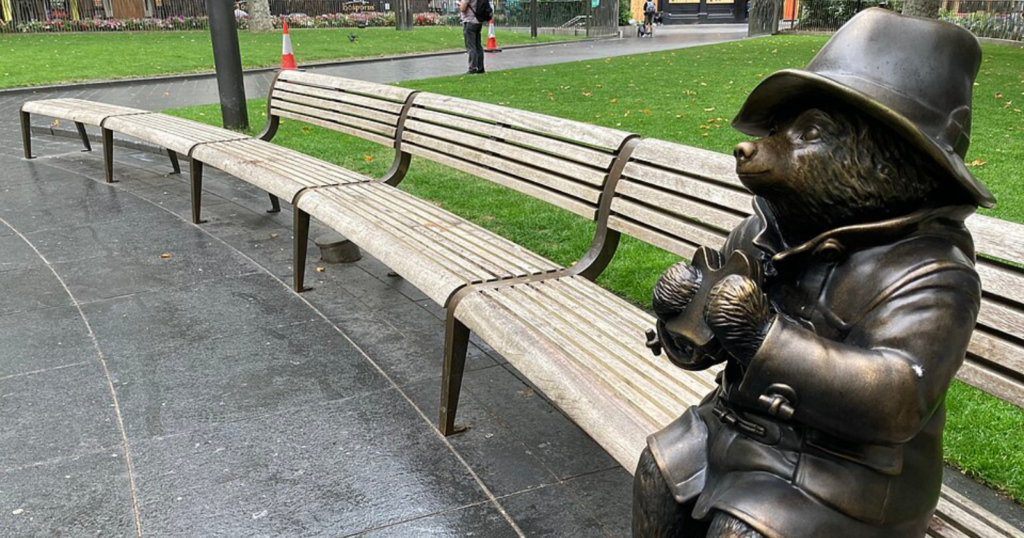
Today, Paddington is one of Britain’s most beloved characters. A bronze statue of the bear stands at Paddington Station, unveiled by Bond in 2000. The films Paddington (2014), Paddington 2 (2017) and Paddington in Peru (2024) became huge hits.
In 2022, Paddington even shared a short film with Queen Elizabeth II for her Platinum Jubilee, in which the two compared marmalade sandwiches hidden in their hats and handbags. When the Queen died later that year, many mourners left Paddington toys and marmalade sandwiches among the floral tributes.
The original bear
Bond died in June 2017, aged 91, but the original toy bear from Selfridges never left the family. After Bond and Brenda divorced in 1981, they remained friends, bonded by the little bear he had bought her that snowy Christmas Eve.
It’s a reminder of how one small act of kindness, feeling sorry for a lonely bear on a shelf, led to a character who has spent nearly 70 years teaching children around the world to look after those who are far from home.