
Roald Dahl’s mother paid half of the more than £4,000 his Buckinghamshire house cost, his Hollywood star wife Patricia Neal said she paid the rest, and his widow says the hut where he wrote his best-known books was modelled on Dylan Thomas’s
In April 1954 Roald Dahl's relatives bid at auction for a Great Missenden cottage that he and Patricia Neal had never seen. His mother put up half the money, Neal wrote that she paid the rest, and its orchard became the site of the hut where he wrote his best-known children's books.
On 8 April 1954, a small country house on the edge of Great Missenden in Buckinghamshire was due to be auctioned. Roald Dahl was not in the room. Nor was his wife, Patricia Neal, the American actress who ten years later would win the Academy Award for Best Actress for Hud. His sister Else and her husband John went to bid, with Dahl’s mother, Sofie Magdalene, beside them. They won. As Dahl’s authorised biographer Donald Sturrock puts it in Storyteller, the couple now owned “a house they had never actually seen”.
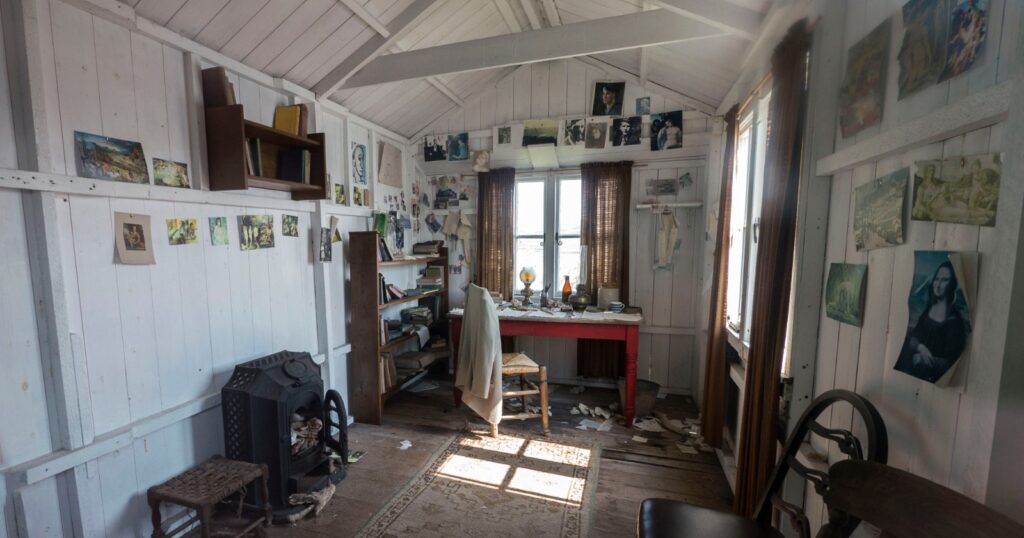
Half the money came from Dahl’s mother. The other half, according to Neal’s 1988 memoir, came from her own savings. The price was more than £4,000. In the orchard Dahl later set up the small hut where he wrote his best-known children’s books, Charlie and the Chocolate Factory and Matilda among them. His widow says he built it to the proportions of the shed where Dylan Thomas wrote in Laugharne, on the Welsh coast.
Little Whitefield bought sight unseen
The plan was modest. Dahl and Neal meant to spend the winters in Manhattan and the summers in England, near his family. In mid-March 1954, Sturrock writes, Sofie Magdalene sent her son the details of a tiny cottage that had come on the market a stone’s throw from the house of Else and her husband, John Logsdail. It stood on an old drove road running from a medieval abbey up to a beech wood, with an orchard of apple and pear trees and two working wells. The Stewart-Liberty family, owners of Liberty’s department store in Regent Street, had let it to tenant farmers and then to a solicitor’s family who had fallen on hard times.
Both of them, Sturrock says, went “crazy” about it. Sofie Magdalene offered to put up half the money, though she first had to persuade her trustees that it was a sound investment.
Neal told it from her side in As I Am. Else and John wrote to say they had found a Georgian farmhouse, three bedrooms on five acres, needing a lot of work, with a low opening bid expected at auction. “We offered more than the bid was expected to reach and still got it for a little over four thousand pounds,” she wrote. “Mormor offered to pay half, and I paid the other half out of my savings.” Mormor, Norwegian for maternal grandmother, was what the family called Sofie Magdalene.
The house, Neal added, already had a name, Little Whitefield. Sturrock tells it differently: he calls it Whitefield Cottage before the sale and has the Dahls choosing the name Little Whitefield themselves.
Almost six weeks after the sale, the couple arrived in England to see the place. Electricity had to be put in, walls knocked down and doorways raised, so while the work went on they lived with Dahl’s mother in the Logsdails’ annex. The house was later renamed Gipsy House, and Dahl lived there for the rest of his life. The Roald Dahl Museum counts 36 years in the village, from that first summer to his death in 1990.
Whose word holds the story up
Both halves of this story rest on accounts written or told long afterwards, and they do not quite line up.
Take the price first. Neal wrote “a little over four thousand pounds”, and Sturrock gives “just over £4,000”. Jeremy Treglown, in Roald Dahl: A Biography, is the odd one out at £4,500. All three agree it was more than £4,000.
Then who paid. All three have Dahl’s mother covering half. For the other half, Treglown names Neal but adds “according to her own account”, so he is passing on her version rather than vouching for it himself. Sturrock, in the passages we could read, does not say where the rest came from. None of the three has Dahl putting in money of his own, and none says he put in nothing.
The hut is shakier. The Thomas connection comes almost entirely from Felicity Dahl, who married him in 1983, long after the hut went up. In 2016 she told BBC News that her husband went to Wales to look at Thomas’s writing hut and “like everybody, fell in love with it”. Then: “He built it exactly to the same proportions as Dylan’s hut, the same roof, one skin of brick.” The BBC itself allowed that the likeness “could be a coincidence”.
Searching both biographies, we found no mention of Thomas in connection with the hut. Treglown describes Dahl “adapting a garden shed as a place in which to write”; Sturrock has him “constructing an isolated work hut in his orchard”. Treglown’s version is the awkward one for the Thomas story, because Felicity Dahl told the BBC there was nothing there before, “an empty space that he built on”. If Treglown is right and Dahl adapted a shed that already stood, its size was at least partly inherited rather than copied.
The two buildings are also made of different stuff. The national monuments record for Wales says Thomas’s shed began life in the 1920s as a prefabricated garage for Laugharne’s first motor car, a Wolseley. It was fitted out for him in 1949 with windows and a stove, and it is a boarded shed on cast-iron pillars. Dahl’s hut was a single skin of brick, yet his widow lists the brick among the likenesses.
None of this makes her story wrong. Sturrock counts Thomas among Dahl’s literary heroes, Treglown calls him Dahl’s favourite poet, and she was married to Dahl for the last seven years of his life, when he was still writing in the hut. But hers is the only version we found, and she gave it in 2016, decades after the building work.
Where the two huts stand now
Whatever its pedigree, the hut was where the work happened. Dahl described it on Desert Island Discs in 1979, as quoted by the BBC: “A little hut, curtains drawn so I don’t see the squirrels up in the apple trees in the orchard. The light on, right away from the house, no vacuum cleaners, nothing.” And then: “When I am in this place it is my little nest. My womb.”
He had good reason to want the distance. Sturrock quotes Dahl telling a friend that babies, until they were six months old, were “nothing but a great whirling blur of wet nappies and vomit and milk…”. He wrote with pencils on yellow paper, his legs on an old suitcase, sitting in his mother’s wing-back chair with a hole cut in it to ease his back. Treglown records a more rural hazard: heifers grazing in the orchard, which, Dahl said, ate the curtains if he left the windows open.
You cannot sit in that chair today, but you can see it. In 2012 the hut’s interior, with the chair and the clutter he kept round him, was moved to the Solo gallery of the Roald Dahl Museum and Story Centre on Great Missenden’s High Street, where it is the centrepiece. The brick shell stayed behind in the garden of Gipsy House, which, in the most recent report we found, is not open to the public. The museum is a short walk from the station, about 45 minutes from London Marylebone.
Thomas’s shed is still on the cliff path above the Boathouse at Laugharne in Carmarthenshire, furnished to look as it did when he died in 1953. Visitors cannot normally go in, but they can look through the window in the door at his table and chair, set to face the view he chose: the Tâf estuary and the hills beyond.
If his widow is right, Dahl travelled to Wales, peered through Thomas’s window, went home and built the same small room. Thomas turned his towards the water. Dahl drew the curtains, switched on an angle-poise lamp and wrote Charlie and the Chocolate Factory by its light.