
Archaeologists at Sutton Hoo have found a ‘sand body’, the outline of a person buried in an Anglo-Saxon cemetery whose bones dissolved in the acid soil
Time Team's 2025 dig at Sutton Hoo uncovered a 'sand body', the outline of a person whose bones dissolved in the acid soil of a separate cemetery.
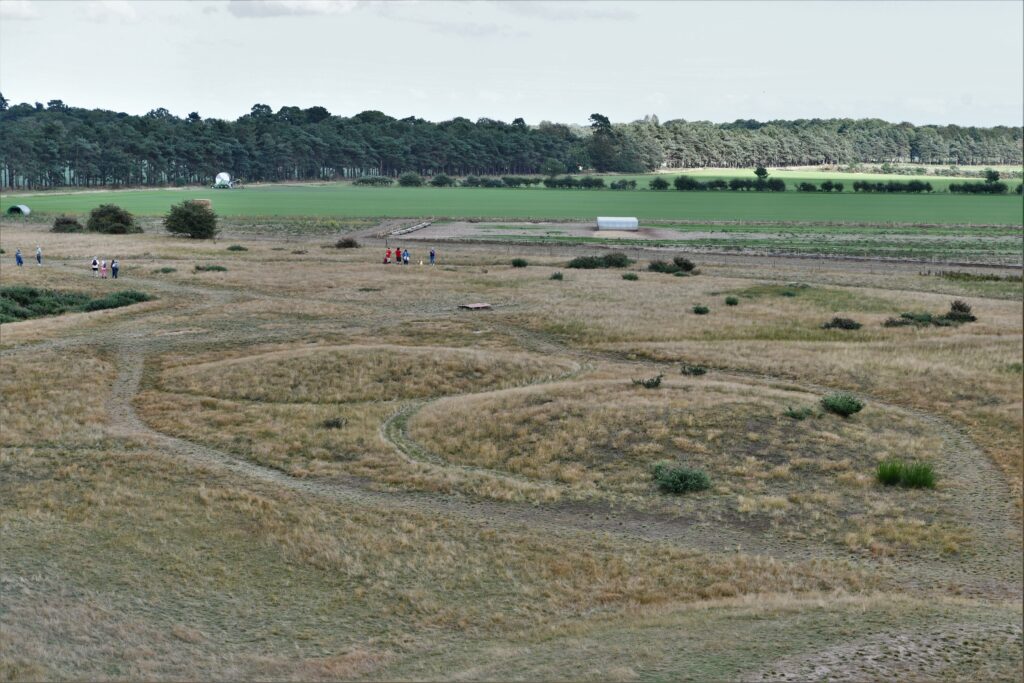
Archaeologists at Sutton Hoo have uncovered the ghostly outline of a person in the sand, the bones long since dissolved by the acid Suffolk soil.
The sand body was found in the final week of a month-long Time Team excavation in 2025, in Garden Field, a separate cemetery from the site’s famous royal and 7th-century ship burial grounds near Woodbridge.
Beads, tweezers, a knife and a brooch lay alongside the burial. Beneath it, the team found evidence suggesting that another person may have been buried in the same grave.
The discovery has only now been made public, in a four-part documentary whose first episode went up on YouTube on 14 November 2026. The BBC reported the finds on 19 November 2026.
“One of the strangest features of the excavations at Sutton Hoo in the 1980s was the discovery of the ‘sand bodies’,” said Angus Wainwright, archaeologist at the National Trust.
“These were burials where the bodies and bones had dissolved away in the acid soil, replaced by hard sand which held the form of the person not unlike some of the bodies at Pompeii. It was certainly a high point of this latest dig, to find another of these bodies in the Garden Field cemetery.”
A shape held in the sand
The soil at Sutton Hoo destroys bone. What can be left, as Wainwright described, is hard sand that took the place of the body and held its form.
The National Trust describes the find as one of Sutton Hoo’s unusual sand bodies, “where the long-decomposed body has left behind a ghost-like shape preserved in the surrounding sand, almost like a fossil”.
The trust lists the headline results of the 2025 season as a sand-preserved burial, unexpected grave goods and evidence of a possible second burial.
Time Team first investigated Garden Field in 2024, exploring evidence of an Anglo-Saxon cemetery. The team returned in 2025 for a four-week dig, hoping to establish how extensive the cemetery was, when it was used, and whether those buried there might have been connected to the communities associated with Sutton Hoo’s royal burial ground.
Not all of those questions have been answered. No date has been given for the sand body, and when the Garden Field cemetery was in use remains open.
A mystery beneath the grave
It was during the final week of the excavation that the team made what the National Trust calls a particularly intriguing discovery, a burial with a mystery beneath it.
The trust puts what lies below as questions rather than conclusions. Could two people have been laid to rest together? Were they buried at different times?
Dr Helen Geake, Time Team’s Anglo-Saxon specialist, said there were “still many questions to answer”, among them “what is the significance of the inhumation grave with its tantalising hint of another below?”
The 2025 season followed work the previous year that recovered the base of the 6th-century Byzantine Bromeswell bucket, which held a cremation burial. Geake said the team was “thrilled to finally locate and excavate the burial contained within the Byzantine ‘Bromeswell Bucket’ and to set it in context”.
Beyond the royal mounds
Sutton Hoo has been excavated from the late 1930s onwards and has been cared for by the National Trust since 1998. Its finds include the Sutton Hoo helmet, and the site is known for its royal burial ground and ship burials.
“Until now archaeologists have focused on the royal burial mounds,” Wainwright said. “Yet these mounds stood in a landscape of significance to the Saxon kings, as well as one familiar to the everyday East Anglians who lived in the villages and farms of the river valley. This excavation moves the focus to these people and their ancestors and descendants.”
The same centuries are covered in British Heritage’s journey through Anglo-Saxon England.
Objects from the period also surface away from organised digs, and their status is not always settled quickly, as with the Norfolk thrymsa, where a coroner’s ruling has been put back.
The documentary runs to four parts on YouTube. Geake said of the wider site: “There is still much to discover about this iconic site.”
Another burial that has drawn attention is that of the man buried inside the Colchester Vase.